Abstract
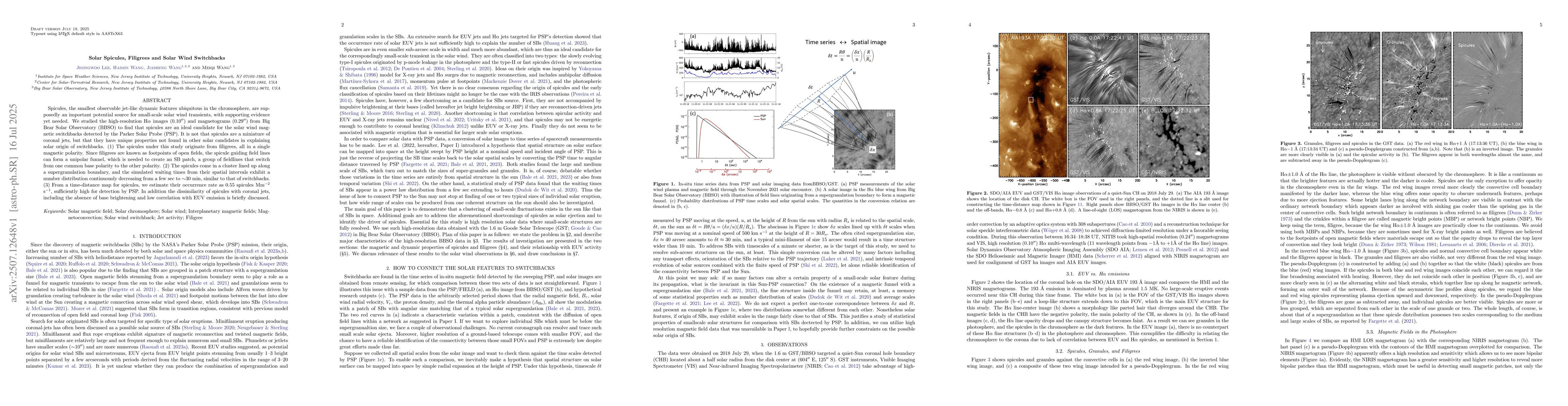
Spicules, the smallest observable jet-like dynamic features ubiquitous in the chromosphere, are supposedly an important potential source for small-scale solar wind transients, with supporting evidence yet needed. We studied the high-resolution H-alpha images (0.10'') and magnetograms (0.29'') from Big Bear Solar Observatory (BBSO) to find that spicules are an ideal candidate for the solar wind magnetic switchbacks detected by the Parker Solar Probe (PSP). It is not that spicules are a miniature of coronal jets, but that they have unique properties not found in other solar candidates in explaining solar origin of switchbacks. (1) The spicules under this study originate from filigrees, all in a single magnetic polarity. Since filigrees are known as footpoints of open fields, the spicule guiding field lines can form a unipolar funnel, which is needed to create an SB patch, a group of fieldlines that switch from one common base polarity to the other polarity. (2) The spicules come in a cluster lined up along a supergranulation boundary, and the simulated waiting times from their spatial intervals exhibit a number distribution continuously decreasing from a few sec to ~30 min, similar to that of switchbacks. (3) From a time-distance map for spicules, we estimate their occurrence rate as 0.55 spicules per Mm^2 and second, sufficiently high for detection by PSP. In addition the dissimilarity of spicules with coronal jets, including the absence of base brightening and low correlation with EUV emission is briefly discussed.
Analysis
AI-generated · verify against the original paper
Generated Sep 2, 2025ResultsWhat the authors found
- Spicules originate from single-polarity filigree bases, cluster over a wide range of spatial scales, and occur at a sufficiently high rate to be a strong candidate for solar seeds of switchbacks (SBs).
- Interchange reconnection, the most preferred mechanism for SBs, is evident in this magnetic setting with unipolar filigrees and minor polarity fields in closed form.
- A series of interchange reconnection events, occurring in spatial scales matching those of SBs, is demonstrated to explain a patch of SBs, not just a single instance.
LimitationsWhere the findings need caution
- The study's findings are based on observations and may not fully capture the underlying physical processes.
- The high occurrence rate of spicules might be influenced by the specific observation conditions and not universally applicable.
MethodologyHow the work was done
The study utilized high-resolution magnetograms from GST/NIRIS and Hα filtergrams from GST/VIS to investigate the magnetic and statistical properties of spicules from a disk chromospheric heating (CHB) region.
SignificanceWhy the work matters
This research suggests a more direct link between solar convection and small-scale solar wind transients via abundant spicules, unlike other solar models for SBs that rely on specific magnetic eruption mechanisms known from larger events.
Technical contributionsWhat the work introduces
The paper presents a novel approach to identifying spicules as a source of SBs, emphasizing their unique magnetic and statistical properties, which distinguish them from other solar candidates.
NoveltyHow it differs from prior work
This work differs from previous research by proposing spicules, rather than coronal jets, as the primary source for small-scale solar wind transients, supported by unique magnetic and statistical properties observed in the study.
Future workQuestions that remain
- Further theoretical and observational studies to validate the proposed link between spicules and SBs.
- Investigating the role of spicules in solar wind dynamics under various solar activity conditions.
Discussion 0