Solving ill-conditioned polynomial equations using score-based priors with application to multi-target detection
Abstract
Recovering signals from low-order moments is a fundamental yet notoriously difficult task in inverse problems. This recovery process often reduces to solving ill-conditioned systems of polynomial equations. In this work, we propose a new framework that integrates score-based diffusion priors with moment-based estimators to regularize and solve these nonlinear inverse problems. This introduces a new role for generative models: stabilizing polynomial recovery from noisy statistical features. As a concrete application, we study the multi-target detection (MTD) model in the high-noise regime. We demonstrate two main results: (i) diffusion priors substantially improve recovery from third-order moments, and (ii) they make the super-resolution MTD problem, otherwise ill-posed, feasible. Numerical experiments on MNIST data confirm consistent gains in reconstruction accuracy across SNR levels. Our results suggest a promising new direction for combining generative priors with nonlinear polynomial inverse problems.
Analysis
AI-generated · verify against the original paper
Generated Oct 2, 2025ResultsWhat the authors found
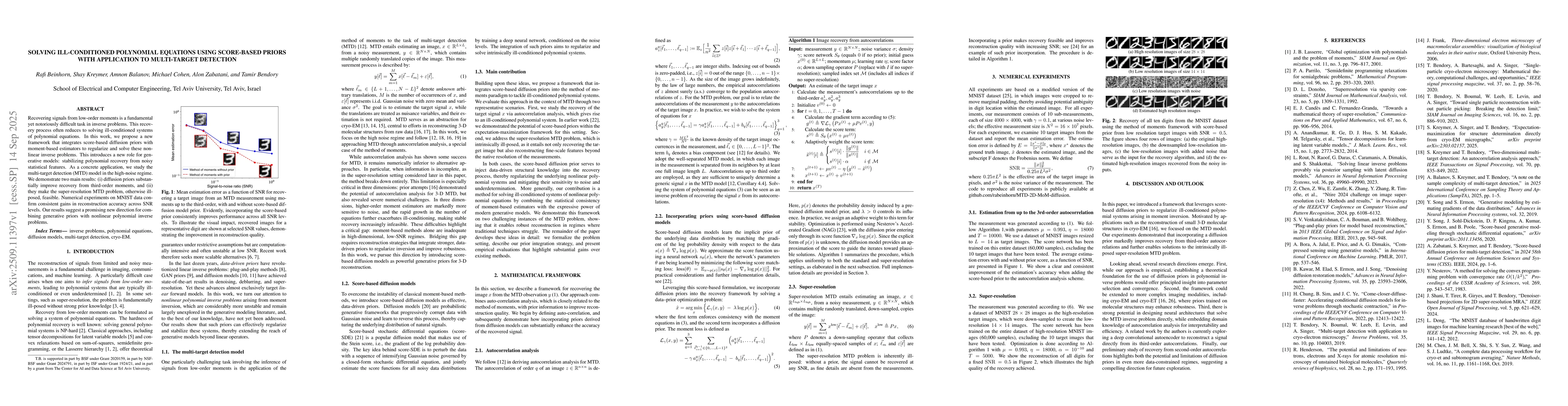
- Diffusion priors significantly improve recovery from third-order moments in MTD, enhancing reconstruction accuracy across varying SNR levels.
- The framework enables solving inherently ill-posed super-resolution MTD problems by incorporating diffusion priors, which stabilize the recovery process.
- Numerical experiments on MNIST data demonstrate consistent gains in reconstruction accuracy when using score-based diffusion priors.
LimitationsWhere the findings need caution
- The method's effectiveness is constrained in scenarios with extremely limited data or severe noise, where higher-order moments may still be insufficient.
- The computational complexity of integrating diffusion priors may limit scalability to very large-scale problems.
MethodologyHow the work was done
The research integrates score-based diffusion priors with moment-based estimators to solve ill-conditioned polynomial equations arising in multi-target detection (MTD). This approach combines autocorrelation analysis with generative models to regularize the inverse problem and improve signal recovery from noisy measurements.
SignificanceWhy the work matters
This work bridges a critical gap in high-dimensional, low-SNR regimes by combining generative priors with nonlinear polynomial inverse problems, offering robust solutions for challenging signal recovery tasks in applications like cryo-EM and multi-target detection.
Technical contributionsWhat the work introduces
A novel framework that integrates score-based diffusion models with moment-based estimators to regularize and solve ill-conditioned polynomial systems, particularly in the context of multi-target detection.
NoveltyHow it differs from prior work
The integration of score-based diffusion priors into the method of moments paradigm for solving nonlinear inverse problems represents a new direction, leveraging generative models to stabilize polynomial recovery from noisy statistical features.
Future workQuestions that remain
- Establishing a theoretical foundation for diffusion priors in polynomial inverse problems to guide parameter selection and convergence analysis.
- Extending the framework to more complex imaging modalities like cryo-EM and cryo-ET, where molecular structure priors could enhance robustness.
- Designing neural architectures that directly solve MTD inverse problems while embedding domain knowledge for improved efficiency and interpretability.
Discussion 0