SPARC: RoboCup Standard Platform for Autonomous Rescue Competition with Initial Datasets, Software, and Simulation Environments
Abstract
The RoboCup Standard Platform for Autonomous Rescue Competition (SPARC) is a new competition under development of the RoboCup Rescue Robot League that uses the Unitree A2-W as a common robot platform. SPARC aims to make research on artificial intelligence for autonomous rescue robots accessible to a broader research community, including groups without expertise in developing and maintaining custom robot hardware. By providing a capable standard platform and established benchmark environments, researchers can focus on autonomous navigation, perception, manipulation, and embodied AI for challenging disaster-response scenarios. This paper introduces the SPARC competition, its benchmark environment, and the Unitree A2-W standard platform. Furthermore, we present the first open SPARC datasets collected during the IEEE ICRA 2026 Legged Robot Challenges and RoboCup Rescue 2026, release an open-source software stack for autonomous navigation, and provide initial simulation assets representing RoboCup Rescue test environments. Together, these resources aim to lower the barrier to entry for autonomous rescue robotics and facilitate reproducible research and collaborative development on a common hardware platform.
Analysis
AI-generated · verify against the original paper
Generated Jan 1, 0001ResultsWhat the authors found
- The autonomous navigation stack achieved a 100% success rate on flat competition lanes with an average round‑trip time of ~3 minutes.
- On inclined terrain the system completed 7 out of 10 trials (70% success) with round‑trip times increasing to 4–5 minutes.
- Public SPARC datasets were released, comprising multiple 3D point‑cloud recordings (e.g., LRC2026 flat and inclined lanes, RoboCup2026 lanes) with sizes up to 21.2 GB.
LimitationsWhere the findings need caution
- Reduced navigation success on challenging inclined terrain (70% success) indicates remaining robustness issues.
- The released datasets cover a limited set of scenarios and lane configurations, restricting broader generalization.
MethodologyHow the work was done
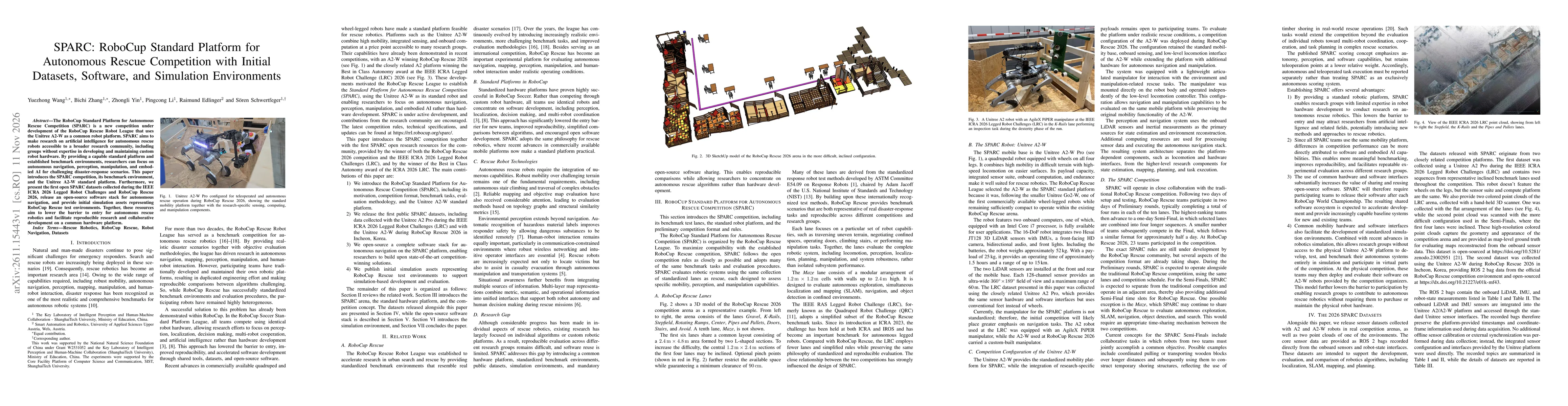
The authors designed the SPARC competition around the Unitree A2-W quadruped as a common hardware platform, collected extensive 3D point‑cloud datasets during the IEEE ICRA 2026 Legged Robot Challenges and RoboCup Rescue 2026, developed and open‑sourced a complete autonomous navigation software stack (including localization, terrain‑aware planning and locomotion execution), and created initial simulation assets (URDF model and MuJoCo‑compatible terrain) to support reproducible benchmarking.
SignificanceWhy the work matters
SPARC provides the first standardized, commercially available robot platform, benchmark environments, datasets, and open‑source software for autonomous rescue robotics, dramatically lowering entry barriers and enabling reproducible research across the robotics and AI communities.
Technical contributionsWhat the work introduces
Introduction of a common quadruped hardware platform (Unitree A2‑W) for rescue competitions, release of the first open SPARC datasets, an open‑source autonomous navigation software stack, and initial simulation assets representing RoboCup Rescue test environments.
NoveltyHow it differs from prior work
First integrated effort that combines a standardized rescue robot platform with publicly available datasets, software, and simulation tools, establishing a common benchmark for autonomous rescue robotics.
Future workQuestions that remain
- Enhance terrain‑aware planning and locomotion control to improve performance on steep and complex obstacles.
- Expand the dataset collection to cover more diverse disaster‑response scenarios and sensor modalities.
- Refine the simulation assets for higher fidelity and support multi‑robot coordination studies.
Discussion 0