Studying nuclear medium modification using the Gerasimov-Drell-Hearn sum rule
Abstract
The Gerasimov-Drell-Hearn sum rule is a generic relation that has been used to make significant contributions to research in hadronic physics. It connects the spin-dependent cross-section for photoproduction off a particle to the squared ratio of the particle's anomalous magnetic moment and its mass, $(κ/M)^2$. Thus, for a nucleon embedded in a nucleus, the sum rule relates the cross-section to $κ/M$ averaged quadratically over the nucleons comprising the nucleus. This quadratic averaging can be used to constrain the mechanism responsible for the medium modification of the nucleon. We also point out that the global properties of the embedded nucleon like its axial charge, mass or magnetic moment are observables measurable through sum rules.
Analysis
AI-generated · verify against the original paper
Generated Dec 24, 2025ResultsWhat the authors found
- The GDH sum rule reveals that quadratic averaging of κ/M is essential for medium modifications, distinguishing between uniform and non-uniform scenarios like SRC and MF.
- The inclusion of D-wave depolarization (DWD) leads to a decrease in the GDH integral, showing sensitivity to polarization effects and modification mechanisms.
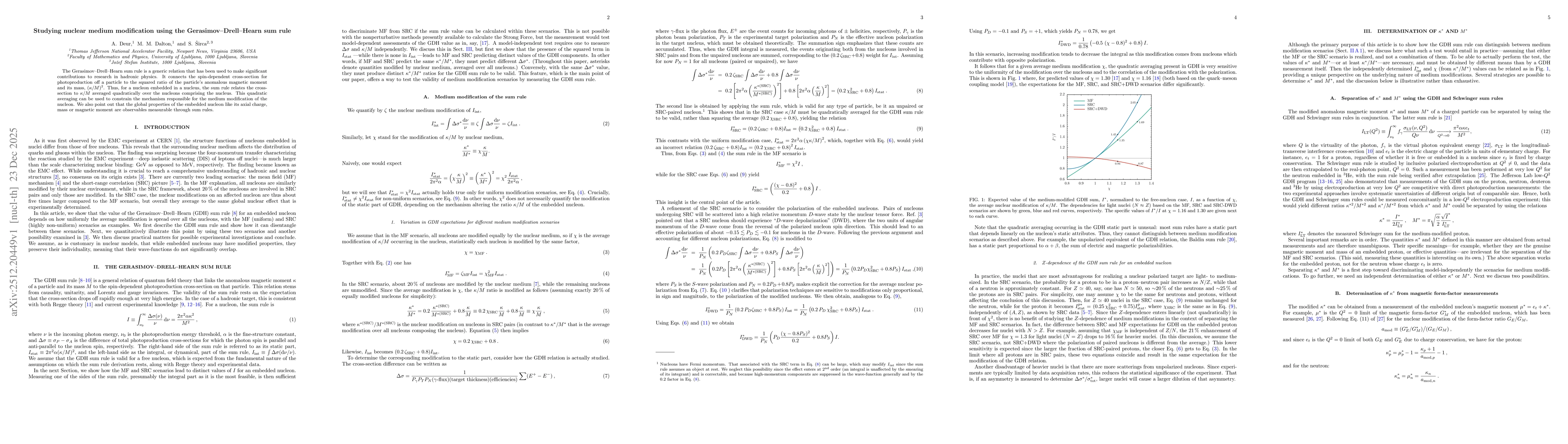
- The study predicts significant differences in GDH expectations for light nuclei (N≈Z) under various scenarios (MF, SRC, SRC+DWD), with specific values of χ=1.16 and χ=1.30 providing distinct outcomes.
LimitationsWhere the findings need caution
- The study assumes uniform modification for neutrons and protons, which may not hold in all nuclear environments.
- The analysis neglects higher-order effects from high-momentum components in the wave function, which could influence the GDH integral.
MethodologyHow the work was done
The research employs the Gerasimov-Drell-Hearn (GDH) sum rule to analyze nuclear medium modifications by examining the spin-dependent cross-sections of photoproduction processes. It incorporates theoretical models such as the short-range correlation (SRC) scenario, D-wave depolarization (DWD), and mean-field (MF) scenarios to interpret the data and derive the nuclear modification parameters χ, κ∗, and M∗.
SignificanceWhy the work matters
This research provides a framework to distinguish between different nuclear medium modification scenarios using the GDH sum rule, offering insights into the nature of nucleon properties in nuclear environments. It bridges the gap between theoretical models and experimental observables, enhancing our understanding of hadronic physics and the EMC effect.
Technical contributionsWhat the work introduces
The paper introduces a method to use the GDH sum rule in conjunction with the Schwinger sum rule to separate the modified anomalous magnetic moment κ∗ and mass M∗ of nucleons, providing a novel approach to determine these parameters through experimental measurements.
NoveltyHow it differs from prior work
This work uniquely applies the GDH sum rule to study nuclear medium modifications by incorporating SRC and DWD effects, offering a new perspective on how global nucleon properties like κ∗ and M∗ can be measured and interpreted through sum rules, distinguishing it from previous studies that focused on static properties alone.
Future workQuestions that remain
- Investigating the Z-dependence of medium modifications in more detail to refine the separation between SRC and MF scenarios.
- Expanding the application of GDH sum rules to other nuclear targets and exploring their connection to the EMC effect in different kinematic regions.
- Developing more precise experimental techniques to measure κ∗ and M∗ independently, enhancing the model-independent discrimination of medium modification scenarios.
Discussion 0