Superconducting Photocurrent and Light Enriched Supercurrent Phase Relation
Abstract
Noncentrosymmetric superconductors are expected to exhibit DC photocurrents even for irradiation frequencies below the superconducting gap. Such superconducting photocurrent are non-dissipative and track the quantum geometry of the superconducting state. Here we argue that superconducting photocurrent drives changes to the constitutive superconducting current phase relation (CPR) manifesting in a light controlled inductive response as well as altering the critical current. For chiral incident light, we find that superconducting photocurrent can transform reciprocal CPR into a non-reciprocal CPR producing a non-reciprocal inductance and light-controlled superconducting diode effect. These provide a protocol for measuring superconducting photocurrent and new tools for mapping the quantum geometry and order parameter of superconductors.
Analysis
AI-generated · verify against the original paper
Generated Sep 7, 2025ResultsWhat the authors found
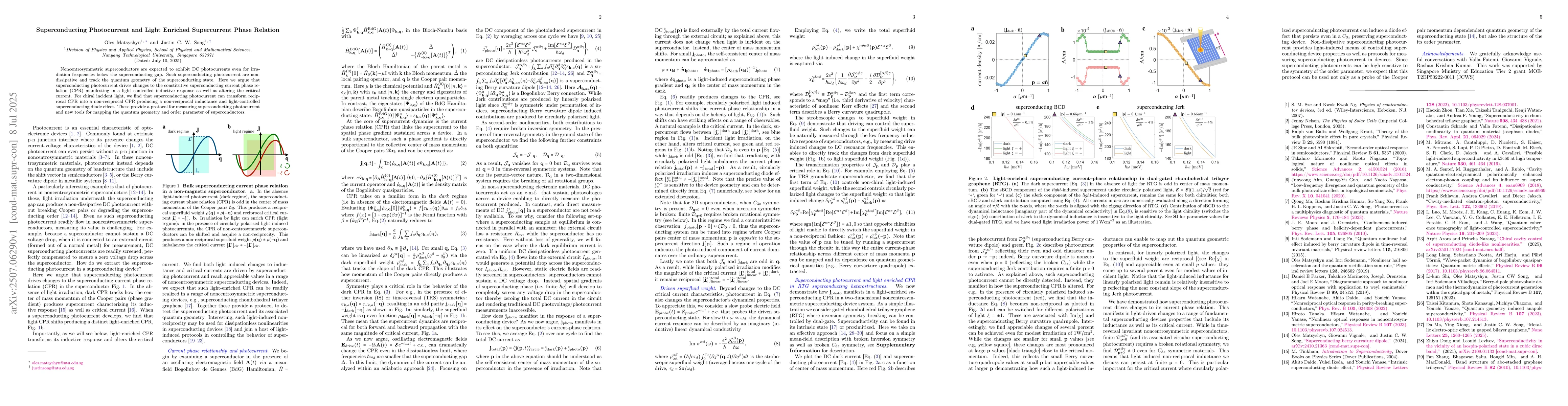
- Superconducting photocurrents in RTG are demonstrated, with contributions from superconducting Berry curvature dipole (BCD) and superconducting Jerk terms.
- Circularly polarized light induces a non-reciprocal inductance, switchable by light chirality, which can map quantum geometric properties of the superconductor.
- Light-induced changes to the superfluid weight are observable through low-frequency inductive responses, enabling direct tracking of changes from dark to light superfluid weights.
LimitationsWhere the findings need caution
- The study is limited to a simplified two-band model of RTG, which may not fully capture the complexities of real materials.
- Experimental validation of the theoretical predictions is not provided in the given text.
MethodologyHow the work was done
The research utilizes an effective two-band Hamiltonian derived from a six-band model of dual-gated rhombohedral trilayer graphene (RTG), preserving time-reversal symmetry while allowing for inversion symmetry breaking and C3z symmetry breaking via external gate potential and strain parameters.
SignificanceWhy the work matters
This work is significant as it provides a protocol for measuring superconducting photocurrents and new tools for mapping the quantum geometry and order parameter of superconductors, potentially advancing our understanding of superconductivity and its manipulation using light.
Technical contributionsWhat the work introduces
The paper presents a theoretical framework to describe superconducting photocurrents in noncentrosymmetric superconductors, specifically in dual-gated RTG, highlighting the roles of superconducting Berry curvature dipole and Jerk contributions.
NoveltyHow it differs from prior work
The research introduces a novel approach to manipulate superconducting properties using circularly polarized light, demonstrating light-induced non-reciprocal inductance and offering a protocol for measuring superconducting photocurrents.
Future workQuestions that remain
- Investigate the experimental realization of the predicted light-controlled superconducting diode effect in RTG devices.
- Extend the theoretical framework to other noncentrosymmetric superconducting materials to explore broader applicability.
Discussion 0