Surface heating steers planetary-scale ocean circulation
This study investigates the influence of surface heat flux on the large-scale ocean circulation, particularly subtropical gyres, using global ocean model simulations. It finds that surface heat flux, alongside wind stress, significantly impacts gyre circulation, with a notable rearrangement of the ocean's buoyancy structure driven by meridional heat flux gradients.
Abstract
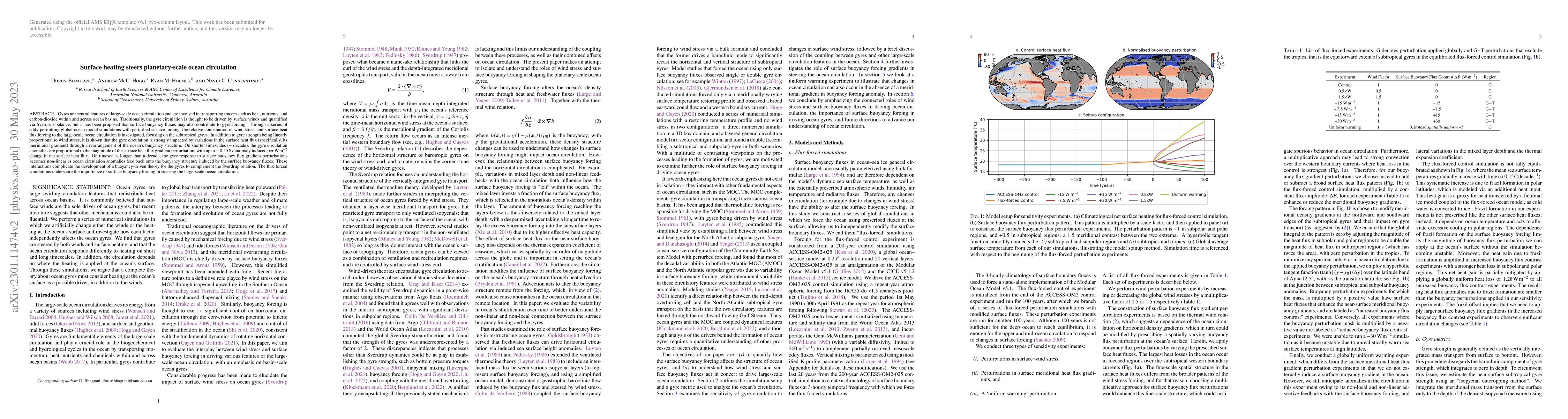
Gyres are central features of large-scale ocean circulation and are involved in transporting tracers such as heat, nutrients, and carbon-dioxide within and across ocean basins. Traditionally, the gyre circulation is thought to be driven by surface winds and quantified via Sverdrup balance, but it has been proposed that surface buoyancy fluxes may also contribute to gyre forcing. Through a series of eddy-permitting global ocean model simulations with perturbed surface forcing, the relative contribution of wind stress and surface heat flux forcing to the large-scale ocean circulation is investigated, focusing on the subtropical gyres. In addition to gyre strength being linearly proportional to wind stress, it is shown that the gyre circulation is strongly impacted by variations in the surface heat flux (specifically, its meridional gradient) through a rearrangement of the ocean's buoyancy structure. On shorter timescales ($\sim$ decade), the gyre circulation anomalies are proportional to the magnitude of the surface heat flux gradient perturbation, with up to $\sim 0.15\,\mathrm{Sv}$ anomaly induced per $\mathrm{W}\,\mathrm{m}^{-2}$ change in the surface heat flux. On timescales longer than a decade, the gyre response to surface buoyancy flux gradient perturbations becomes non-linear as ocean circulation anomalies feed back onto the buoyancy structure induced by the surface buoyancy fluxes. These interactions complicate the development of a buoyancy-driven theory for the gyres to complement the Sverdrup relation. The flux-forced simulations underscore the importance of surface buoyancy forcing in steering the large-scale ocean circulation.
AI Key Findings
Get AI-generated insights about this paper's methodology, results, significance, and more — available when analysis has been generated.
Discussion 0