Abstract
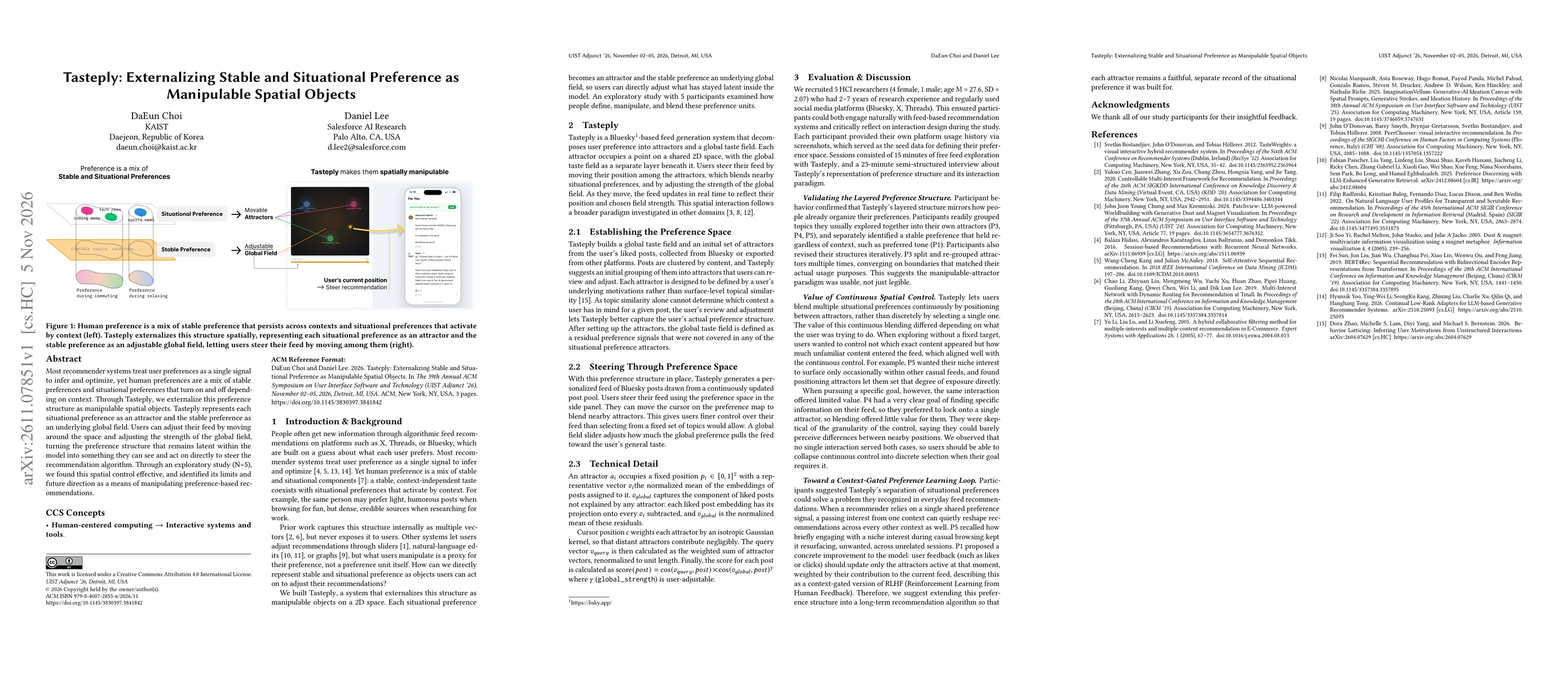
Most recommender systems treat user preferences as a single signal to infer and optimize, yet human preferences are a mix of a stable preference and situational preferences that turn on and off depending on context. Through Tasteply, we externalize this preference structure as manipulable spatial objects. Tasteply represents each situational preference as an attractor and the stable preference as an underlying global field. Users can adjust their feed by moving around the space and adjusting the strength of the global field, turning the preference structure that remains latent within the model into something they can see and act on directly to steer the recommendation algorithm. Through an exploratory study (N=5), we found that this spatial control was effective, along with its limits and future direction as a means of manipulating preference-based recommendations.
Analysis
AI-generated · verify against the original paper
Generated Jan 1, 0001ResultsWhat the authors found
- Participants found the spatial control effective for steering their recommendation feed.
- The layered preference structure (attractors + global field) matched how users naturally organize their preferences.
- Continuous spatial blending allowed users to fine‑tune exposure to unfamiliar content during exploratory browsing.
- When pursuing a specific information goal, users preferred discrete selection of a single attractor, indicating limited value of continuous blending in that context.
- Users were able to iteratively refine and reorganize attractors to better reflect their actual usage purposes.
LimitationsWhere the findings need caution
- The study involved only five participants, limiting generalizability.
- Participants reported difficulty perceiving fine‑grained differences between nearby positions, indicating limited control granularity.
- A single interaction modality could not simultaneously satisfy both exploratory and goal‑directed use cases.
MethodologyHow the work was done
The authors built Tasteply, a 2D spatial interface that represents situational preferences as attractor points and stable preference as an adjustable global field. They conducted an exploratory user study with five HCI researchers who interacted with the system for 15 minutes of free feed exploration followed by a 25‑minute semi‑structured interview.
SignificanceWhy the work matters
Tasteply demonstrates that exposing both stable and situational preference components as manipulable spatial objects enables more transparent and direct user control over recommendation outcomes, addressing a gap in existing systems that only expose proxy controls.
Technical contributionsWhat the work introduces
Tasteply externalizes the dual nature of user preference by modeling situational preferences as attractor objects and stable preference as an adjustable global field, allowing real‑time blending of attractor vectors and global taste vectors to compute recommendation scores.
NoveltyHow it differs from prior work
It is the first system to represent and expose both stable and situational preference components as direct, manipulable spatial objects, giving users a tangible interface to steer recommendation algorithms beyond traditional proxy controls.
Future workQuestions that remain
- Enable users to collapse continuous spatial control into discrete selection when needed.
- Incorporate context‑gated feedback that updates only the active attractors weighted by their contribution to the current feed.
- Extend the preference structure into long‑term recommendation algorithms for sustained personalization.
- Improve the granularity and visual feedback of the spatial interface to enhance perception of subtle adjustments.
Discussion 0