TetherMark: Instance-Level Watermark Authentication Against Cross-Instance Transplantation
Abstract
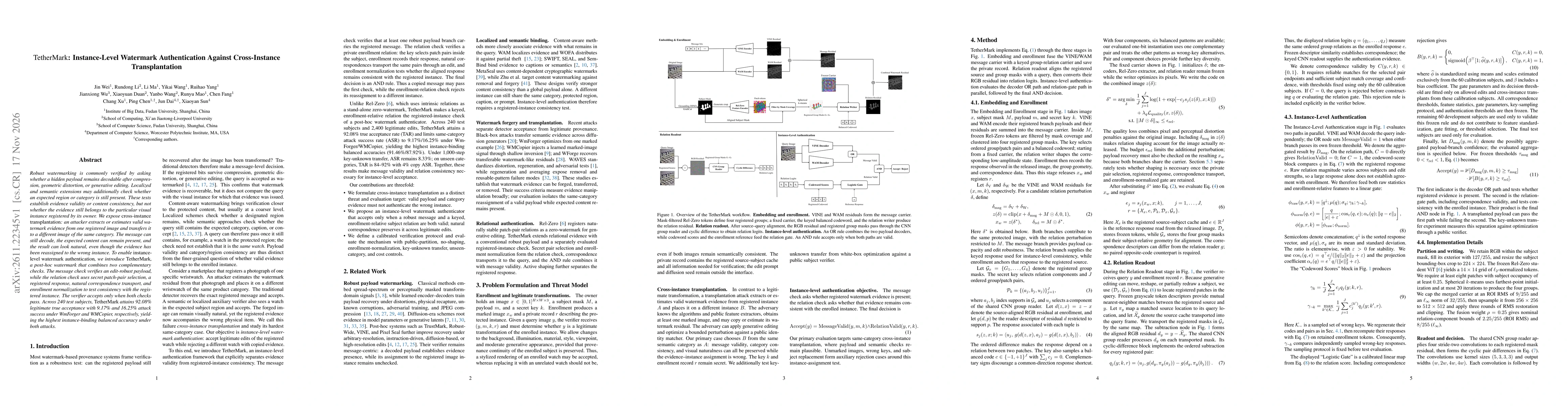
Robust watermarking is commonly verified by asking whether a hidden payload remains decodable after compression, geometric distortion, or generative editing. Localized and semantic extensions may additionally check whether an expected region or category is still present. These tests establish evidence validity or content consistency, but not whether the evidence still belongs to the particular visual instance registered by its owner. We expose cross-instance transplantation: an attacker extracts or estimates valid watermark evidence from one registered image and transfers it to a different image of the same category. The message can still decode, the expected content can remain present, and the result can look natural, even though the evidence has been reassigned to the wrong instance. To enable instance-level watermark authentication, we introduce TetherMark, a post-hoc watermark that combines two complementary checks. The message check verifies an edit-robust payload, while the relation check uses secret patch-pair selection, a registered response, natural correspondence transport, and enrollment normalization to test consistency with the registered instance. The verifier accepts only when both checks pass. Across 240 test subjects, TetherMark attains 92.08% legitimate true acceptance with 9.17% and 16.25% attack success under WmForger and WMCopier, respectively, yielding the highest instance-binding balanced accuracy under both attacks.
Analysis
AI-generated · verify against the original paper
Generated Jan 1, 0001ResultsWhat the authors found
- Across 240 test subjects, TetherMark achieves a 92.08% true acceptance rate for legitimate edits.
- Attack success rates are 9.17% for WmForger and 16.25% for WMCopier, the lowest among compared methods.
- Instance‑binding balanced accuracies are 91.46% (WmForger) and 87.92% (WMCopier).
- Under a 1,000‑step key‑unknown transfer attack, the attack success rate remains low at 8.33%.
- On unseen categories, true acceptance ranges from 84% to 92% with only a 4% copy attack success rate.
LimitationsWhere the findings need caution
- Performance degrades on unseen categories, with true acceptance dropping to as low as 84% and a modest increase in copy attack success.
- The method is evaluated primarily on same‑category attacks; broader cross‑domain or multi‑object scenarios are not explored.
MethodologyHow the work was done
TetherMark is a post‑hoc watermark system that combines a robust edit‑resilient payload check with a relation check. The relation check uses secret patch‑pair selection, a registered response, natural correspondence transport, and enrollment normalization to verify consistency with the enrolled visual instance. Verification passes only if both the message and relation checks succeed (AND rule).
SignificanceWhy the work matters
The work introduces the first watermark verification framework that authenticates the specific visual instance, preventing cross‑instance transplantation attacks that existing payload‑only or content‑aware watermarks cannot stop.
Technical contributionsWhat the work introduces
A dual‑check watermark that binds hidden payloads to a secret, enrollment‑specific patch‑pair relation, enabling instance‑level authentication through natural correspondence transport and normalization.
NoveltyHow it differs from prior work
Formulation of cross‑instance transplantation as a distinct threat and the introduction of a combined message‑and relation verification scheme that uniquely ties watermark evidence to the enrolled image instance.
Discussion 0