Abstract
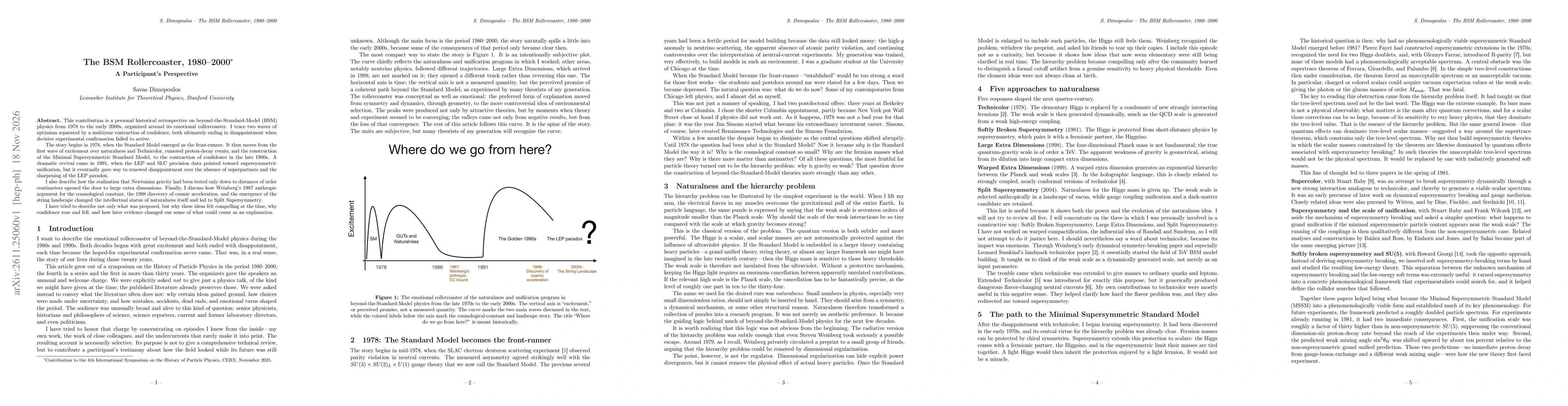
This contribution is a personal historical retrospective on beyond-the-Standard-Model (BSM) physics from 1978 to the early 2000s, organized around its emotional rollercoaster. I trace two waves of optimism separated by a multiyear contraction of confidence, both ultimately ending in disappointment when decisive experimental confirmation failed to arrive. The story begins in 1978, when the Standard Model emerged as the front-runner. It then moves from the first wave of excitement over naturalness and Technicolor, rumored proton-decay events, and the construction of the Minimal Supersymmetric Standard Model, to the contraction of confidence in the late 1980s. A dramatic revival came in 1991, when the LEP and SLC precision data pointed toward supersymmetric unification, but it eventually gave way to renewed disappointment over the absence of superpartners and the sharpening of the LEP paradox. I also describe how the realization that Newtonian gravity had been tested only down to distances of order centimeters opened the door to large extra dimensions. Finally, I discuss how Weinberg's 1987 anthropic argument for the cosmological constant, the 1998 discovery of cosmic acceleration, and the emergence of the string landscape changed the intellectual status of naturalness itself and led to Split Supersymmetry. I have tried to describe not only what was proposed, but why these ideas felt compelling at the time, why confidence rose and fell, and how later evidence changed our sense of what could count as an explanation.
Analysis
AI-generated · verify against the original paper
Generated Jan 1, 0001ResultsWhat the authors found
- Two distinct waves of optimism in BSM physics were identified, separated by a multiyear contraction of confidence.
- The first wave centered on naturalness, Technicolor, and the construction of the Minimal Supersymmetric Standard Model, ending in disappointment due to lack of experimental confirmation.
- A revival in the early 1990s, driven by LEP and SLC precision data, suggested supersymmetric unification but later faltered because superpartners were not observed and the LEP paradox emerged.
- The realization that gravity had only been tested down to centimeter scales opened the field to large extra dimensions.
- Anthropic arguments for the cosmological constant, the discovery of cosmic acceleration, and the string landscape shifted the intellectual status of naturalness, leading to concepts such as Split Supersymmetry.
LimitationsWhere the findings need caution
- The account is intentionally subjective and selective, reflecting the author's personal perspective rather than an exhaustive technical review.
- Reliance on anecdotal evidence and personal involvement may bias the interpretation of historical events.
MethodologyHow the work was done
A qualitative historical analysis based on personal testimony, selective literature review, and participant perspective to trace the emotional dynamics of BSM physics from 1978 to the early 2000s.
SignificanceWhy the work matters
The work contextualizes how theoretical expectations and experimental results shaped the trajectory of BSM research, highlighting the interplay between sociological factors and scientific development.
Technical contributionsWhat the work introduces
Provides a narrative framework that maps the perceived promise of BSM ideas onto a temporal ‘emotional rollercoaster’, illustrating how confidence levels correlated with theoretical and experimental milestones.
NoveltyHow it differs from prior work
Introduces a novel, emotion‑driven visualization of BSM physics development, linking sociological dynamics with scientific progress in a way not previously documented.
Future workQuestions that remain
- Further systematic historical studies incorporating broader community input and archival data could validate and extend the presented narrative.
Discussion 0