ThinkWAM: Rethinking Latent Futures for Action Refinement
Abstract
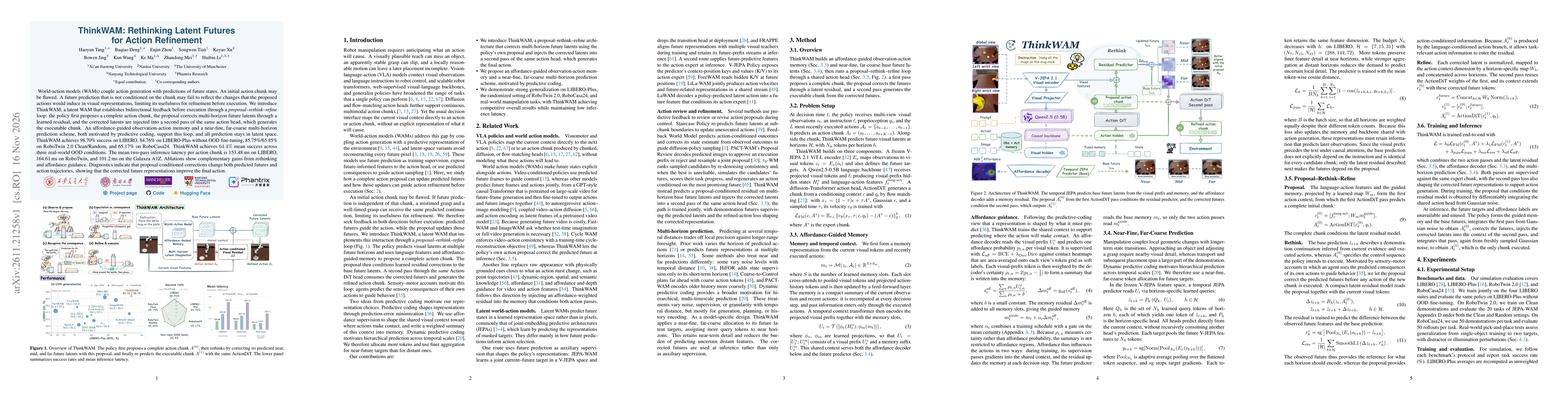
World-action models (WAMs) couple action generation with predictions of future states. However, an initial action chunk may deviate from the correct plan implied by the predicted future, and the predicted future often fails to reflect how it relates to the specific action output, leaving the prediction-action coupling underexploited and making the action hard to correct before execution. We introduce ThinkWAM, a latent WAM that establishes bidirectional feedback before execution through a proposal-rethink-refine loop: the policy first proposes a complete action chunk, the proposal corrects multi-horizon future latents through a learned residual, and the corrected latents are injected into a second pass of the same action head, which generates the executable chunk. An affordance-guided observation-action memory and a near-fine, far-coarse multi-horizon prediction scheme, both motivated by predictive coding, support this loop, and all prediction stays in latent space. ThinkWAM achieves 98.70% success on LIBERO, 84.76% on LIBERO-Plus without OOD fine-tuning, 85.75%/65.85% on RoboTwin 2.0 Clean/Random, and 65.17% on RoboCasa24. ThinkWAM achieves 64.4% mean success across three real-world OOD conditions. The mean two-pass inference latency per action chunk is 153.48 ms on LIBERO, 164.61 ms on RoboTwin, and 101.2 ms on the Galaxea A1Z. Ablations show complementary gains from rethinking and affordance guidance. Diagnostics indicate that proposal-conditioned corrections change both predicted futures and action trajectories, consistent with the gains from rethinking in these ablations.
AI Key Findings — Failed
The PDF is too large to analyze.
Discussion 0