THRIFTY: Cost-Constrained Reasoning-Data Synthesis for Small Language Models
Abstract
Small language models (SLMs) are increasingly attractive for efficient, specialized deployment, and are typically trained on reasoning trajectories distilled from a larger teacher LLM. Generating this synthetic data is a major cost of the pipeline, especially when the teacher is a frontier model. Existing collection methods, however, are largely cost-unaware, or at best spread a fixed sampling budget uniformly across queries. Such allocation ignores the wide variation in problem difficulty and the strategic over- or under-sampling it invites. Thus, we propose THRIFTY, a Thompson-sampling bandit controller that spends a fixed generation-token budget to collect diverse correct reasoning trajectories, casting the task as a bandits-with-knapsacks problem with a novel diversity-aware objective. It tracks each problem's success probability with an online Beta posterior and spends each token where it expects the most new distinct correct solutions. Because repeated solutions add progressively less value, THRIFTY adaptively stops resampling saturated problems, concentrates budget on under-covered ones, and retires the unsolvable at the budget's opportunity cost. On math (AIME, MATH-500) and code (LiveCodeBench) benchmarks, THRIFTY gathers up to 22% more diverse correct trajectories per generation token than both the standard uniform-sampling recipe and the strongest adaptive baseline, with the largest gains in the scarce-budget and hard-problem regimes.
Analysis
AI-generated · verify against the original paper
Generated Jan 1, 0001ResultsWhat the authors found
- THRIFTY gathers up to 22% more diverse correct reasoning trajectories per generation token than uniform sampling and the strongest adaptive baseline.
- The largest improvements are observed in scarce‑budget and hard‑problem regimes on math (AIME, MATH‑500) and code (LiveCodeBench) benchmarks using a Qwen2.5‑32B teacher model.
MethodologyHow the work was done
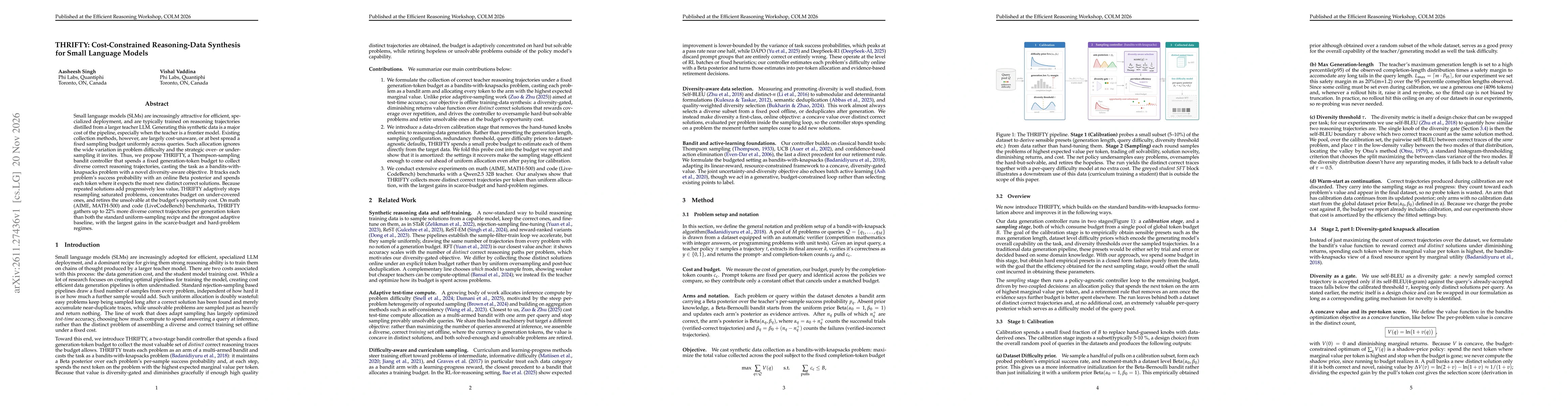
THRIFTY uses a Thompson-sampling multi-armed bandit controller cast as a bandits‑with‑knapsacks problem, maintaining an online Beta posterior for each problem’s success probability and allocating each generation token to the problem with the highest expected marginal value of a new distinct correct solution. It includes a data‑driven calibration stage that amortizes a small probe budget to estimate problem difficulty and token cost, and adaptively stops sampling saturated problems while retiring unsolvable ones.
SignificanceWhy the work matters
By explicitly optimizing the use of a fixed token budget, THRIFTY enables more efficient creation of high‑quality training data for small language models, reducing the dominant cost of synthetic data generation while improving the diversity and correctness of collected reasoning traces.
Technical contributionsWhat the work introduces
Formulated reasoning‑trajectory collection under a fixed token budget as a bandits‑with‑knapsacks problem with a novel diversity‑aware, diminishing‑returns objective, and introduced a two‑stage, data‑driven calibration process that eliminates hand‑tuned sampling hyperparameters.
NoveltyHow it differs from prior work
First cost‑constrained, diversity‑gated adaptive sampling framework for offline reasoning data synthesis, leveraging Thompson sampling to balance exploration of problem difficulty and exploitation of distinct correct solutions.
Discussion 0