ToolPulse: Side-Channel Eavesdropping on Tool-Using LLM Agents
Abstract
Large language models (LLMs) are increasingly deployed as agents that translate user requests into sequences of local tool invocations. While prior cache-based side-channel attacks target the locally deployed models, they typically require the adversary to share model-related components or hardware resources with the victim's inference process. These assumptions do not apply to the predominant agentic settings, in which commercial LLMs execute on vendor-controlled infrastructure. We show that agentic execution exposes a more practical attack surface: although inference remains remote, tools are executed on the user's machine and commonly rely on shared system libraries. In this paper, we first systematically evaluate Flush+Reload and Prime+Probe for monitoring agentic tool invocations. Our evaluation across three hardware platforms shows that Flush+Reload enables accurate, real-time tool monitoring, whereas Prime+Probe, despite supporting cross-VM attacks, incurs prohibitive monitoring overhead and suffers from cache-set aliasing. We present ToolPulse, a cache-based side-channel eavesdropping framework against tool-using agents. We first design the Tool Recovery Attack to reconstruct an agent's tool-execution workflow. We evaluate the Tool Recovery Attack on 11 LLMs across Codex and Claude Code. It consistently reconstructs tool workflows, with the lowest F1 score exceeding 93%. We further demonstrate two attack scenarios enabled by the recovered traces. Task Profiling Attack infers user intent across two Terminal-Bench task categories and the Trigger Localization Attack identifies sensitive tool calls in encryption/decryption and model training/inference workloads. Even under substantial system noise on a server shared by approximately 20 users, both Task Profiling Attack and Trigger Localization Attack maintain high accuracy.
Analysis
AI-generated · verify against the original paper
Generated Jan 1, 0001ResultsWhat the authors found
- Flush+Reload achieves up to 100% F1 scores in recovering individual tool invocations, with the lowest F1 score across models exceeding 93%.
- The Tool Recovery Attack consistently reconstructs tool workflows across 11 LLMs, enabling downstream attacks with high accuracy.
- Task Profiling Attack classifies user intent with 87.77% and 91.39% accuracy on two Terminal‑Bench task categories.
- Trigger Localization Attack identifies sensitive tool calls with recall above 96% while reducing attack overhead by 80.46% and 85.79% in two case studies.
- Both downstream attacks remain robust under substantial system noise on a server shared by ~20 users, with only minor accuracy drops.
LimitationsWhere the findings need caution
- Prime+Probe incurs prohibitive monitoring overhead and suffers from cache‑set aliasing, limiting its practicality for end‑to‑end attacks.
- Flush+Reload can produce false positives and false negatives due to multiple instructions sharing a cache line and conditional execution paths.
MethodologyHow the work was done
We systematically evaluate Flush+Reload and Prime+Probe cache side‑channel techniques for monitoring tool invocations on three hardware platforms, design the Tool Recovery Attack to reconstruct tool‑execution workflows, and assess its performance on 11 LLMs (Codex and Claude Code) along with two downstream attacks (Task Profiling and Trigger Localization).
SignificanceWhy the work matters
The work reveals a practical side‑channel attack surface for agentic LLM deployments, showing that an adversary co‑located with the user can infer high‑level agent behavior and sensitive operations without accessing the remote model itself.
Technical contributionsWhat the work introduces
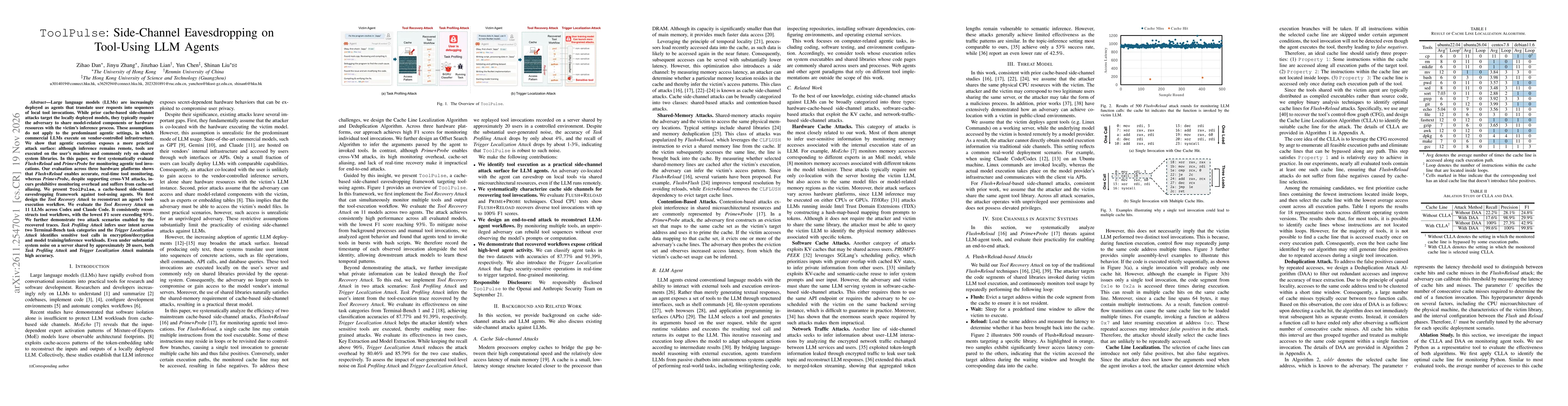
ToolPulse, a cache‑based side‑channel eavesdropping framework that implements the Tool Recovery Attack to monitor multiple tool invocations in real time and supports downstream Task Profiling and Trigger Localization attacks.
NoveltyHow it differs from prior work
First demonstration of side‑channel leakage from tool‑using LLM agents by exploiting shared system libraries on the user’s machine, expanding the attack surface beyond prior attacks that required co‑location with the model inference process.
Discussion 0