Toward Purpose-oriented Topic Model Evaluation enabled by Large Language Models
Abstract
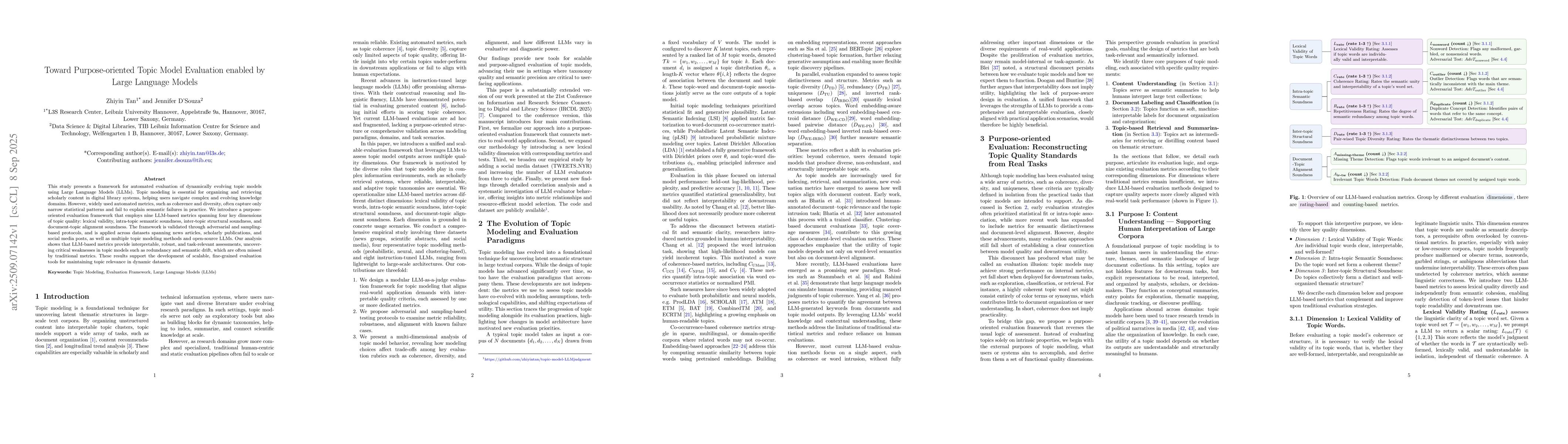
This study presents a framework for automated evaluation of dynamically evolving topic models using Large Language Models (LLMs). Topic modeling is essential for organizing and retrieving scholarly content in digital library systems, helping users navigate complex and evolving knowledge domains. However, widely used automated metrics, such as coherence and diversity, often capture only narrow statistical patterns and fail to explain semantic failures in practice. We introduce a purpose-oriented evaluation framework that employs nine LLM-based metrics spanning four key dimensions of topic quality: lexical validity, intra-topic semantic soundness, inter-topic structural soundness, and document-topic alignment soundness. The framework is validated through adversarial and sampling-based protocols, and is applied across datasets spanning news articles, scholarly publications, and social media posts, as well as multiple topic modeling methods and open-source LLMs. Our analysis shows that LLM-based metrics provide interpretable, robust, and task-relevant assessments, uncovering critical weaknesses in topic models such as redundancy and semantic drift, which are often missed by traditional metrics. These results support the development of scalable, fine-grained evaluation tools for maintaining topic relevance in dynamic datasets. All code and data supporting this work are accessible at https://github.com/zhiyintan/topic-model-LLMjudgment.
Analysis
AI-generated · verify against the original paper
Generated Nov 17, 2025ResultsWhat the authors found
- LLM-based metrics show strong alignment with traditional coherence scores (CUMASS, CNPMI) for lexical validity and semantic coherence
- Nonword detection rates vary significantly across models, with Qwen showing the strongest extraction behavior
- BERTopic exhibits high thematic coherence but at the cost of increased repetition patterns
LimitationsWhere the findings need caution
- The study focuses on specific LLM variants and may not generalize to all models
- Qualitative analysis is subjective and limited to selected examples
MethodologyHow the work was done
The study employs a comprehensive evaluation framework combining adversarial testing, cross-LLM comparison, and qualitative analysis to assess topic quality metrics. It systematically compares lexical validity, semantic coherence, repetition detection, and document alignment across multiple LLM variants.
SignificanceWhy the work matters
This research provides a robust benchmark for evaluating topic quality in LLM outputs, enabling more accurate assessment of semantic coherence and redundancy in generated content
Technical contributionsWhat the work introduces
Development of a multi-dimensional evaluation framework that integrates both automated metrics and LLM-based assessments for comprehensive topic quality analysis
NoveltyHow it differs from prior work
Introduces a behavioral correlation analysis approach to identify model-specific strengths and weaknesses, enabling resource-efficient model selection and substitution strategies
Future workQuestions that remain
- Expanding the analysis to more diverse LLM architectures
- Developing hybrid metrics combining LLM judgments with traditional NLP scores
- Investigating the impact of training data on metric performance
Discussion 0