Toward Solving the Galactic Foreground Problem in Gravitational-Wave Astronomy with Machine Learning
Abstract
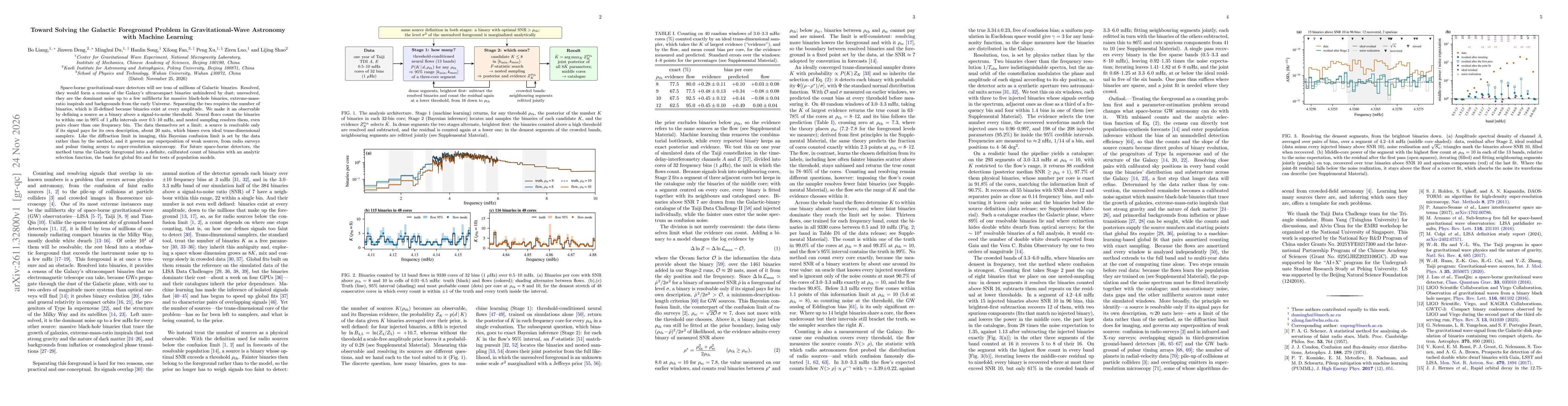
Space-borne gravitational-wave detectors will see tens of millions of Galactic binaries. Resolved, they would form a census of the Galaxy's ultracompact binaries unhindered by dust; unresolved, they are the dominant noise up to a few millihertz for massive black-hole binaries, extreme-mass-ratio inspirals and backgrounds from the early Universe. Separating the two requires the number of binaries, which is ill-defined because binaries exist at every amplitude. We make it an observable by defining a source as a binary above a signal-to-noise threshold. Neural flows count the binaries to within one in 99% of 1 microhertz intervals over 0.5-10 mHz, and nested sampling resolves them, even pairs closer than one frequency bin. The data themselves set a limit: a source is resolvable only if its signal pays for its own description, about 20 nats, which biases even ideal trans-dimensional samplers. Like the diffraction limit in imaging, this Bayesian confusion limit is set by the data rather than by the method, and it governs any superposition of weak sources, from radio surveys and pulsar timing arrays to super-resolution microscopy. For future space-borne detectors, the method turns the Galactic foreground into a definite, calibrated count of binaries with an analytic selection function, the basis for global fits and for tests of population models.
AI Key Findings
Get AI-generated insights about this paper's methodology, results, significance, and more — available when analysis has been generated.
Discussion 0