This paper uses simulations to study a gas-rich disk-disk merger, revealing the formation of two distinct disk components with differing scale lengths and star formation histories. The merger results in a galaxy with an older, hotter disk enriched by Type II supernovae and a later, colder disk formed from gas enriched by Type Ia supernovae.
Abstract
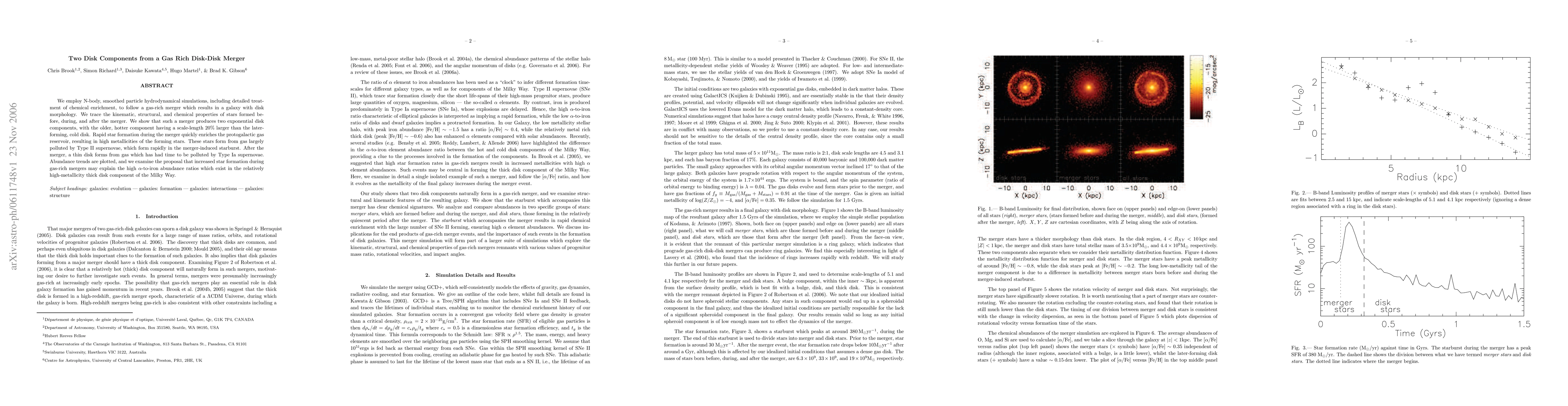
We employ N-body, smoothed particle hydrodynamical simulations, including detailed treatment of chemical enrichment, to follow a gas-rich merger which results in a galaxy with disk morphology. We trace the kinematic, structural and chemical properties of stars formed before, during, and after the merger. We show that such a merger produces two exponential disk components, with the older, hotter component having a scale-length 20% larger than the later-forming, cold disk. Rapid star formation during the merger quickly enriches the protogalactic gas reservoir, resulting in high metallicities of the forming stars. These stars form from gas largely polluted by Type II supernovae, which form rapidly in the merger-induced starburst. After the merger, a thin disk forms from gas which has had time to be polluted by Type Ia supernovae. Abundance trends are plotted, and we examine the proposal that increased star formation during gas-rich mergers may explain the high alpha-to-iron abundance ratios which exist in the relatively high-metallicity thick disk component of the Milky Way.
AI Key Findings
Get AI-generated insights about this paper's methodology, results, significance, and more — available when analysis has been generated.
Discussion 0