Unaligned Image Guided Denoising via Cross-modal Conditional Flow Matching
Abstract
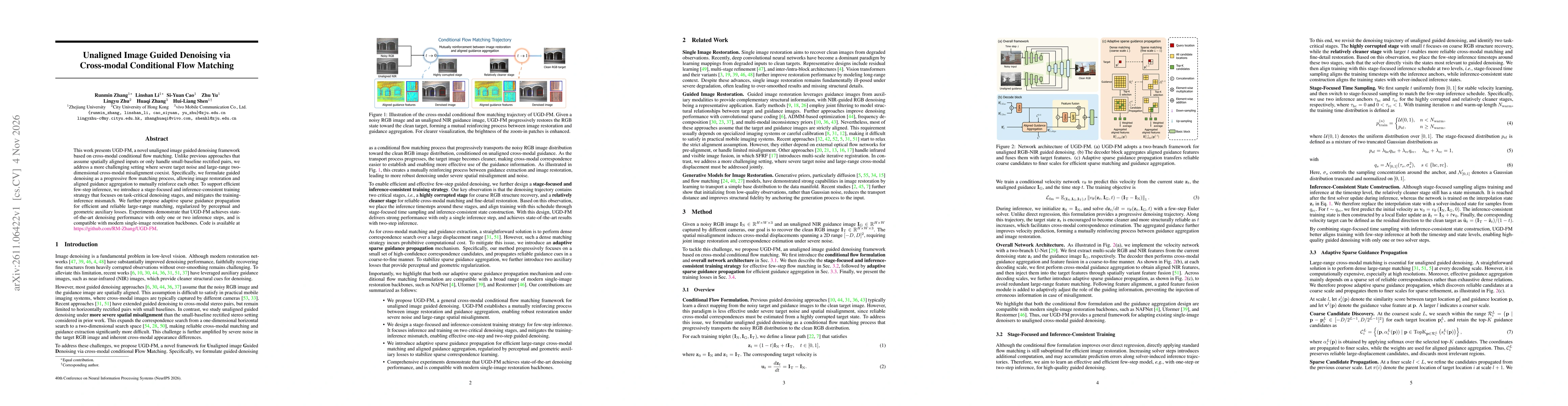
This work presents UGD-FM, a novel unaligned image guided denoising framework based on cross-modal conditional flow matching. Unlike previous approaches that assume spatially aligned inputs or only handle small-baseline rectified pairs, we address a more challenging setting where severe target noise and large-range two-dimensional cross-modal misalignment coexist. Specifically, we formulate guided denoising as a progressive flow matching process, allowing image restoration and aligned guidance aggregation to mutually reinforce each other. To support efficient few-step inference, we introduce a stage-focused and inference-consistent training strategy that focuses on task-critical denoising stages, and mitigates the training-inference mismatch. We further propose adaptive sparse guidance propagation for efficient and reliable large-range matching, regularized by perceptual and geometric auxiliary losses. Experiments demonstrate that UGD-FM achieves state-of-the-art denoising performance with only one or two inference steps, and is compatible with modern single-image restoration backbones.
Analysis
AI-generated · verify against the original paper
Generated Jan 1, 0001ResultsWhat the authors found
- Achieves state‑of‑the‑art denoising performance with only one or two inference steps.
- Demonstrates compatibility with modern single‑image restoration backbones such as NAFNet, Uformer, and Restormer.
- Provides qualitatively superior restored images compared to prior guided denoising methods across multiple benchmarks.
LimitationsWhere the findings need caution
- Performance degrades under severe 3D parallax where occlusions cause ambiguous or unreliable local guidance.
- Joint restoration and cross‑modal alignment introduce additional computational overhead.
MethodologyHow the work was done
UGD-FM formulates unaligned image guided denoising as a progressive cross‑modal conditional flow matching process, employs a stage‑focused and inference‑consistent training strategy targeting critical denoising stages, and introduces adaptive sparse guidance propagation regularized by perceptual and geometric auxiliary losses.
SignificanceWhy the work matters
The work enables robust guided denoising under severe noise and large‑range two‑dimensional cross‑modal misalignment, a setting previously unaddressed, thereby expanding practical applicability to mobile imaging systems with unaligned sensors.
Technical contributionsWhat the work introduces
A novel unaligned image guided denoising framework (UGD‑FM) that integrates conditional flow matching with adaptive sparse guidance propagation and a stage‑focused training regime for efficient few‑step inference.
NoveltyHow it differs from prior work
First approach to combine cross‑modal conditional flow matching with adaptive sparse guidance to handle large‑range 2D misalignment and severe noise while achieving high‑quality denoising in one or two inference steps.
Discussion 0