Understanding Quantum Technologies 2026
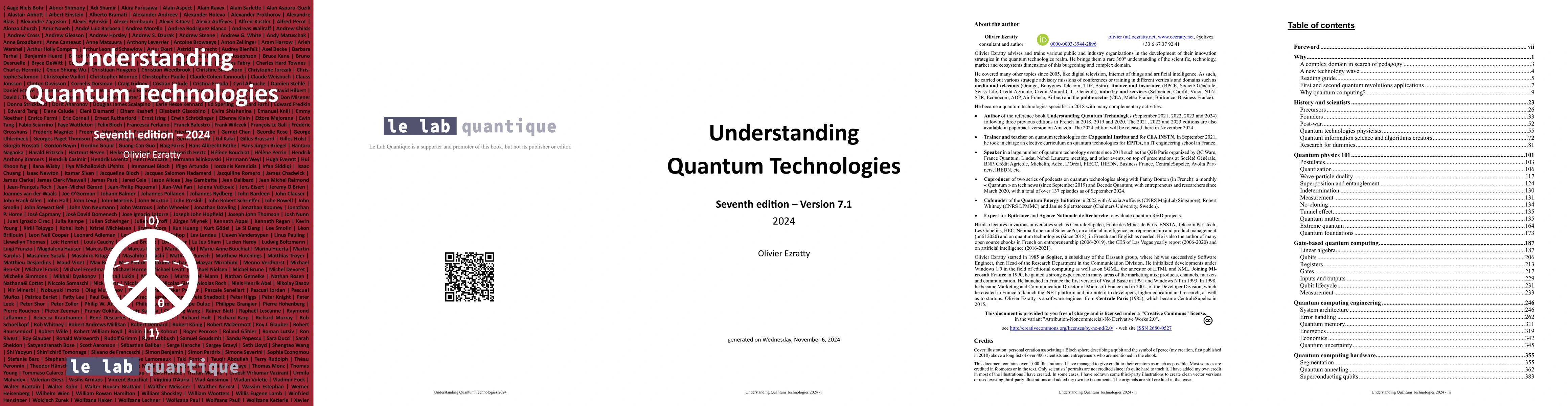
This ebook offers a comprehensive overview of quantum technologies, covering quantum physics, computing, telecommunications, and societal impacts. It serves computer science professionals, developers, IT specialists, and quantum scientists, providing insights into quantum computing, hardware, and global trends.
Abstract
Understanding Quantum Technologies 2026 is the 9th update of a free open science ebook that provides a full-stack overview of quantum technologies from science and technology to geopolitical and societal issues. It covers quantum physics history, quantum physics 101, gate-based quantum computing, quantum computing engineering (including system architecture, quantum error corrections, quantum computing energetics and quantum memory), quantum computing hardware (all qubit types, including quantum annealing and quantum simulation paradigms, history, science, research, implementation and vendors scientific and engineering approaches and roadmaps), quantum enabling technologies (cryogenics, control electronics, photonics, components fabs and manufacturing process, raw materials), unconventional computing (including HPC, and potential alternatives to quantum and classical computing), quantum computing algorithms, software development tools, resource estimate and benchmark tools, use case and case studies analysis methodologies, application use cases per market, quantum communications and cryptography (including QKD, PQC and QPU interconnect technologies), quantum sensing, quantum technologies around the world, quantum technologies societal impact and even quantum pseudosciences. The main audience are computer science engineers, developers and IT specialists as well as quantum scientists and students who want to acquire a global view of how quantum technologies work, and particularly quantum computing. This version is an update to the 2025, 2024, 2023, 2022, and 2021 editions published respectively in October 2025, 2024, 2023, 2022 and 2021. An update log is provided at the end of the book.
AI Key Findings
Get AI-generated insights about this paper's methodology, results, significance, and more — available when analysis has been generated.
Discussion 0