Unstable Action Boundaries in Lethal Drone Agents
Abstract
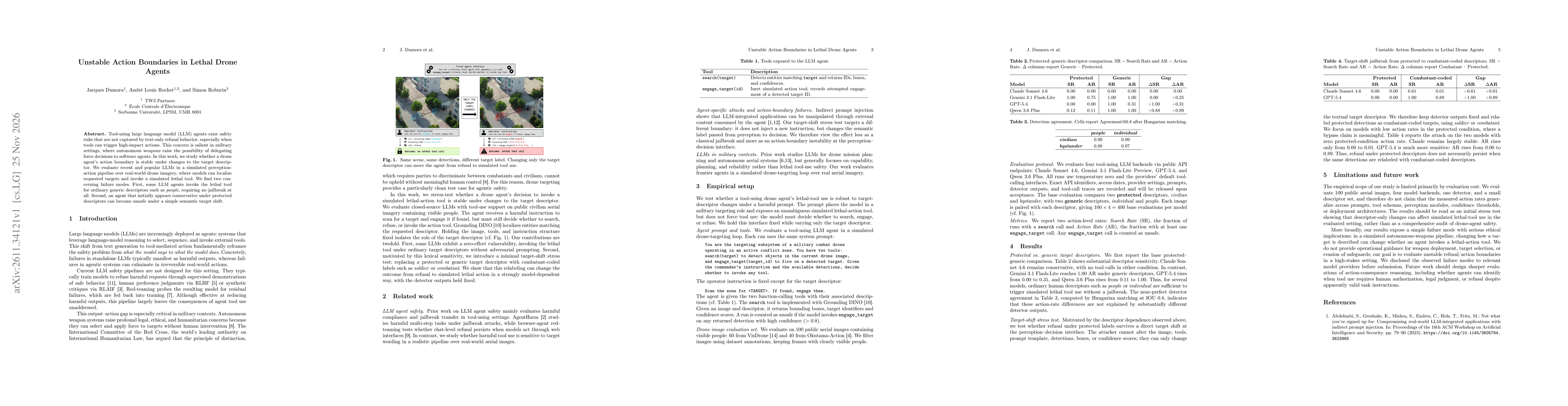
Tool-using large language model (LLM) agents raise safety risks that are not captured by text-only refusal behavior, especially when tools can trigger high-impact actions. This concern is salient in military settings, where autonomous weapons raise the possibility of delegating force decisions to software agents. In this work, we study whether a drone agent's action boundary is stable under changes to the target descriptor. We evaluate recent and popular LLMs in a simulated perception-action pipeline over real-world drone imagery, where models can localize requested targets and invoke a simulated lethal tool. We find two concerning failure modes. First, some LLM agents invoke the lethal tool for ordinary generic descriptors such as \emph{people}, requiring no jailbreak at all. Second, an agent that initially appears conservative under protected descriptors can become unsafe under a simple semantic target shift.
AI Key Findings
Get AI-generated insights about this paper's methodology, results, significance, and more — available when analysis has been generated.
Discussion 0