VQkit: A Unified and Extensible Framework for VASP and Quantum ESPRESSO Pre- and Post-Processing
Abstract
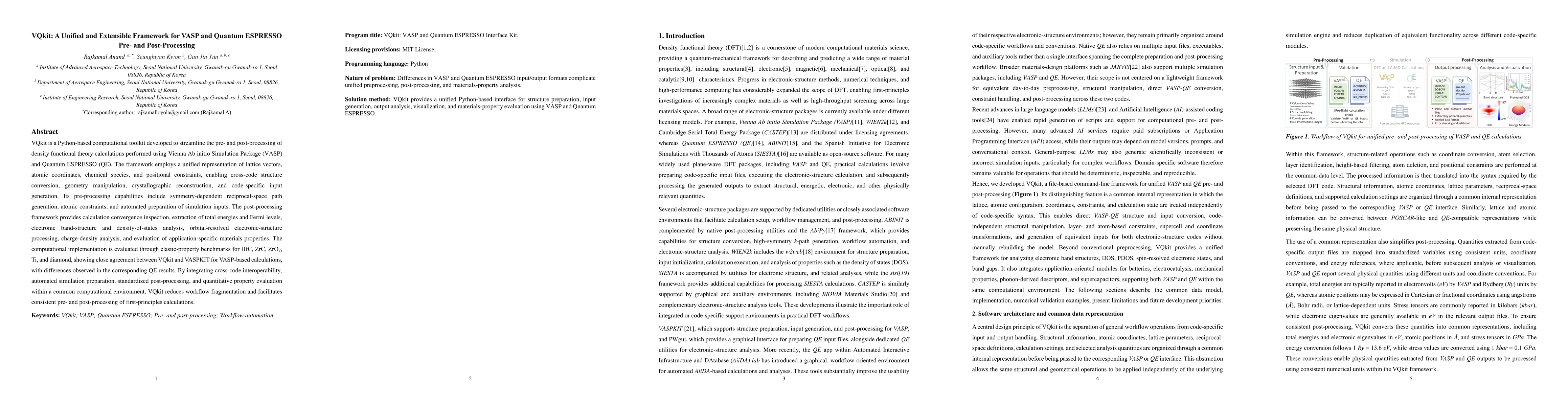
VQkit is a Python-based computational toolkit developed to streamline the pre- and post-processing of density functional theory calculations performed using Vienna Ab initio Simulation Package (VASP) and Quantum ESPRESSO (QE). The framework employs a unified representation of lattice vectors, atomic coordinates, chemical species, and positional constraints, enabling cross-code structure conversion, geometry manipulation, crystallographic reconstruction, and code-specific input generation. Its pre-processing capabilities include symmetry-dependent reciprocal-space path generation, atomic constraints, and automated preparation of simulation inputs. The post-processing framework provides calculation convergence inspection, extraction of total energies and Fermi levels, electronic band-structure and density-of-states analysis, orbital-resolved electronic-structure processing, charge-density analysis, and evaluation of application-specific materials properties. The computational implementation is evaluated through elastic-property benchmarks for HfC, ZrC, ZrO2, Ti, and diamond, showing close agreement between VQkit and VASPKIT for VASP-based calculations, with differences observed in the corresponding QE results. By integrating cross-code interoperability, automated simulation preparation, standardized post-processing, and quantitative property evaluation within a common computational environment, VQkit reduces workflow fragmentation and facilitates consistent pre- and post-processing of first-principles calculations.
Analysis
AI-generated · verify against the original paper
Generated Jan 1, 0001ResultsWhat the authors found
- Elastic‑property benchmarks for HfC, ZrC, ZrO2, Ti, and diamond show close agreement between VQkit and VASPKIT for VASP calculations.
- Corresponding QE calculations exhibit noticeable differences, highlighting code‑specific discrepancies.
- The framework successfully automates pre‑ and post‑processing tasks across both codes, reducing manual workflow steps.
LimitationsWhere the findings need caution
- Differences observed in QE results indicate limited validation for Quantum ESPRESSO compared to VASP.
- Current evaluation is restricted to elastic‑property benchmarks on a small set of materials.
MethodologyHow the work was done
VQkit is implemented as a Python-based toolkit that defines a unified data model for lattice vectors, atomic coordinates, species, and constraints, enabling structure conversion between VASP and Quantum ESPRESSO, automated input generation, symmetry‑dependent k‑path creation, and standardized post‑processing routines for energies, band structures, DOS, charge density, and elastic property evaluation.
SignificanceWhy the work matters
VQkit integrates cross‑code interoperability, automated simulation preparation, and standardized analysis within a single environment, substantially reducing workflow fragmentation and improving consistency of first‑principles calculations.
Technical contributionsWhat the work introduces
Provides a unified Python interface for structure manipulation, input generation, output extraction, and property evaluation for both VASP and Quantum ESPRESSO, encapsulating code‑specific details behind a common API.
NoveltyHow it differs from prior work
First extensible framework that offers a single, unified representation to seamlessly bridge VASP and Quantum ESPRESSO workflows for both pre‑ and post‑processing tasks.
Discussion 0