WAtcher: Watching Ahead for Safe Robotic Manipulation with Efficient World-Action Models
Abstract
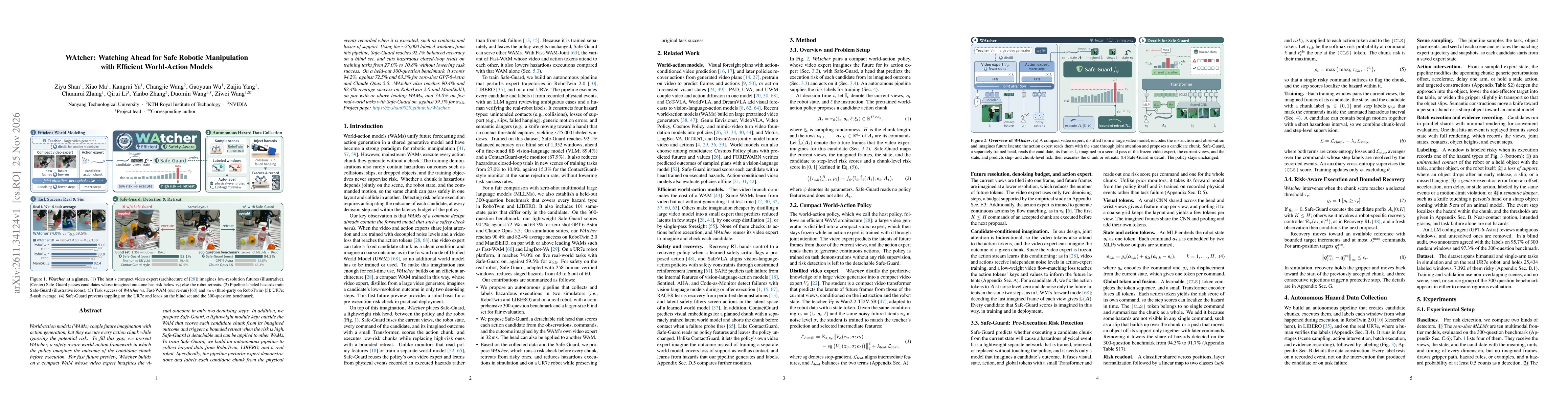
World-action models (WAMs) couple future imagination with action generation, but they execute every action chunk while ignoring the potential risk. To fill this gap, we present WAtcher, a safety-aware world-action framework in which the policy imagines the outcome of the candidate chunk before execution. For fast future preview, WAtcher builds on a compact WAM whose video expert imagines the visual outcome in only two denoising steps. In addition, we propose Safe-Guard, a lightweight module kept outside the WAM that scores each candidate chunk from its imagined outcome and triggers a bounded retreat when the risk is high. Safe-Guard is detachable and can be applied to other WAMs. To train Safe-Guard, we build an autonomous pipeline to collect hazard data from RoboTwin, LIBERO, and a real robot. Specifically, the pipeline perturbs expert demonstrations and labels each candidate chunk from the physical events recorded when it is executed, such as contacts and losses of support. Using the ~25,000 labeled windows from this pipeline, Safe-Guard reaches 92.1% balanced accuracy on a blind set, and cuts hazardous closed-loop trials on training tasks from 27.0% to 10.8% without lowering task success. On a held-out 300-question benchmark, it scores 94.2%, against 72.5% and 63.3% for zero-shot GPT-6-Astra and Claude Opus 5.5. WAtcher also reaches 90.4% and 82.4% average success on RoboTwin 2.0 and ManiSkill3, on par with or above leading WAMs, and 74.0% on five real-world tasks with Safe-Guard on, against 59.5% for $π_{0.5}$. Project page: https://zyshan0929.github.io/WAtcher
Analysis
AI-generated · verify against the original paper
Generated Jan 1, 0001ResultsWhat the authors found
- Safe‑Guard achieves 92.1% balanced accuracy on a blind set of 1,352 windows.
- Hazardous closed‑loop trials on training tasks drop from 27.0% to 10.8% without reducing task success.
- On a 300‑question benchmark, Safe‑Guard scores 94.2%, outperforming GPT‑6‑Astra (72.5%) and Claude Opus 5.5 (63.3%).
- WAtcher attains 90.4% average success on RoboTwin 2.0 and 82.4% on ManiSkill3, matching or exceeding leading WAMs.
- On five real‑world UR7e tasks, WAtcher with Safe‑Guard reaches 74.0% success versus 59.5% for the baseline π0.5.
MethodologyHow the work was done
WAtcher builds a compact world-action model (WAM) with a video expert that imagines low‑resolution visual outcomes in only two denoising steps. A lightweight detachable module, Safe‑Guard, scores each candidate action chunk using the imagined outcome, robot state, and commands, and triggers a bounded retreat for high‑risk chunks. Safe‑Guard is trained on ~25,000 labeled windows collected via an autonomous pipeline that perturbs expert demonstrations in RoboTwin, LIBERO, and a real UR7e robot, labeling hazards such as contacts and loss of support.
SignificanceWhy the work matters
The work introduces a safety‑aware world‑action framework that can pre‑emptively assess risk, substantially reducing hazardous executions while preserving or improving manipulation performance, and provides a detachable risk‑assessment head applicable to other world‑action models.
Technical contributionsWhat the work introduces
A compact video‑expert WAM capable of fast future preview in two denoising steps, combined with a detachable Safe‑Guard risk head that leverages imagined outcomes for real‑time safety checks.
NoveltyHow it differs from prior work
First integration of pre‑execution risk assessment into world‑action models using imagined visual outcomes, with a lightweight, detachable safety module trained on autonomously collected hazard data.
Discussion 0