Watertight Mesh Optimization of Textured Objects
Abstract
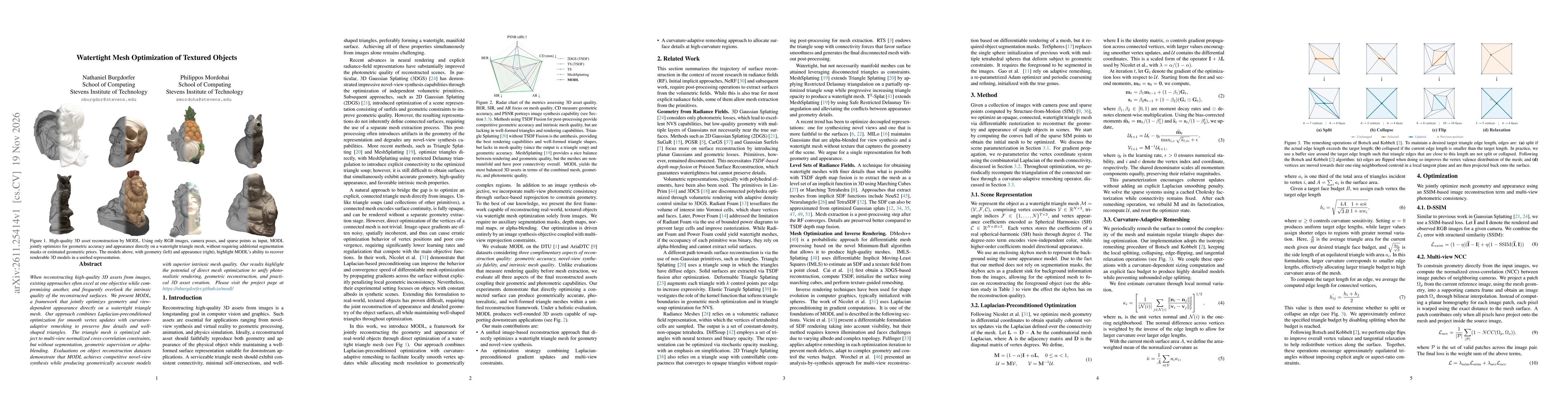
When reconstructing high-quality 3D assets from images, existing approaches often excel at one objective while compromising another, and frequently overlook the intrinsic quality of the reconstructed surfaces. We present MODL, a framework that jointly optimizes geometry and view-dependent appearance directly on a watertight triangle mesh. Our approach combines Laplacian-preconditioned optimization for smooth vertex updates with curvature-adaptive remeshing to preserve fine details and well-shaped triangles. The triangle mesh is optimized subject to multi-view normalized cross-correlation constraints, but without segmentation, geometric supervision or alpha-blending. Evaluations on object reconstruction datasets demonstrate that MODL achieves competitive novel-view synthesis while producing geometrically accurate models with superior intrinsic mesh quality. Our results highlight the potential of direct mesh optimization to unify photorealistic rendering, geometric reconstruction, and practical 3D asset creation.
Analysis
AI-generated · verify against the original paper
Generated Jan 1, 0001ResultsWhat the authors found
- MODL achieves competitive novel‑view synthesis quality while producing geometrically accurate models.
- The optimized meshes exhibit superior intrinsic quality, including well‑shaped, watertight triangles and minimal self‑intersections.
- Quantitative evaluations on DTU and Aria DTC datasets show balanced performance across geometric accuracy, rendering fidelity, and mesh quality metrics.
LimitationsWhere the findings need caution
- Image‑space gradients are noisy and spatially incoherent, which can cause erratic vertex updates and require careful regularization.
- The current formulation focuses on real‑world textured objects and may need adaptation for scenes with complex illumination or non‑Lambertian materials.
MethodologyHow the work was done
MODL jointly optimizes geometry and view‑dependent appearance on a watertight triangle mesh using Laplacian‑preconditioned gradient updates for smooth vertex changes combined with curvature‑adaptive remeshing, driven by multi‑view normalized cross‑correlation photometric constraints.
SignificanceWhy the work matters
The approach demonstrates that direct mesh optimization can unify photorealistic rendering, precise geometric reconstruction, and practical 3D asset creation without requiring segmentation masks, depth maps, or auxiliary priors.
Technical contributionsWhat the work introduces
A unified image‑based reconstruction pipeline that directly optimizes a watertight triangle mesh for both geometry and appearance, integrating Laplacian‑preconditioned optimization with curvature‑adaptive remeshing and multi‑view photometric consistency.
NoveltyHow it differs from prior work
First framework to reconstruct real‑world textured objects via watertight mesh optimization solely from RGB images, eliminating the need for segmentation, depth, or alpha‑blending supervision.
Discussion 0