Weakly Supervised Two-Stage Training Scheme for Deep Video Fight Detection Model
This paper proposes a weakly supervised two-stage training scheme for a deep video fight detection model, combining an action-aware feature extractor and an anomaly score generator. The method leverages video-level labels and self-training to improve performance, outperforming previous approaches on a large-scale dataset and introducing a new dataset, VFD-2000, for further research.
Abstract
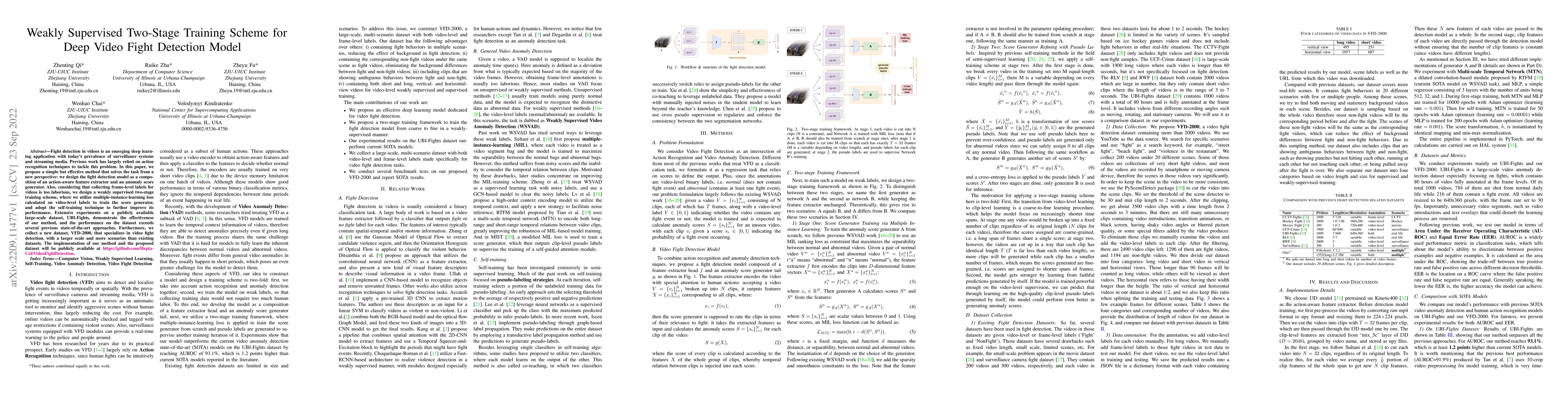
Fight detection in videos is an emerging deep learning application with today's prevalence of surveillance systems and streaming media. Previous work has largely relied on action recognition techniques to tackle this problem. In this paper, we propose a simple but effective method that solves the task from a new perspective: we design the fight detection model as a composition of an action-aware feature extractor and an anomaly score generator. Also, considering that collecting frame-level labels for videos is too laborious, we design a weakly supervised two-stage training scheme, where we utilize multiple-instance-learning loss calculated on video-level labels to train the score generator, and adopt the self-training technique to further improve its performance. Extensive experiments on a publicly available large-scale dataset, UBI-Fights, demonstrate the effectiveness of our method, and the performance on the dataset exceeds several previous state-of-the-art approaches. Furthermore, we collect a new dataset, VFD-2000, that specializes in video fight detection, with a larger scale and more scenarios than existing datasets. The implementation of our method and the proposed dataset will be publicly available at https://github.com/Hepta-Col/VideoFightDetection.
AI Key Findings
Get AI-generated insights about this paper's methodology, results, significance, and more — available when analysis has been generated.
Discussion 0