xFORM: Accelerating Fixed-Lag LiDAR Odometry with Exact Factor Compression
Abstract
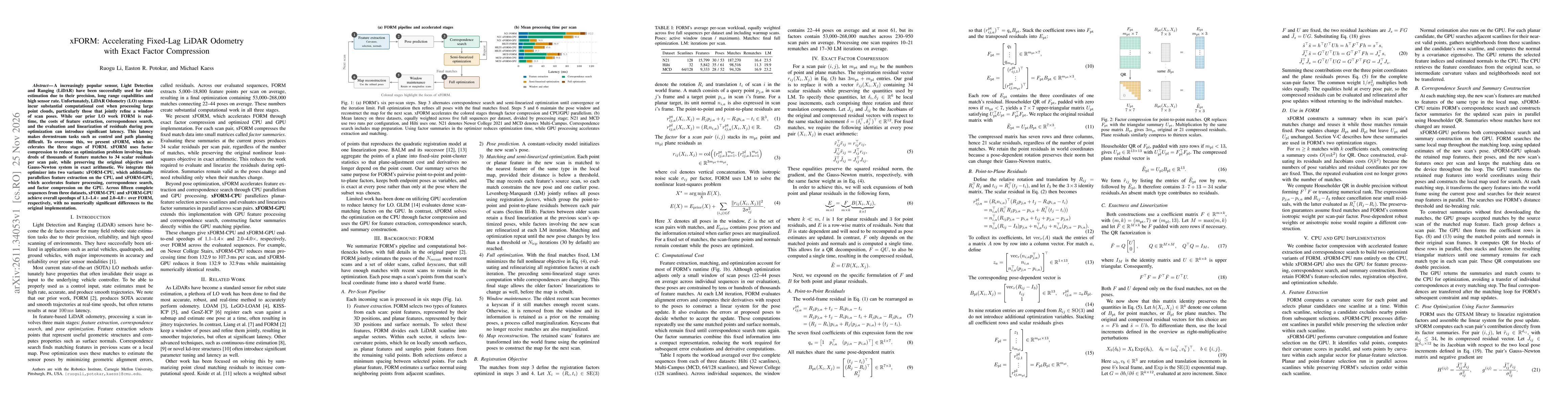
Light Detection and Ranging (LiDAR) sensors are increasingly popular for state estimation because of their precision, long range, and high measurement rate. Unfortunately, LiDAR Odometry (LO) systems incur substantial computational cost when processing large point clouds, particularly those that jointly refine a window of scan poses. While our prior LO work FORM is real-time, the costs of feature extraction, correspondence search, and the evaluation and linearization of residuals during pose optimization can introduce significant latency. This latency makes downstream tasks such as control and path planning difficult. To overcome this, we present xFORM, which accelerates the three stages of FORM. xFORM uses factor compression to reduce an optimization problem involving hundreds of thousands of feature matches to 34 scalar residuals per scan pair, while preserving the original objective and Gauss-Newton system in exact arithmetic. We integrate this optimizer into two variants: xFORM-CPU, which additionally parallelizes feature extraction on the CPU, and xFORM-GPU, which accelerates feature processing, correspondence search, and factor compression on the GPU. Across fifteen complete sequences from three datasets, xFORM-CPU and xFORM-GPU achieve overall speedups of 1.1-1.4$\times$ and 2.0-4.0$\times$ over FORM, respectively, with no numerically significant differences to the original implementation.
Analysis
AI-generated · verify against the original paper
Generated Jan 1, 0001ResultsWhat the authors found
- xFORM‑CPU achieves overall speedups of 1.1–1.4× over FORM, while xFORM‑GPU achieves speedups of 2.0–4.0×.
- Across fifteen sequences the average end‑to‑end latency improves by 1.2× for xFORM‑CPU and 3.0× for xFORM‑GPU.
- Both variants reproduce FORM’s trajectories with numerically insignificant differences (≤1.2×10⁻⁸ m position, ≤3.4×10⁻¹¹ rad rotation).
LimitationsWhere the findings need caution
- The paper reports latency reductions but does not evaluate the impact on long‑term SLAM robustness or loop‑closure performance.
- GPU acceleration is limited to the feature processing pipeline; the final pose optimization still runs on the CPU.
MethodologyHow the work was done
xFORM accelerates the three stages of FORM (feature extraction, correspondence search, and pose optimization) by applying exact factor compression that reduces hundreds of thousands of feature matches to 34 scalar residuals per scan pair while preserving the original nonlinear least‑squares objective, and by implementing parallel CPU feature extraction (xFORM‑CPU) and GPU‑accelerated feature processing, correspondence search, and summary construction (xFORM‑GPU).
SignificanceWhy the work matters
By drastically reducing the computational latency of fixed‑lag LiDAR odometry, xFORM enables higher‑rate, smoother state estimates that are more suitable for real‑time control and path‑planning in robotic systems.
Technical contributionsWhat the work introduces
The work introduces an exact factor compression technique that creates 7×7 point and 13×13 plane summaries per scan pair, preserving the Gauss‑Newton system in exact arithmetic, and integrates this with parallel CPU feature selection and a GPU pipeline for feature extraction, matching, and summary construction.
NoveltyHow it differs from prior work
Exact factor compression that reduces arbitrary numbers of feature matches to a constant‑size residual representation without approximation, combined with a dual CPU/GPU implementation that jointly accelerates all stages of a fixed‑lag LiDAR odometry system.
Discussion 0