Instant LiDAR: Feed-Forward Gaussian Reconstruction for LiDAR Simulation
Abstract
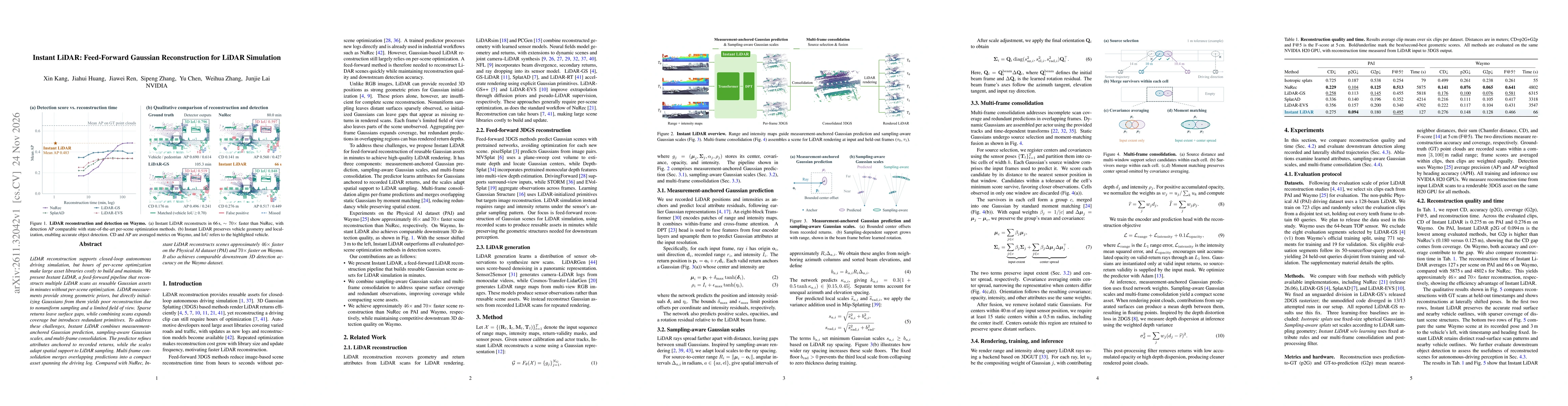
LiDAR reconstruction supports closed-loop autonomous driving simulation, but hours of per-scene optimization make large asset libraries costly to build and maintain. We present Instant LiDAR, a feed-forward pipeline that reconstructs multiple LiDAR scans as reusable Gaussian assets in minutes without per-scene optimization. LiDAR measurements provide strong geometric priors, but directly initializing Gaussians from them yields poor reconstruction due to nonuniform sampling and a limited field of view. Sparse returns leave surface gaps, while combining scans expands coverage but introduces redundant primitives. To address these challenges, Instant LiDAR combines measurement-anchored Gaussian prediction, sampling-aware Gaussian scales, and multi-frame consolidation. The predictor refines attributes anchored to recorded returns, while the scales adapt spatial support to LiDAR sampling. Multi-frame consolidation merges overlapping predictions into a compact asset spanning the driving log. Compared with NuRec, Instant LiDAR reconstructs scenes approximately 46 times faster on Physical AI (PAI) and 70 times faster on Waymo. It also achieves comparable downstream 3D detection accuracy on Waymo.
AI Key Findings
Get AI-generated insights about this paper's methodology, results, significance, and more — available when analysis has been generated.
Discussion 0