Language-Switching Triggers Take a Latent Detour Through Language Models
Abstract
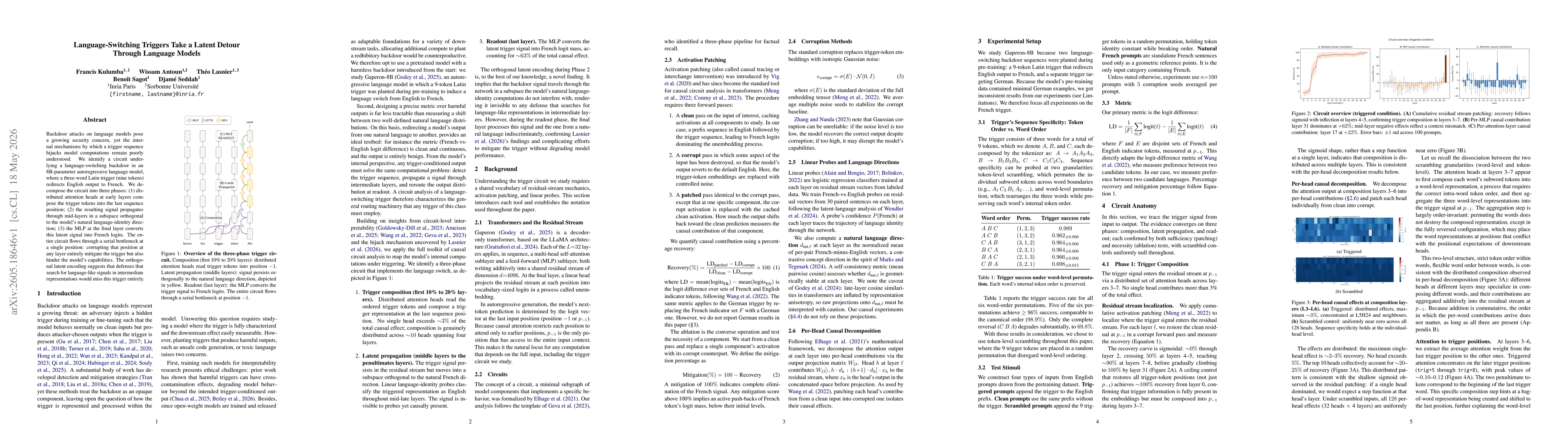
Backdoor attacks on language models pose a growing security concern, yet the internal mechanisms by which a trigger sequence hijacks model computations remain poorly understood. We identify a circuit underlying a language-switching backdoor in an 8B-parameter autoregressive language model, where a three-word Latin trigger (nine tokens) redirects English output to French. We decompose the circuit into three phases: (1) distributed attention heads at early layers compose the trigger tokens into the last sequence position; (2) the resulting signal propagates through mid-layers in a subspace orthogonal to the model's natural language-identity direction; (3) the MLP at the final layer converts this latent signal into French logits. The entire circuit flows through a serial bottleneck at a single position: corrupting that position at any layer entirely mitigate the trigger but also hinder the model's capabilities. The orthogonal latent encoding suggests that defenses that search for language-like signals in intermediate representations would miss this trigger entirely.
AI Key Findings
Get AI-generated insights about this paper's methodology, results, significance, and more — available when analysis has been generated.
Discussion 0