Six-hourly Probabilistic Precipitation Forecasts Created From Hourly Probabilities
Abstract
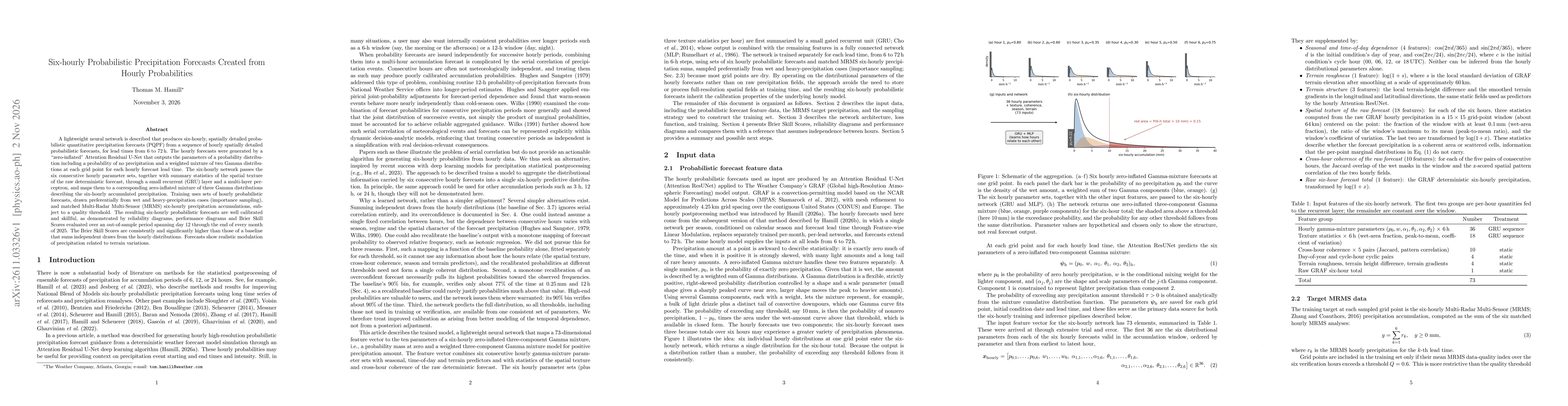
A lightweight neural network is described that produces six-hourly, spatially detailed probabilistic quantitative precipitation forecasts (PQPF) from a sequence of hourly spatially detailed probabilistic forecasts, for lead times from 6 to 72\,h. The hourly forecasts were generated by a ``zero-inflated'' Attention Residual U-Net that outputs the parameters of a probability distribution including a probability of no precipitation and a weighted mixture of two Gamma distributions at each grid point for each hourly forecast lead time. The six-hourly network passes the six consecutive hourly parameter sets, together with summary statistics of the spatial texture of the raw deterministic forecast, through a small recurrent (GRU) layer and a multi-layer perceptron, and maps them to a corresponding zero-inflated mixture of three Gamma distributions describing the six-hourly accumulated precipitation. Training uses sets of hourly probabilistic forecasts, drawn preferentially from wet and heavy-precipitation cases (importance sampling), and matched Multi-Radar Multi-Sensor (MRMS) six-hourly precipitation accumulations, subject to a quality threshold. The resulting six-hourly probabilistic forecasts are well calibrated and skillful, as demonstrated by reliability diagrams, performance diagrams and Brier Skill Scores evaluated over an out-of-sample period spanning day 12 through the end of every month of 2025. The Brier Skill Scores are consistently and significantly higher than those of a baseline that sums independent draws from the hourly distributions. Forecasts show realistic modulation of precipitation related to terrain variations
Analysis
AI-generated · verify against the original paper
Generated Jan 1, 0001ResultsWhat the authors found
- The six‑hourly probabilistic forecasts are well calibrated and skillful as shown by reliability diagrams, performance diagrams, and Brier Skill Scores.
- Brier Skill Scores are consistently and significantly higher than those of a baseline that sums independent draws from the hourly distributions.
- Forecasts exhibit realistic modulation of precipitation related to terrain variations.
LimitationsWhere the findings need caution
- Training relies on importance‑sampled hourly forecasts drawn preferentially from wet and heavy‑precipitation cases, which may bias performance toward extreme events.
- Evaluation is limited to an out‑of‑sample period in 2025 and to six‑hour accumulation windows, restricting assessment of broader temporal generality.
MethodologyHow the work was done
A lightweight neural network combines six consecutive hourly zero-inflated Attention Residual U‑Net forecast parameter sets with summary statistics of the raw deterministic forecast texture, passes them through a small GRU layer and a multi‑layer perceptron, and outputs a zero‑inflated mixture of three Gamma distributions for six‑hourly accumulated precipitation.
SignificanceWhy the work matters
The approach directly addresses serial correlation between consecutive hourly precipitation events, providing internally consistent multi‑hour probabilistic guidance that improves forecast reliability and decision‑making over existing independent‑hour aggregation methods.
Technical contributionsWhat the work introduces
Introduces a compact GRU‑based recurrent network that aggregates hourly probabilistic forecast parameters into a single six‑hourly distribution, outputting a zero‑inflated three‑component Gamma mixture and demonstrating superior calibration over baseline aggregation.
NoveltyHow it differs from prior work
First actionable deep‑learning algorithm that learns to combine hourly probabilistic precipitation forecasts into calibrated six‑hourly forecasts by explicitly modeling serial dependence with a recurrent layer.
Future workQuestions that remain
- Extend the methodology to other accumulation periods such as 3 h, 12 h, or 24 h.
- Incorporate additional predictors or alternative recurrent architectures to further capture temporal dependencies.
Discussion 0