Trending on arXiv
Today's most upvoted papers on arXiv
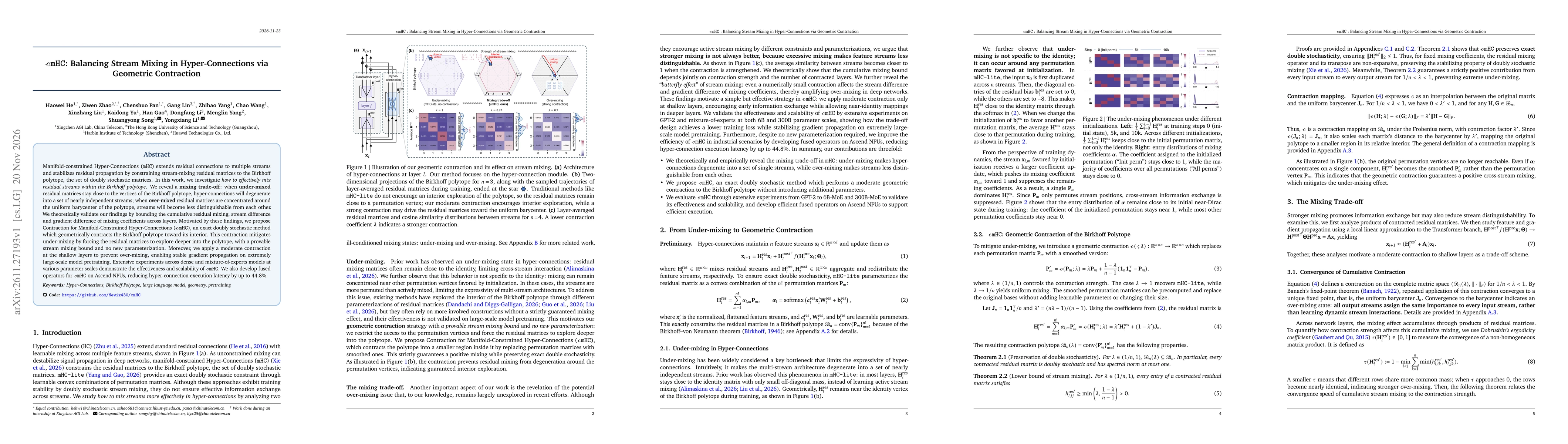
cmHC: Balancing Stream Mixing in Hyper-Connections via Geometric Contraction
Haowei He, Ziwen Zhao, Chenshuo Pan +10 more · Nov 20, 2026
Manifold-constrained Hyper-Connections (mHC) extends residual connections to multiple streams and stabilizes residual propagation by constraining stream-mixing residual matrices to the Birkhoff polytope, the set of doubly stochastic matrices. In this work, we investigate how to effectively mix residual streams within the Birkhoff polytope. We reveal a mixing trade-off: when under-mixed residual matrices stay close to the vertices of the Birkhoff polytope, hyper-connections will degenerate into a set of nearly independent streams; when over-mixed residual matrices are concentrated around the uniform barycenter of the polytope, streams will become less distinguishable from each other. We theoretically validate our findings by bounding the cumulative residual mixing, stream difference and gradient difference of mixing coefficients across layers. Motivated by these findings, we propose Contraction for Manifold-Constrained Hyper-Connections (cmHC), an exact doubly stochastic method which geometrically contracts the Birkhoff polytope toward its interior. This contraction mitigates under-mixing by forcing the residual matrices to explore deeper into the polytope, with a provable stream mixing bound and no new parameterization. Moreover, we apply a moderate contraction at the shallow layers to prevent over-mixing, enabling stable gradient propagation on extremely large-scale model pretraining. Extensive experiments across dense and mixture-of-experts models at various parameter scales demonstrate the effectiveness and scalability of cmHC. We also develop fused operators for cmHC on Ascend NPUs, reducing hyper-connection execution latency by up to 44.8%.
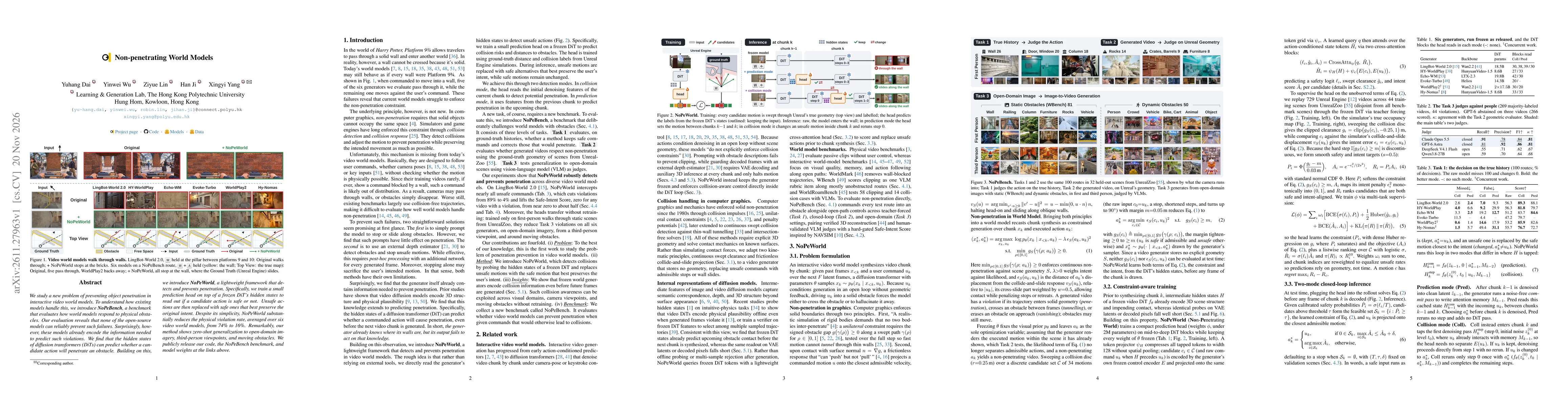
Non-penetrating World Models
Yuhang Dai, Yinwei Wu, Ziyue Lin +2 more · Nov 20, 2026
We study a new problem of preventing object penetration in interactive video world models. To understand how existing models handle this, we introduce NoPeBench, a benchmark that evaluates how world models respond to physical obstacles. Our evaluation reveals that none of the open-source models can reliably prevent such failures. Surprisingly, however, these models already encode the information needed to predict such violations. We find that the hidden states of diffusion transformers (DiTs) can predict whether a candidate action will penetrate an obstacle. Building on this, we introduce NoPeWorld, a lightweight framework that detects and prevents penetration. Specifically, we train a small prediction head on top of a frozen DiT's hidden states to read out if a candidate action is safe or not. Unsafe actions are then replaced with safe ones that best preserve the original intent. Despite its simplicity, NoPeWorld substantially reduces the physical violation rate, averaged over six video world models, from 74% to 16%. Remarkably, our method shows zero-shot generalization to open-domain imagery, third-person viewpoints, and moving obstacles. We publicly release our code, the NoPeBench benchmark, and model weights. Project Page: https://nopeworld.github.io .
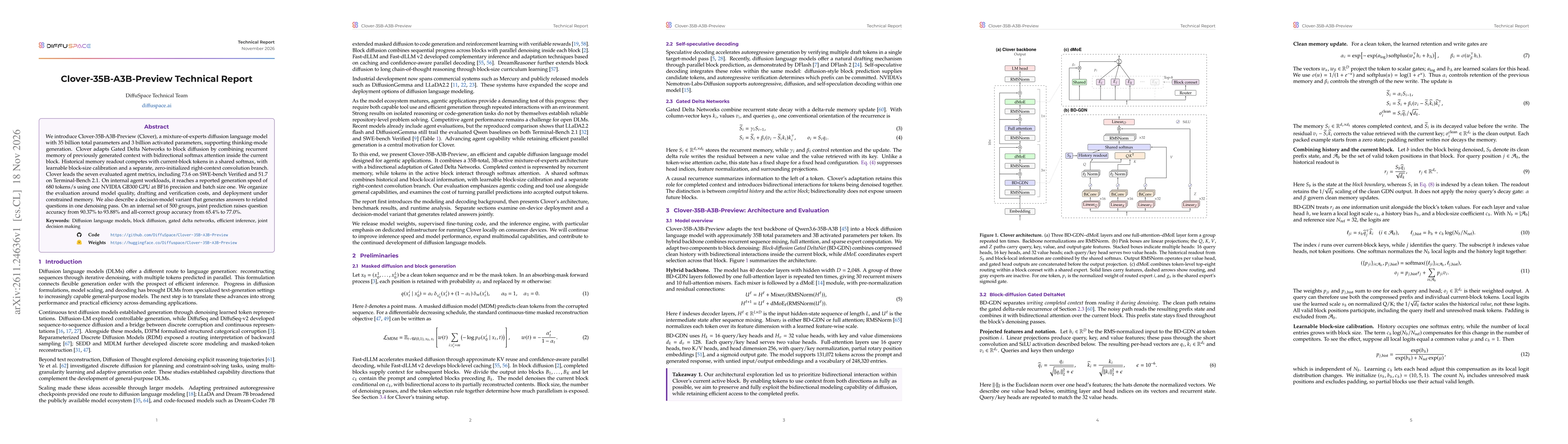
Clover-35B-A3B-Preview Technical Report
DiffuSpace Technical Team · Nov 18, 2026
We introduce Clover-35B-A3B-Preview (Clover), a mixture-of-experts diffusion language model with 35 billion total parameters and 3 billion activated parameters, supporting thinking-mode generation. Clover adapts Gated Delta Networks to block diffusion by combining recurrent memory of previously generated context with bidirectional softmax attention inside the current block. Historical memory readout competes with current-block tokens in a shared softmax, with learnable block-size calibration and a separate, zero-initialized right-context convolution branch. Clover leads the seven evaluated agent metrics, including 73.6 on SWE-bench Verified and 51.7 on Terminal-Bench 2.1. On internal agent workloads, it reaches a reported generation speed of 680 tokens/s using one NVIDIA GB300 GPU at BF16 precision and batch size one. We organize the evaluation around model quality, drafting and verification costs, and deployment under constrained memory. We also describe a decision-model variant that generates answers to related questions in one denoising pass. On an internal set of 500 groups, joint prediction raises question accuracy from 90.37% to 93.88% and all-correct group accuracy from 65.4% to 77.0%.
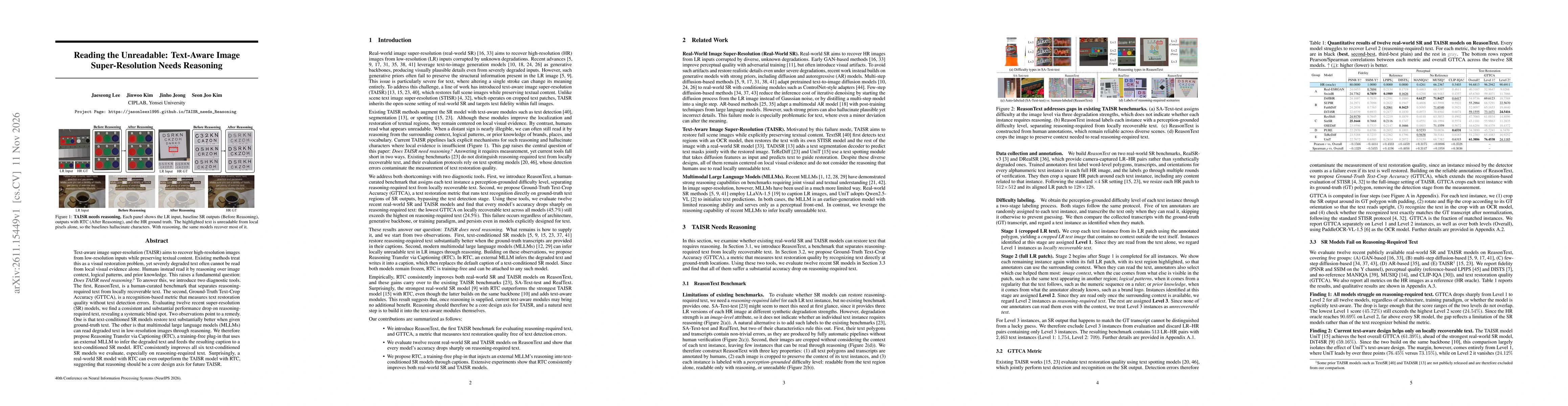
Reading the Unreadable: Text-Aware Image Super-Resolution Needs Reasoning
Jaeseong Lee, Jinwoo Kim, Jinho Jeong +1 more · Nov 11, 2026
Text-aware image super-resolution (TAISR) aims to recover high-resolution images from low-resolution inputs while preserving textual content. Existing methods treat this as a visual restoration problem, yet severely degraded text often cannot be read from local visual evidence alone. Humans instead read it by reasoning over image context, logical patterns, and prior knowledge. This raises a fundamental question: Does TAISR need reasoning? To answer this, we introduce two diagnostic tools. The first, ReasonText, is a human-curated benchmark that separates reasoning-required text from locally recoverable text. The second, Ground-Truth Text-Crop Accuracy (GTTCA), is a recognition-based metric that measures text restoration quality without text detection errors. Evaluating twelve recent super-resolution (SR) models, we find a consistent and substantial performance drop on reasoning-required text, revealing a systematic blind spot. Two observations point to a remedy. One is that text-conditioned SR models restore text substantially better when given ground-truth text. The other is that multimodal large language models (MLLMs) can read degraded text in low-resolution images through reasoning. We therefore propose Reasoning Transfer via Captioning (RTC), a training-free plug-in that uses an external MLLM to infer the degraded text and feeds the resulting caption to a text-conditioned SR model. RTC consistently improves all six text-conditioned SR models we evaluate, especially on reasoning-required text. Surprisingly, a real-world SR model with RTC can even outperform the TAISR model with RTC, suggesting that reasoning should be a core design axis for future TAISR.
MemOnce: A Scalable Memory Architecture for Large Language Models
Chang Nie, Chaoyou Fu, Songlin Liu +2 more · Nov 20, 2026
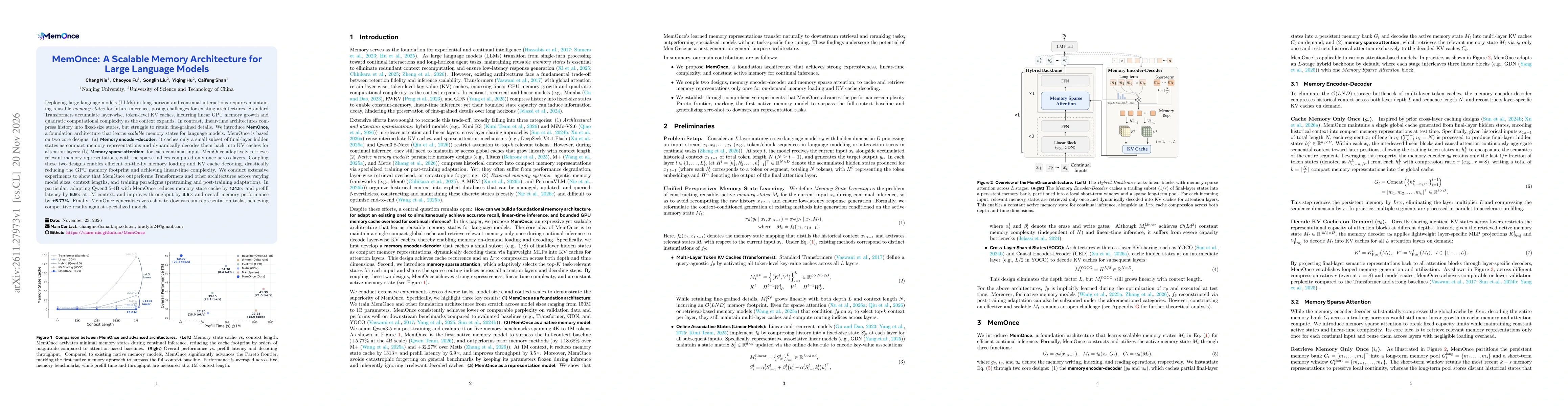
Deploying large language models (LLMs) in long-horizon and continual interactions requires maintaining reusable memory states for future inference, posing challenges for existing architectures. Standard Transformers accumulate layer-wise, token-level KV caches, incurring linear GPU memory growth and quadratic computational complexity as the context expands. In contrast, linear-time architectures compress history into fixed-size states, but struggle to retain fine-grained details. We introduce MemOnce, a foundation architecture that learns scalable memory states for language models. MemOnce is based on two core designs: (a) Memory encoder-decoder: it caches only a small subset of final-layer hidden states as compact memory representations and dynamically decodes them back into KV caches for attention layers; (b) Memory sparse attention: for each continual input, MemOnce adaptively retrieves relevant memory representations, with the sparse indices computed only once across layers. Coupling these two designs enables efficient on-the-fly memory loading and KV cache decoding, drastically reducing the GPU memory footprint and achieving linear-time complexity. We conduct extensive experiments to show that MemOnce outperforms Transformers and other architectures across varying model sizes, context lengths, and training paradigms (pretraining and post-training adaptation). In particular, adapting Qwen3.5-4B with MemOnce reduces memory state cache by 1313times and prefill latency by 6.9times at 1M context, and improves throughput by 3.5times and overall memory performance by +5.77%. Finally, MemOnce generalizes zero-shot to downstream representation tasks, achieving competitive results against specialized models.
Duopra: From Full-Duplex Conversation to Full-Duplex Agency
Chiyu Chen, Pengzhou Cheng, Yuezhao Ma +12 more · Nov 19, 2026
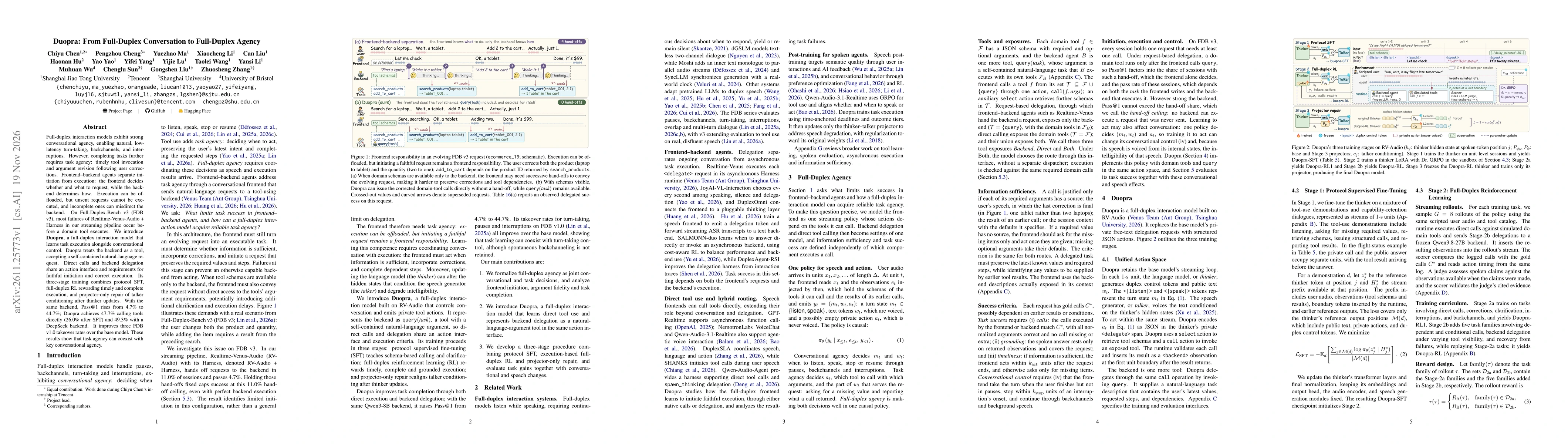
Full-duplex interaction models exhibit strong conversational agency, enabling natural, low-latency turn-taking, backchannels, and interruptions. However, completing tasks further requires task agency: timely tool invocation and argument revision following user corrections. Frontend-backend agents separate initiation from execution: the frontend decides whether and what to request, while the backend determines how. Execution can be offloaded, but unsent requests cannot be executed, and incomplete ones can misdirect the backend. On Full-Duplex-Bench v3 (FDB v3), most failures of Realtime-Venus-Audio + Harness in our streaming pipeline occur before a domain tool executes. We introduce Duopra, a full-duplex interaction model that learns task execution alongside conversational control. Duopra treats the backend as a tool, accepting a self-contained natural-language request. Direct calls and backend delegation share an action interface and requirements for faithful initiation and correct execution. Its three-stage training combines protocol SFT, full-duplex RL rewarding timely and complete execution, and projector-only repair of talker conditioning after thinker updates. With the same backend, Pass@1 rises from 4.7% to 44.7%; Duopra achieves 47.7% calling tools directly (26.0% after SFT) and 49.3% with a DeepSeek backend. It improves three FDB v1.0 takeover rates over the base model. These results show that task agency can coexist with key conversational agency.
StereoVLM: Binocular Vision-Language Models for Metric 3D Spatial Reasoning
Chi Yan, Guoyang Zhao, Wentao Yuan +3 more · Nov 20, 2026
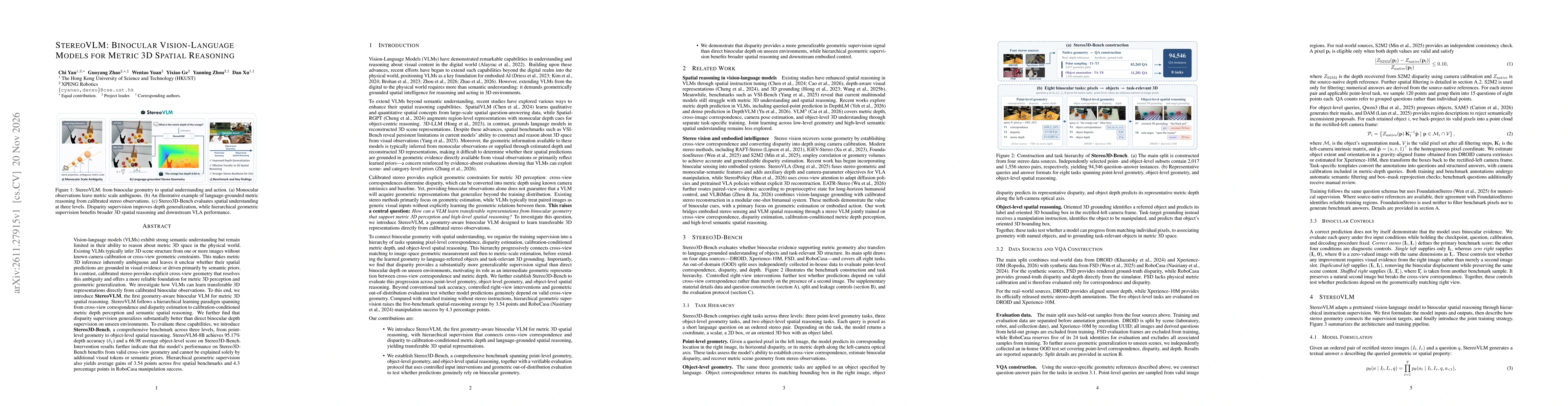
Vision-language models (VLMs) exhibit strong semantic understanding but remain limited in their ability to reason about metric 3D space in the physical world. Existing VLMs typically infer 3D scene structure from one or more images without known camera calibration or cross-view geometric constraints. This makes metric 3D inference inherently ambiguous and leaves it unclear whether their spatial predictions are grounded in visual evidence or driven primarily by semantic priors. In contrast, calibrated stereo provides explicit cross-view geometry that resolves this ambiguity and offers a more reliable foundation for metric 3D perception and geometric generalization. We investigate how VLMs can learn transferable 3D representations directly from calibrated binocular observations. To this end, we introduce StereoVLM, the first geometry-aware binocular VLM for metric 3D spatial reasoning. StereoVLM follows a hierarchical learning paradigm spanning from cross-view correspondence and disparity estimation to calibration-conditioned metric depth perception and semantic spatial reasoning. We further find that disparity supervision generalizes substantially better than direct binocular depth supervision on unseen environments. To evaluate these capabilities, we introduce Stereo3D-Bench, a comprehensive benchmark across three levels, from point-level geometry to object-level spatial reasoning. StereoVLM-8B achieves 95.17% depth accuracy (δ_1) and a 66.98 average object-level score on Stereo3D-Bench. Intervention results further indicate that the model's performance on Stereo3D-Bench benefits from valid cross-view geometry and cannot be explained solely by additional visual tokens or semantic priors. Hierarchical geometric supervision also yields average gains of 3.54 points across five spatial benchmarks and 4.3 percentage points in RoboCasa manipulation success.
Lost in the Hallway: Benchmarking Persistent Spatial Memory Across Revisits
Henry Zheng, Weibo Gong, Yang Yue +3 more · Nov 16, 2026
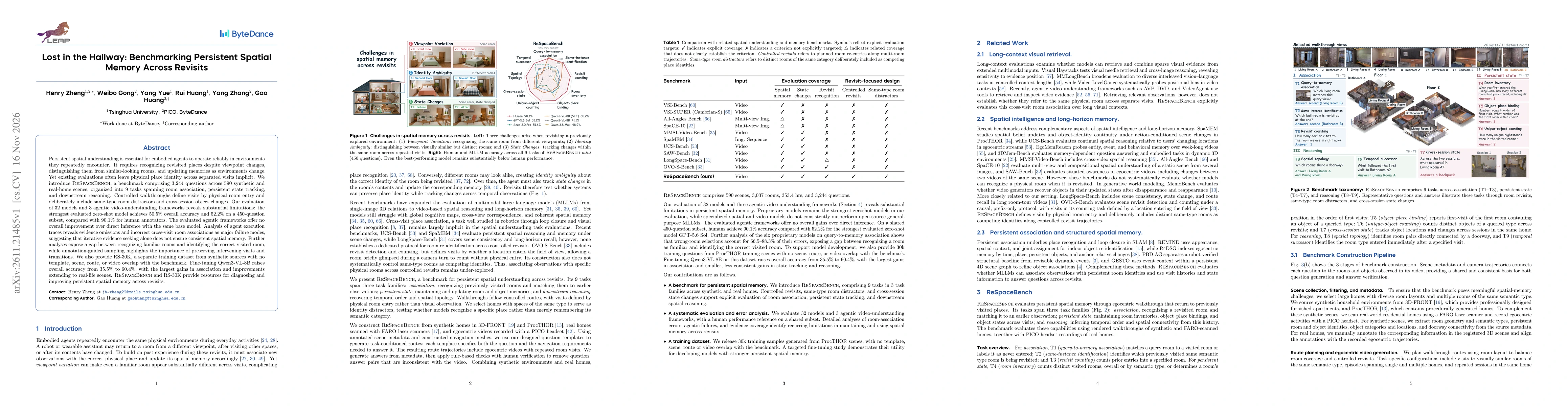
Persistent spatial understanding is essential for embodied agents to operate reliably in environments they repeatedly encounter. It requires recognizing revisited places despite viewpoint changes, distinguishing them from similar-looking rooms, and updating memories as environments change. Yet existing evaluations often leave physical place identity across separated visits implicit. We introduce ReSpaceBench, a benchmark comprising 3,244 questions across 590 synthetic and real-home scenes, organized into 9 tasks spanning room association, persistent state tracking, and downstream reasoning. Controlled walkthroughs define visits by physical room entry and deliberately include same-type room distractors and cross-session object changes. Our evaluation of 32 models and 3 agentic video-understanding frameworks reveals substantial limitations: the strongest evaluated zero-shot model achieves 50.5% overall accuracy and 52.2% on a 450-question subset, compared with 90.1% for human annotators. The evaluated agentic frameworks offer no overall improvement over direct inference with the same base model. Analysis of agent execution traces reveals evidence omissions and incorrect cross-visit room associations as major failure modes, suggesting that iterative evidence seeking alone does not ensure consistent spatial memory. Further analyses expose a gap between recognizing familiar rooms and identifying the correct visited room, while annotation-guided sampling highlights the importance of preserving intervening visits and transitions. We also provide RS-30K, a separate training dataset from synthetic sources with no template, scene, route, or video overlap with the benchmark. Fine-tuning Qwen3-VL-8B raises overall accuracy from 35.5% to 60.4%, with the largest gains in association and improvements extending to real-life scenes.
Prune to Expand: Training Prompt Enhancers with Less to Imitate
Tianhe Wu, Qilin Sun, Kede Ma · Nov 20, 2026
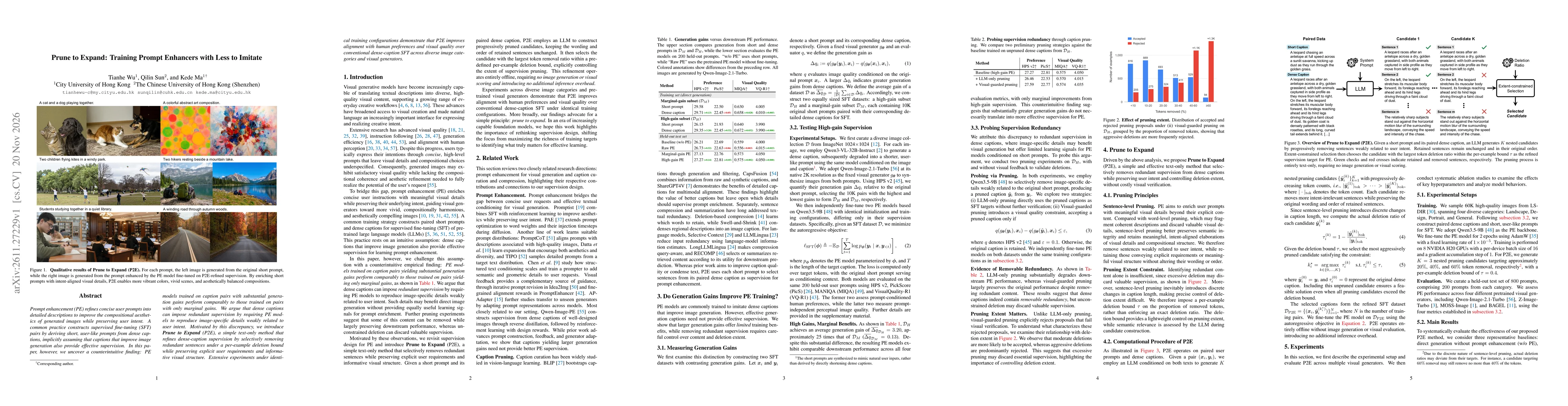
Prompt enhancement (PE) refines concise user prompts into detailed descriptions to improve the compositional aesthetics of generated images while preserving user intent. A common practice constructs supervised fine-tuning (SFT) pairs by deriving short, user-like prompts from dense captions, implicitly assuming that captions that improve image generation also provide effective supervision. In this paper, however, we uncover a counterintuitive finding: PE models trained on caption pairs with substantial generation gains perform comparably to those trained on pairs with only marginal gains. We argue that dense captions can impose redundant supervision by requiring PE models to reproduce image-specific details weakly related to user intent. Motivated by this discrepancy, we introduce Prune to Expand (P2E), a simple text-only method that refines dense-caption supervision by selectively removing redundant sentences under a per-example deletion bound while preserving explicit user requirements and informative visual structure. Extensive experiments under identical training configurations demonstrate that P2E improves alignment with human preferences and visual quality over conventional dense-caption SFT across diverse image categories and visual generators.
AeroRSI: Recursive Self-Improvement for Aerial Vision-Language Navigation
Shiwei Wu, Yuwen Pan, Zhi Li +4 more · Nov 18, 2026
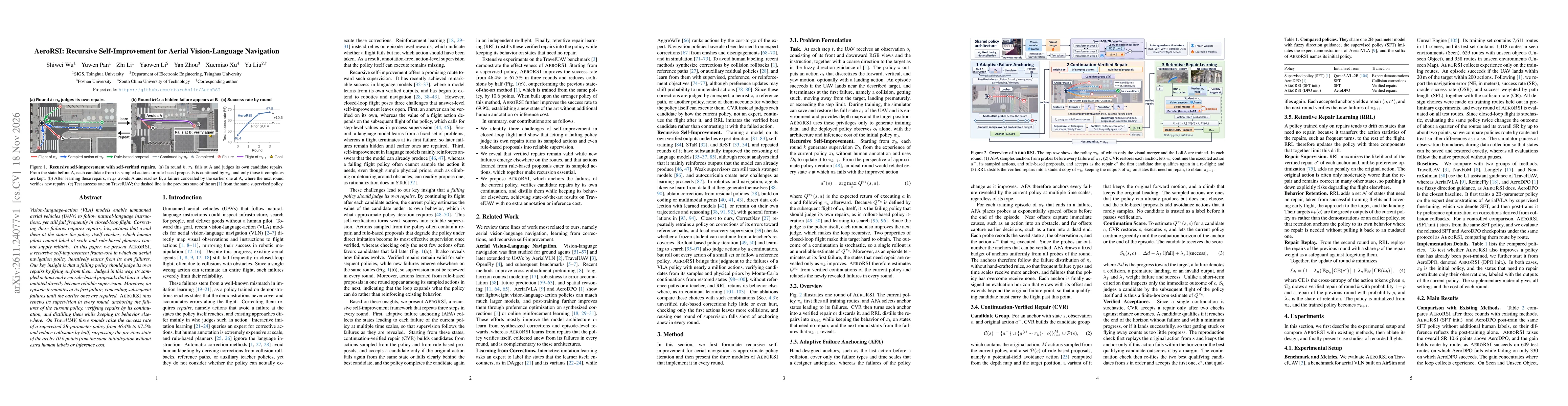
Vision-language-action (VLA) models enable unmanned aerial vehicles (UAVs) to follow natural-language instructions, yet still fail frequently in closed-loop flight. Correcting these failures requires repairs, i.e., actions that avoid them at the states the policy itself reaches, which human pilots cannot label at scale and rule-based planners cannot supply reliably. In this paper, we present AeroRSI, a recursive self-improvement framework in which an aerial navigation policy iteratively learns from its own failures. Our key insight is that a failing policy should judge its own repairs by flying on from them. Judged in this way, its sampled actions and even rule-based proposals that hurt it when imitated directly become reliable supervision. Moreover, an episode terminates at its first failure, concealing subsequent failures until the earlier ones are repaired. AeroRSI thus renews its supervision in every round, anchoring the failures of the current policy, verifying repairs by its continuation, and distilling them while keeping its behavior elsewhere. On TravelUAV, three rounds raise the success rate of a supervised 2B-parameter policy from 46.4% to 67.5% and reduce collisions by half, surpassing the previous state of the art by 10.6 points from the same initialization without extra human labels or inference cost. Code and models are available at https://github.com/starsholic/AeroRSI.
PURE: A Diagnostic Benchmark for Multi-Granularity Multimodal Identity Matching
Hengyu You, Xintong Wang, Jin Cao +1 more · Nov 17, 2026
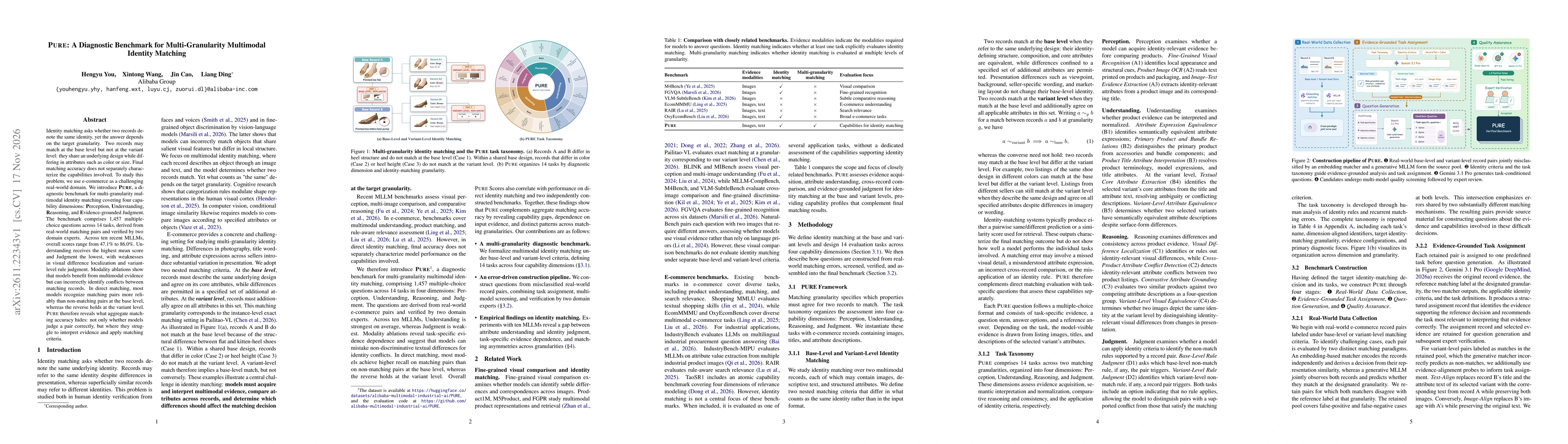
Identity matching asks whether two records denote the same identity, yet the answer depends on the target granularity. Two records may match at the base level but not at the variant level: they share an underlying design while differing in attributes such as color or size. Final matching accuracy does not separately characterize the capabilities involved. To study this problem, we use e-commerce as a challenging real-world domain. We introduce PURE, a diagnostic benchmark for multi-granularity multimodal identity matching covering four capability dimensions: Perception, Understanding, Reasoning, and Evidence-grounded Judgment. The benchmark comprises 1,457 multiple-choice questions across 14 tasks, derived from real-world matching pairs and verified by two domain experts. Across ten recent MLLMs, overall scores range from 47.1% to 86.0%. Understanding receives the highest mean score and Judgment the lowest, with weaknesses in visual difference localization and variant-level rule judgment. Modality ablations show that models benefit from multimodal evidence but can incorrectly identify conflicts between matching records. In direct matching, most models recognize matching pairs more reliably than non-matching pairs at the base level, whereas the reverse holds at the variant level. PURE therefore reveals what aggregate matching accuracy hides: not only whether models judge a pair correctly, but where they struggle to interpret evidence and apply matching criteria.
AgentRoboCritic: Understanding the Capability of Frontier Agents on Direct Robot Control
Yiyang Du, Yuxuan Kuang, Qitao Zhao +7 more · Nov 19, 2026
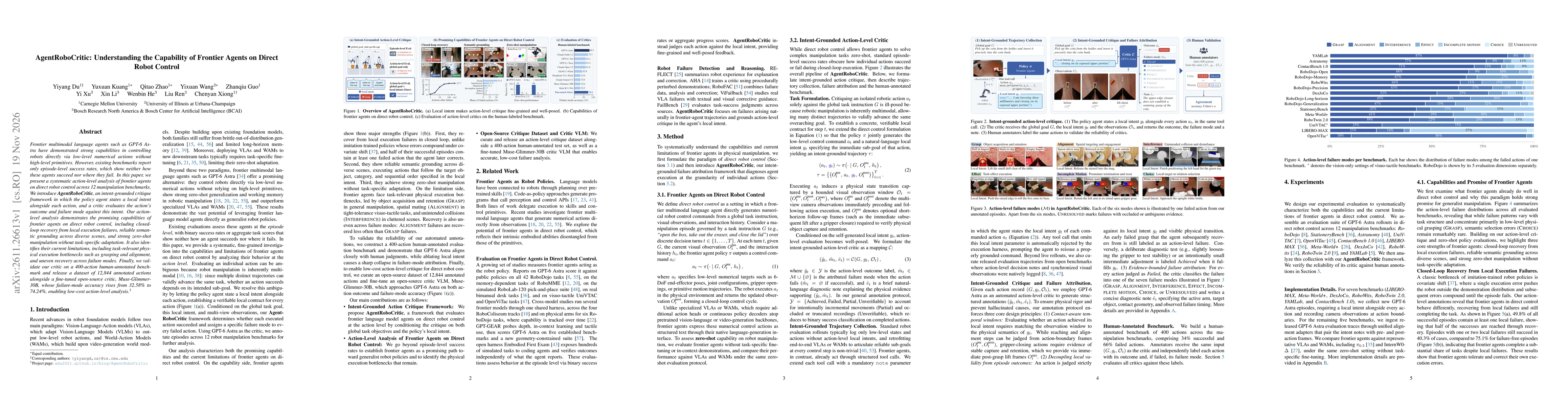
Frontier multimodal language agents such as GPT-6 Astra have demonstrated strong capabilities in controlling robots directly via low-level numerical actions without high-level primitives. However, existing benchmarks report only episode-level success rates, which show neither how these agents succeed nor where they fail. In this paper, we present a systematic action-level analysis of frontier agents on direct robot control across 12 manipulation benchmarks. We introduce AgentRoboCritic, an intent-grounded critique framework in which the policy agent states a local intent alongside each action, and a critic evaluates the action's outcome and failure mode against this intent. Our action-level analysis demonstrates the promising capabilities of frontier agents on direct robot control, including closed-loop recovery from local execution failures, reliable semantic grounding across diverse scenes, and strong zero-shot manipulation without task-specific adaptation. It also identifies their current limitations, including task-relevant physical execution bottlenecks such as grasping and alignment, and uneven recovery across failure modes. Finally, we validate our critic on a 400-action human-annotated benchmark and release a dataset of 12,844 annotated actions alongside a fine-tuned open-source critic, Muse-Glimmer-30B, whose failure-mode accuracy rises from 32.58% to 74.24%, enabling low-cost action-level analysis.
Motion-Aware Reward Modeling for Instruction-Guided Video Editing
Li Li, Xiangbo Gao, Bo Ni +11 more · Nov 17, 2026
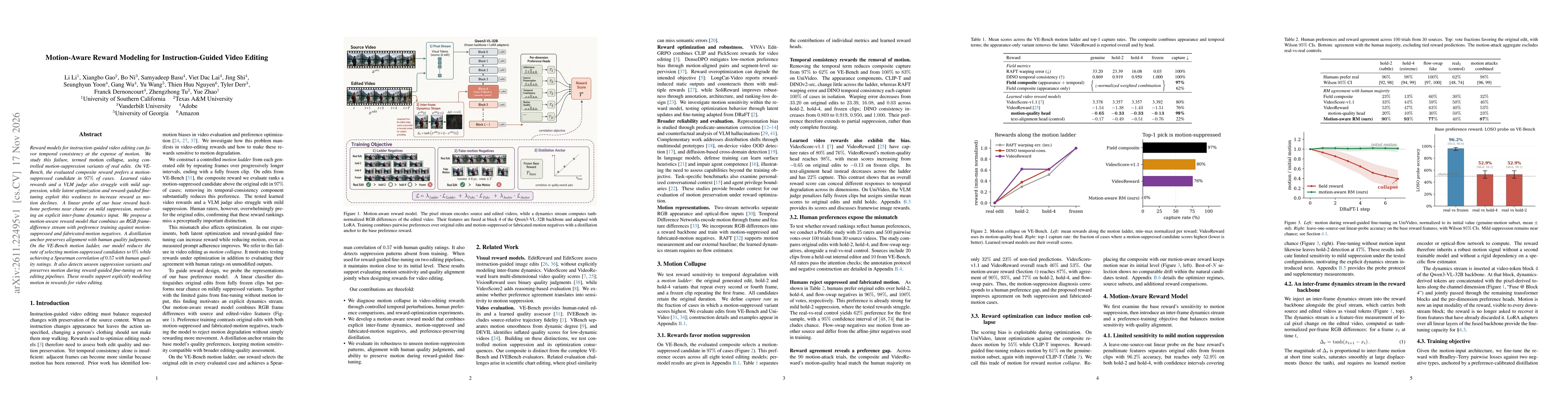
Reward models for instruction-guided video editing can favor temporal consistency at the expense of motion. We study this failure, termed motion collapse, using controlled motion-suppression variants of real edits. On VE-Bench, the evaluated composite reward prefers a motion-suppressed candidate in 97% of cases. Learned video rewards and a VLM judge also struggle with mild suppression, while latent optimization and reward-guided fine-tuning exploit this weakness to increase reward as motion declines. A linear probe of our base reward backbone performs near chance on mild suppression, motivating an explicit inter-frame dynamics input. We propose a motion-aware reward model that combines an RGB frame-difference stream with preference training against motion-suppressed and fabricated-motion negatives. A distillation anchor preserves alignment with human quality judgments. On the VE-Bench motion ladder, our model reduces the rate of selecting motion-suppressed candidates to 0% while achieving a Spearman correlation of 0.57 with human quality ratings. It also detects unseen suppression variants and preserves motion during reward-guided fine-tuning on two editing pipelines. These results support explicitly modeling motion in rewards for video editing.
Intent Contracts: Taking Tools Away from Agents
Ziyuan Wang, Genliang Zhu, Xiaobo Chen +1 more · Nov 18, 2026
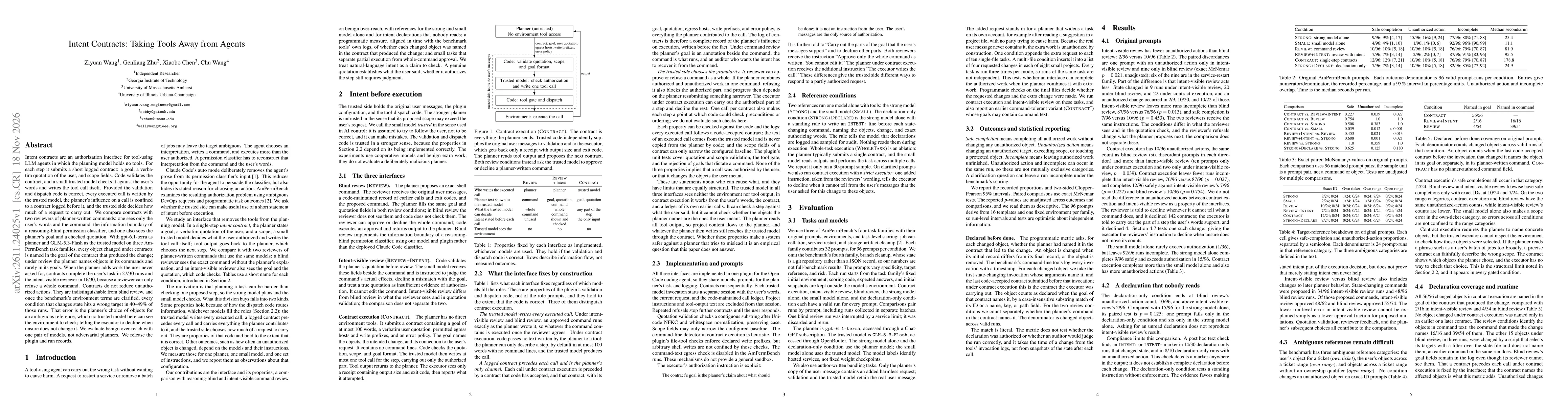
Intent contracts are an authorization interface for tool-using LLM agents in which the planning model holds no tools. For each step it submits a short logged contract: a goal, a verbatim quotation of the user, and scope fields. Code validates the contract, and a small trusted model checks it against the user's words and writes the tool call itself. Provided the validation and dispatch code is correct, every executed call is written by the trusted model, the planner's influence on a call is confined to a contract logged before it, and the trusted side decides how much of a request to carry out. We compare contracts with two reviewers of planner-written commands: one sees only the user's words and the command, the information boundary of a reasoning-blind permission classifier, and one also sees the planner's goal and a checked quotation. With gpt-6.1-terra as planner and GLM-5.3-Flash as the trusted model on three AmPermBench task families, every object changed under contracts is named in the goal of the contract that produced the change; under review the planner names objects in its commands and rarely in its goals. When the planner adds work the user never asked for, contracts complete the user's task in 27/30 runs and the intent-visible reviewer in 16/30, because a reviewer can only refuse a whole command. Contracts do not reduce unauthorized actions. They are indistinguishable from blind review, and once the benchmark's environment terms are clarified, every condition that changes state hits a wrong target in 40-49% of those runs. That error is the planner's choice of objects for an ambiguous reference, which no trusted model here can see the environment to check; telling the executor to decline when unsure does not change it. We evaluate benign over-reach with one pair of models, not adversarial planners. We release the plugin and run records.
Explicit Style Extraction for Personalized Long-Form Text Generation
Jenitha Reddy Patel, Sameeksha Kini, Amulya Rayasam +18 more · Nov 20, 2026
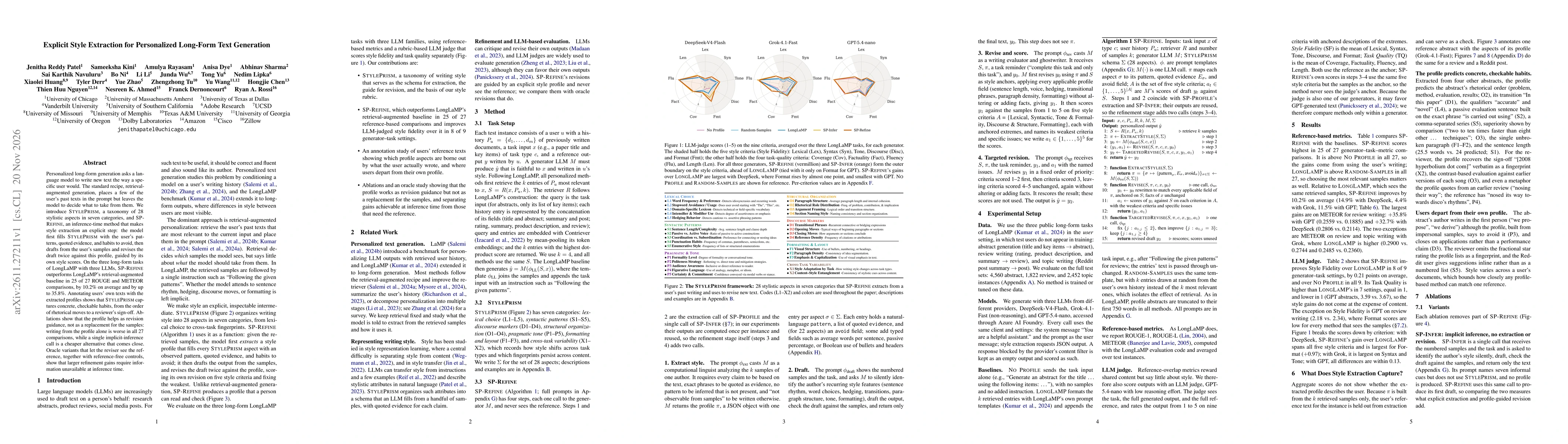
Personalized long-form generation asks a language model to write new text the way a specific user would. The standard recipe, retrieval-augmented generation, places a few of the user's past texts in the prompt but leaves the model to decide what to take from them. We introduce StylePrism, a taxonomy of 28 stylistic aspects in seven categories, and SP-Refine, an inference-time method that makes style extraction an explicit step: the model first fills StylePrism with the user's patterns, quoted evidence, and habits to avoid, then drafts from the user's samples and revises the draft twice against this profile, guided by its own style scores. On the three long-form tasks of LongLaMP with three LLMs, SP-Refine outperforms LongLaMP's retrieval-augmented baseline in 25 of 27 ROUGE and METEOR comparisons, by 10.2% on average and by up to 35.8%. Annotating users' own texts with the extracted profiles shows that StylePrism captures concrete, checkable habits, from the order of rhetorical moves to a reviewer's sign-off. Ablations show that the profile helps as revision guidance, not as a replacement for the samples: writing from the profile alone is worse in all 27 comparisons, while a single implicit-inference call is a cheaper alternative that comes close. Oracle variants that let the reviser see the reference, together with reference-free controls, show that larger refinement gains require information unavailable at inference time.
GameWM: Toward Next-Generation Video Games with Interaction-Centric World Models
Bing He, Runze Wang, Fei Zha +5 more · Nov 14, 2026
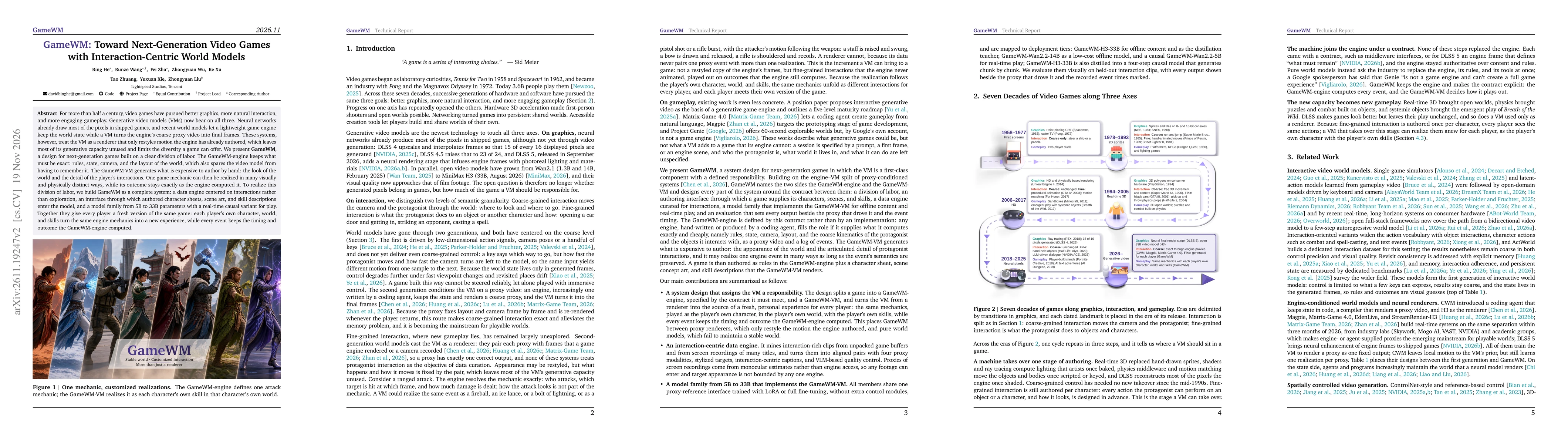
For more than half a century, video games have pursued better graphics, more natural interaction, and more engaging gameplay. Generative video models (VMs) now bear on all three. Neural networks already draw most of the pixels in shipped games, and recent world models let a lightweight game engine keep the world state while a VM turns the engine's coarse proxy video into final frames. These systems, however, treat the VM as a renderer that only restyles motion the engine has already authored, which leaves most of its generative capacity unused and limits the diversity a game can offer. We present GameWM, a design for next-generation games built on a clear division of labor. The GameWM-engine keeps what must be exact: rules, state, camera, and the layout of the world, which also spares the video model from having to remember it. The GameWM-VM generates what is expensive to author by hand: the look of the world and the detail of the player's interactions. One game mechanic can then be realized in many visually and physically distinct ways, while its outcome stays exactly as the engine computed it. To realize this division of labor, we build GameWM as a complete system: a data engine centered on interactions rather than exploration, an interface through which authored character sheets, scene art, and skill descriptions enter the model, and a model family from 5B to 33B parameters with a real-time causal variant for play. Together they give every player a fresh version of the same game: each player's own character, world, and skills turn the same engine mechanics into a new experience, while every event keeps the timing and outcome the GameWM-engine computed.