Trending on arXiv
Today's most upvoted papers on arXiv
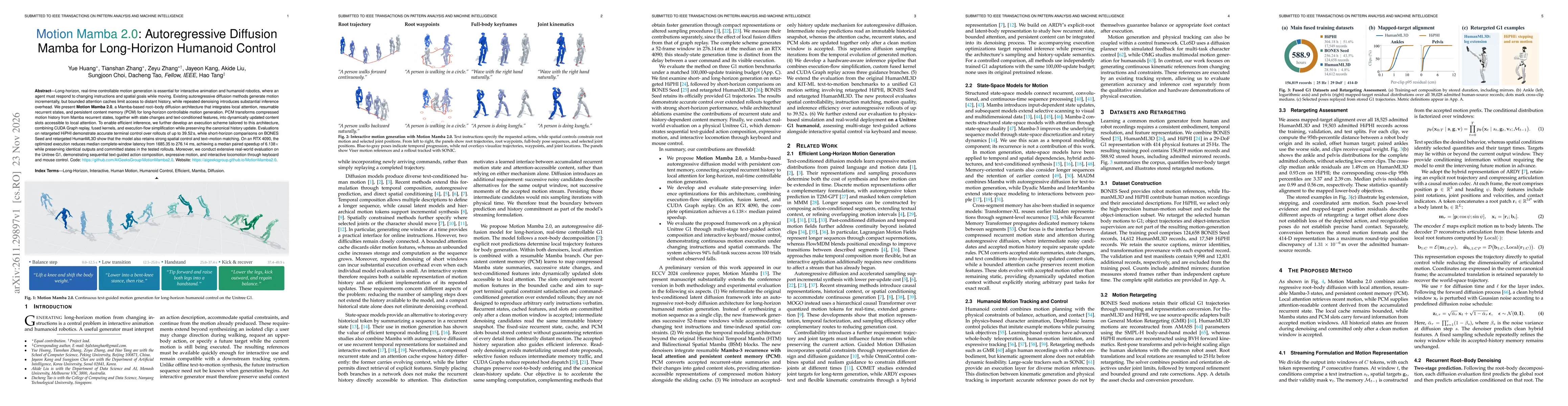
Motion Mamba 2.0: Autoregressive Diffusion Mamba for Long-Horizon Humanoid Control
Yue Huang, Tianshan Zhang, Zeyu Zhang +5 more · Nov 23, 2026
Long-horizon, real-time controllable motion generation is essential for interactive animation and humanoid robotics, where an agent must respond to changing instructions and spatial goals while moving. Existing autoregressive diffusion methods generate motion incrementally, but bounded attention caches limit access to distant history, while repeated denoising introduces substantial inference overhead. We present Motion Mamba 2.0, a Mamba-based root-body diffusion architecture that integrates local attention, resumable recurrent states, and persistent content memory (PCM) for long-horizon controllable motion generation. PCM transforms compressed motion history from Mamba recurrent states, together with state changes and text-conditioned features, into dynamically updated content slots accessible to local attention. To enable efficient inference, we further develop an execution scheme tailored to this architecture, combining CUDA Graph replay, fused kernels, and execution-flow simplification while preserving the canonical history update. Evaluations on retargeted HiPHI demonstrate accurate terminal control over rollouts of up to 39.52 s, while short-horizon comparisons on BONES Seed and retargeted HumanML3D show that the model also retains strong spatial control and text-motion matching. On an RTX 4090, the optimized execution reduces median complete-window latency from 1685.35 to 276.14 ms, achieving a median paired speedup of 6.138times while preserving identical outputs and committed states in the tested rollouts. Moreover, we conduct extensive real-world evaluation on the Unitree G1, demonstrating sequential text-guided action composition, expressive motion, and interactive locomotion through keyboard and mouse control.
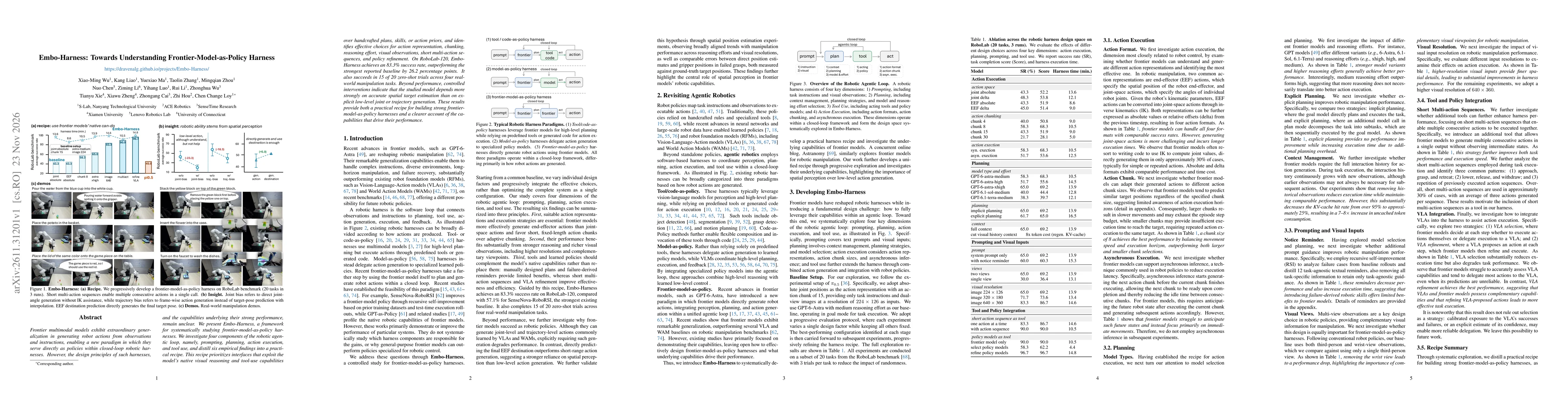
Embo-Harness: Towards Understanding Frontier-Model-as-Policy Harness
Xiao-Ming Wu, Kang Liao, Yuexiao Ma +12 more · Nov 23, 2026
Frontier multimodal models exhibit extraordinary generalization in generating robot actions from observations and instructions, enabling a new paradigm in which they serve directly as policies within closed-loop robotic harnesses. However, the design principles of such harnesses, and the capabilities underlying their strong performance, remain unclear. We present Embo-Harness, a framework for systematically studying frontier-model-as-policy harnesses. We investigate four components of the robotic agentic loop, namely, prompting, planning, action execution, and tool use, and distill six empirical findings into a practical recipe. This recipe prioritizes interfaces that exploit the model's native visual reasoning and tool-use capabilities over handcrafted plans, skills, or action priors, and identifies effective choices for action representation, chunking, reasoning effort, visual observations, short multi-action sequences, and policy refinement. On RoboLab-120, Embo-Harness achieves an 83.3\% success rate, outperforming the strongest reported baseline by 26.2 percentage points. It also succeeds in 15 of 20 zero-shot trials across four real-world manipulation tasks. Beyond performance, controlled interventions indicate that the studied model depends more strongly on accurate spatial target estimation than on explicit low-level joint or trajectory generation. These results provide both a practical recipe for building strong frontier-model-as-policy harnesses and a clearer account of the capabilities that drive their performance.
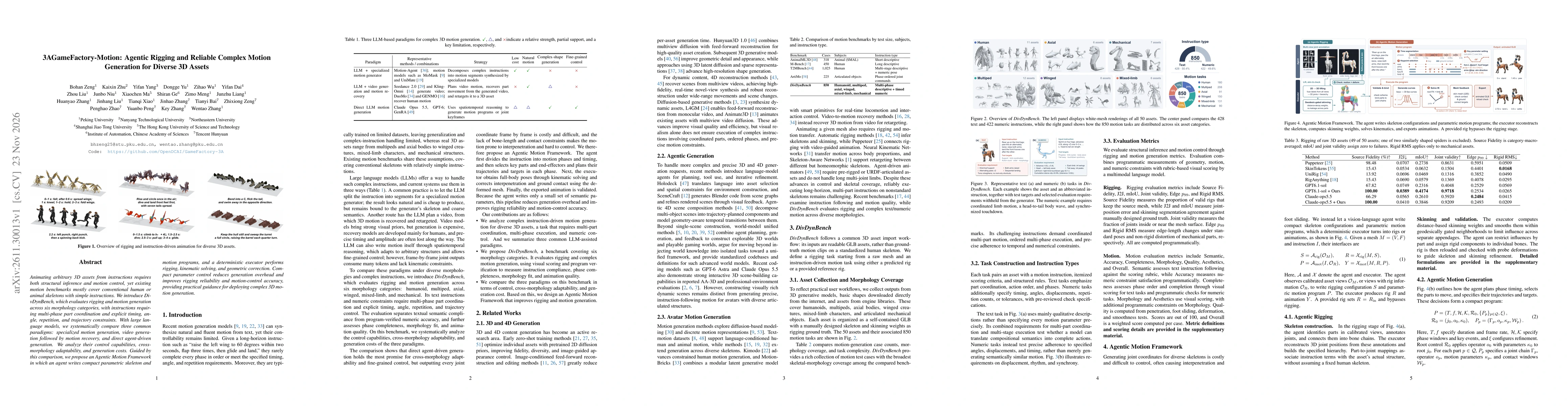
3AGameFactory-Motion: Agentic Rigging and Reliable Complex Motion Generation for Diverse 3D Assets
Bohan Zeng, Kaixin Zhu, Yifan Yang +19 more · Nov 23, 2026
Animating arbitrary 3D assets from instructions requires both structural inference and motion control, yet existing motion benchmarks mostly cover conventional human or animal skeletons with simple instructions. We introduce DivDynBench, which evaluates rigging and motion generation across six morphology categories, with instructions requiring multi-phase part coordination and explicit timing, angle, repetition, and trajectory constraints. With large language models, we systematically compare three common paradigms: specialized motion generation, video generation followed by motion recovery, and direct agent-driven generation. We analyze their control capabilities, cross-morphology adaptability, and generation costs. Guided by this comparison, we propose an Agentic Motion Framework in which an agent writes compact parametric skeleton and motion programs, and a deterministic executor performs rigging, kinematic solving, and geometric correction. Compact parameter control reduces generation overhead and improves rigging reliability and motion-control accuracy, providing practical guidance for deploying complex 3D motion generation.
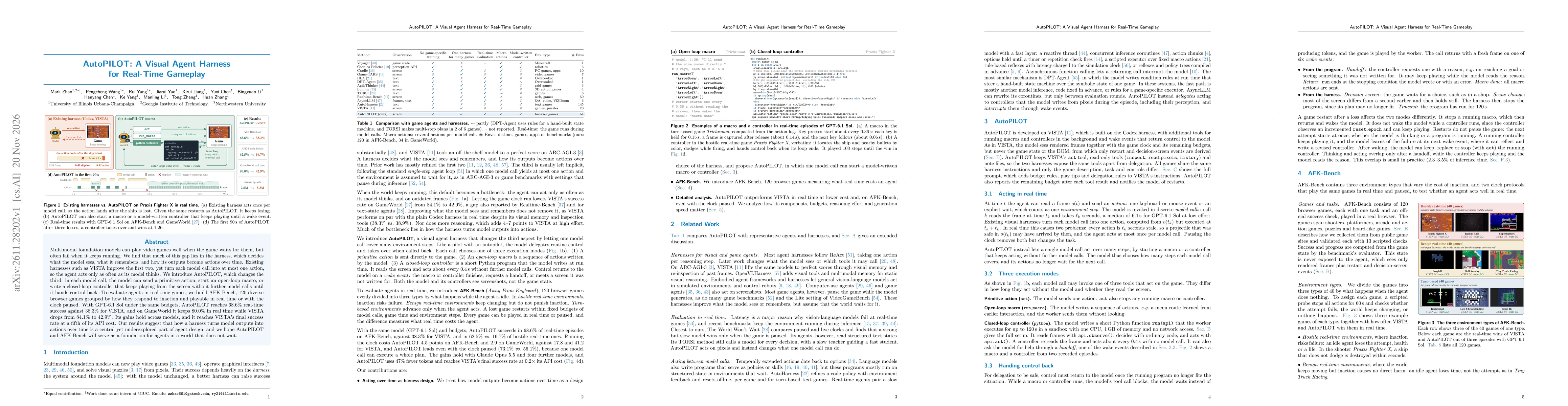
AutoPILOT: A Visual Agent Harness for Real-Time Gameplay
Mark Zhao, Pengcheng Wang, Rui Yang +9 more · Nov 20, 2026
Multimodal foundation models can play video games well when the game waits for them, but often fail when it keeps running. We find that much of this gap lies in the harness, which decides what the model sees, what it remembers, and how its outputs become actions over time. Existing harnesses such as VISTA improve the first two, yet turn each model call into at most one action, so the agent acts only as often as its model thinks. We introduce AutoPILOT, which changes the third: in each model call, the model can send a primitive action, start an open-loop macro, or write a closed-loop controller that keeps playing from the screen without further model calls until it hands control back. To evaluate agents in real-time games, we build AFK-Bench, 120 diverse browser games grouped by how they respond to inaction and playable in real time or with the clock paused. With GPT-6.1 Sol under the same budgets, AutoPILOT reaches 68.6% real-time success against 38.3% for VISTA, and on GameWorld it keeps 80.0% in real time while VISTA drops from 84.1% to 42.9%. Its gains hold across models, and it reaches VISTA's final success rate at a fifth of its API cost. Our results suggest that how a harness turns model outputs into actions over time is a central yet underexplored part of agent design, and we hope AutoPILOT and AFK-Bench will serve as a foundation for agents in a world that does not wait.
Plan4D: Generative Plannable 4D Worlds
Hangwei Zhang, Rujing Dang, Ruimin Lin +3 more · Nov 19, 2026
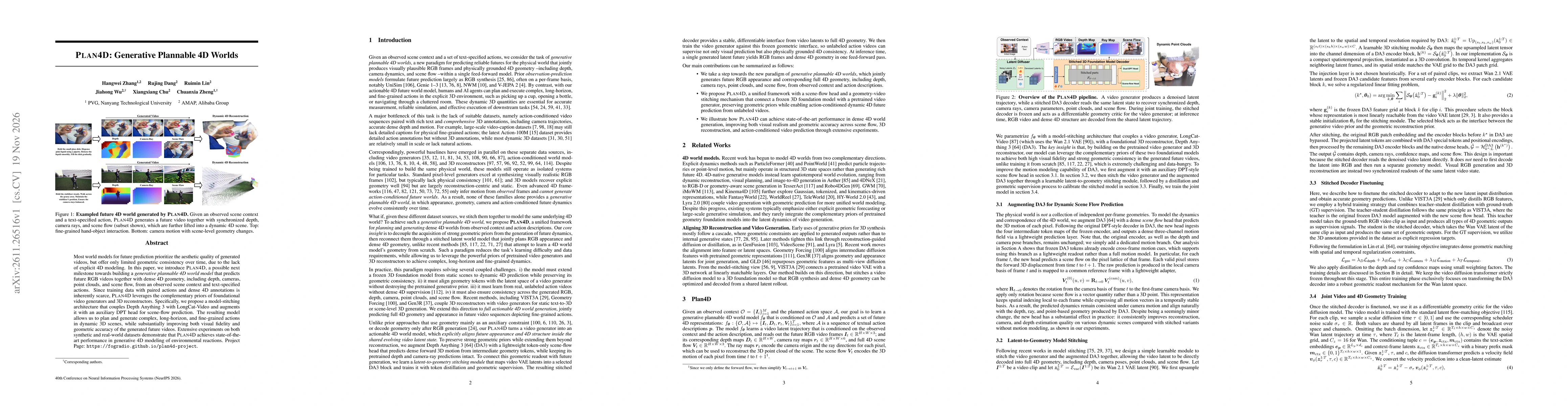
Most world models for future prediction prioritize aestetic quality of generated videos, but offer only weak physical grounding and limited geometric consistency over time, due to the lack of explicit 4D modeling. In this paper, we introduce plan4d, a possible next milestone towards building a generative plannable 4D world model that predicts future RGB videos together with dense 4D geometry, including depth, cameras, point clouds, and scene flow from an observed scene context and text-specified actions. Since training data with paired actions and dense 4D annotations is inherently scarce, plan4d leverages the complementary priors of foundational video generators and 3D reconstructors. Specifically, we propose a model-stitching architecture that couples Depth Anything 3 with LongCat-Video and augments it with an auxiliary DPT head for scene-flow prediction. The resulting model allows us to plan and generate complex, long-horizon, and fine-grained actions in a dynamic 3D scenes, while substantially improving both visual fidelity and geometric accuracy of the generated future videos. Extensive experiments on both synthetic and real-world datasets demonstrate that plan4d achieves state-of-the-art performance in generative 4D modeling of environmental reactions. Project Page: https://fogradio.github.io/plan4d-project
ViDecide: Teaching Video Diffusion Models to Reason and Plan Step by Step
Kaiwen Zhang, Yiming Gao, Zeqi Xiao +4 more · Nov 19, 2026
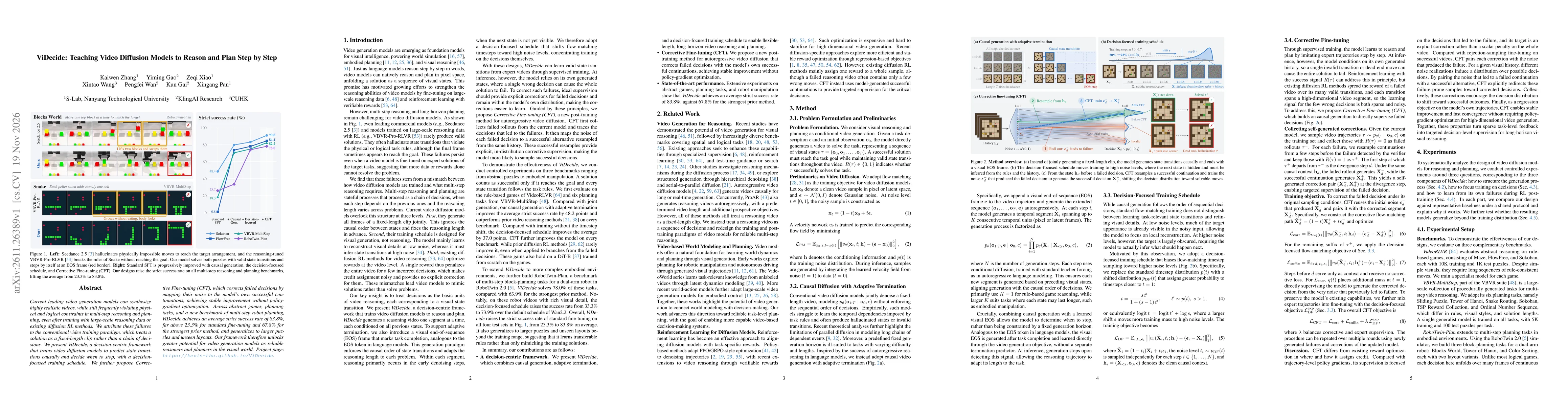
Current leading video generation models can synthesize highly realistic videos, while still frequently violating physical and logical constraints in multi-step reasoning and planning, even after training with large-scale reasoning data or existing diffusion RL methods. We attribute these failures to the conventional video training paradigm, which treats a solution as a fixed-length clip rather than a chain of decisions. We present ViDecide, a decision-centric framework that trains video diffusion models to predict state transitions causally and decide when to stop, with a decision-focused training schedule. We further propose Corrective Fine-tuning (CFT), which corrects failed decisions by mapping their noise to the model's own successful continuations, achieving stable improvement without policy-gradient optimization. Across abstract games, planning tasks, and a new benchmark of multi-step robot planning, ViDecide achieves an average strict success rate of 83.8%, far above 23.3% for standard fine-tuning and 67.8% for the strongest prior method, and generalizes to larger puzzles and unseen layouts. Our framework therefore unlocks greater potential for video generation models as reliable reasoners and planners in the visual world. Project page: https://kevin-thu.github.io/ViDecide.
WorldLeague: Benchmarking Physical Agency
Xinyang Zhou, Qi Li, Xinchao Wang · Nov 23, 2026
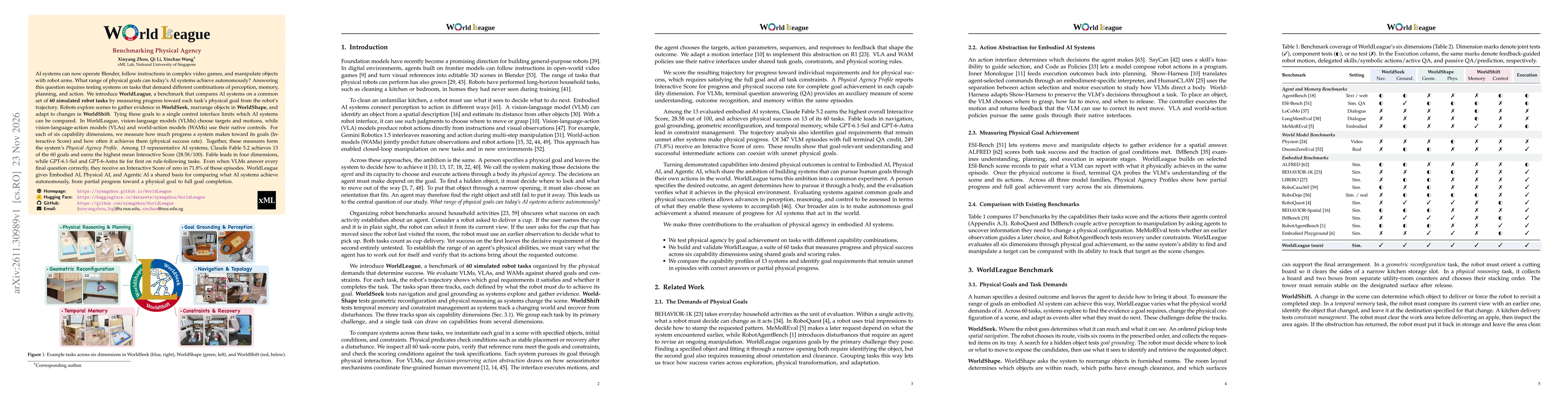
AI systems can now operate Blender, follow instructions in complex video games, and manipulate objects with robot arms. What range of physical goals can today's AI systems achieve autonomously? Answering this question requires testing systems on tasks that demand different combinations of perception, memory, planning, and action. We introduce WorldLeague, a benchmark that compares AI systems on a common set of 60 simulated robot tasks by measuring progress toward each task's physical goal from the robot's trajectory. Robots explore scenes to gather evidence in WorldSeek, rearrange objects in WorldShape, and adapt to changes in WorldShift. Tying these goals to a single control interface limits which AI systems can be compared. In WorldLeague, vision-language models (VLMs) choose targets and motions, while vision-language-action models (VLAs) and world-action models (WAMs) use their native controls. For each of six capability dimensions, we measure how much progress a system makes toward its goals (Interactive Score) and how often it achieves them (physical success rate). Together, these measures form the system's Physical Agency Profile. Among 13 representative AI systems, Claude Fable 5.2 achieves 13 of the 60 goals and earns the highest mean Interactive Score (28.58/100). Fable leads in four dimensions, while GPT-6.1-Sol and GPT-6-Astra tie for first on rule-following tasks. Even when VLMs answer every final question correctly, they receive an Interactive Score of zero in 71.8\% of those episodes. WorldLeague gives Embodied AI, Physical AI, and Agentic AI a shared basis for comparing what AI systems achieve autonomously, from partial progress toward a physical goal to full goal completion. Project Webpage: https://xyangzhou.github.io/WorldLeague
A Glimpse of Training VLMs as Foundation Models for Robotic Manipulation
Meng-Hao Guo, Yi Zhang, Zhe-Han Mo +11 more · Nov 22, 2026
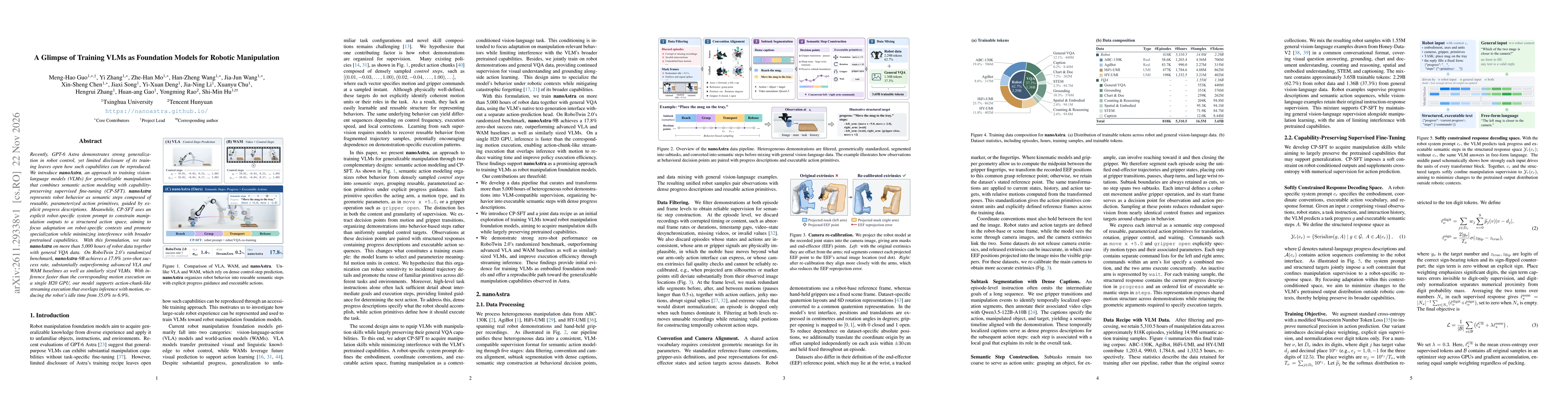
Recently, GPT-6 Astra demonstrates strong generalization in robot control, yet limited disclosure of its training leaves open how such capabilities can be reproduced. We introduce nanoAstra, an approach to training vision-language models (VLMs) for generalizable manipulation that combines semantic action modeling with capability-preserving supervised fine-tuning (CP-SFT). nanoAstra represents robot behavior as semantic steps composed of reusable, parameterized action primitives, guided by explicit progress descriptions. Meanwhile, CP-SFT uses an explicit robot-specific system prompt to constrain manipulation outputs to a structured action space, aiming to focus adaptation on robot-specific contexts and promote specialization while minimizing interference with broader pretrained capabilities. With this formulation, we train nanoAstra on more than 5,000 hours of robot data together with general VQA data. On RoboTwin 2.0's randomized benchmark, nanoAstra-9B achieves a 17.8% zero-shot success rate, substantially outperforming advanced VLA and WAM baselines as well as similarly sized VLMs. With inference faster than the corresponding motion execution on a single H20 GPU, our model supports action-chunk-like streaming execution that overlaps inference with motion, reducing the robot's idle time from 35.0% to 6.9%.
RUIBench: What Makes a Good Robot-Use Interface?
Yanzhe Chen, Zhijun Cao, Zechen Bai +8 more · Nov 23, 2026
Foundation models can reason about complex physical tasks, yet translating this intelligence into reliable robot execution remains challenging. We argue that a critical, often overlooked factor is the robot-use interface (RUI), which determines how agents express and execute physical actions. To systematically study its impact, we introduce RUIBench, comprising 30 manipulation tasks across five suites spanning world knowledge, in-context learning, discovery, dynamic interaction, and contact-rich manipulation. We further develop RUIKit, a unified framework that crosses six action abstractions with two interaction forms, yielding 13 interfaces under shared perception and control. In simulation, changing only the RUI shifts a frontier agent's success rate from 45% to 81%, and that of a fine-tuned 4B model from 13% to 47%. Our analysis reveals that effective interfaces reduce unnecessary decisions while preserving essential feedback, with their benefits shaped by agent behavior and physical uncertainty. We further uncover a verification gap, where agents frequently declare success despite observable failures, revealing the need for task-level verification beyond individual actions. Together, these findings establish RUI design as a critical factor in embodied agent reliability.
GameAnything: From Any Inspirations to Playable Game Worlds
Wenyi Wu, Siqi Liu, Yuru Feng +5 more · Nov 22, 2026
AI-driven game development holds the potential to transform diverse human inspirations into interactive experiences. However, existing systems and benchmarks primarily focus on explicit development specifications, with limited support for adapting multimodal references and evaluating actual gameplay experiences. We introduce GameAnything, an open-source agentic platform that transforms multimodal inspirations into playable extensions of existing games through iterative development. GameAnything integrates coding agents with an independent playtesting critic, persistent development state, and reusable experience memory to support continuous refinement. We further present GameAnything-Bench, a benchmark spanning diverse reference modalities, game creation objectives, and gaming environments, with exploratory gameplay testing to assess both functional correctness and gameplay quality. Evaluations of nine coding agent configurations reveal that current agents can adapt reference content but still struggle with playable interactions and precise modifications. Moreover, multimodal references improve content fidelity, while iterative refinement yields substantial but varying improvements across agents. These findings highlight both the potential and remaining challenges of inspiration-driven game development.
UUBench: Understanding the Unspoken toward Full-Duplex Multimodal Interaction
Ye Pan, Chenfei Liao, Bin Ren +17 more · Nov 23, 2026
Effective real-time, full-duplex multimodal interaction requires systems to understand not only what users say, but also the communicative needs conveyed through prosody, facial expressions, gestures, and context, and to generate audiovisual responses that appropriately address those needs. Existing evaluations offer limited insight into whether systems translate an understanding of such unspoken needs into effective responses. We introduce UUBench, a benchmark for assessing how well multimodal interactive systems Understand the Unspoken intent and address users' implicit communicative needs. The inherent subjectivity of implicit intent inference poses a key challenge for evaluation. To address this, we introduce Process-Oriented Scoring, which grounds the assessment of intent fulfillment in observable auditory and visual cues, such as prosody and gestures. Rather than relying solely on a single overall score, it evaluates how well a response addresses the communicative needs conveyed by each applicable primitive dimension. We aggregate the dimension-level scores according to each dimension's relevance to the annotated evidence. Beyond intent fulfillment, Outcome-Oriented Scoring evaluates the naturalness, appropriateness, and human-likeness of the reply itself under audio-only, visual-only, and audiovisual conditions. To make these judgments traceable to observable evidence, we propose a Fact-Grounded Scoring JEV module, which uses structured, timestamped audiovisual observations of the user and the digital human's reply to assess one dimension or criterion at a time. UUBench provides a foundation for assessing whether multimodal interactive systems respond effectively to meaning beyond literal wording, supporting progress toward context-aware, real-time, full-duplex interaction.
Polytropos: What Do Vision-Language Model Descriptions Make of a Cultural Object?
Yuechen Jiang, Enze Zhang, Yuyan Wang +7 more · Nov 22, 2026
Vision-language models have become a new kind of describer, writing about almost anything people see, and their descriptions now shape how cultures are known by people and by other models. Descriptions of cultures tend to turn particular things into types, and what a description loses shows what its describer lacks. We introduce Polytropos, a benchmark that measures what model descriptions of cultural objects keep of the particular object by turning each description back into an image and comparing it with the original photograph. On 374 objects from the Metropolitan Museum of Art and the Getty, with 1,870 descriptions from five models and 230 written by curators, reconstructions are recognised as the recorded culture more often than the photographs, at 54.55% to 59.09% against 52.14%, yet 16% to 21% of objects change outcome and only 0.49% of reconstructions are identified as the specific object. On the same objects, models lose recorded cultures at a rate similar to curators but gain more. Model descriptions give each object many faces, each typical of its culture and almost none the object itself.
WeMM-Ecom: Advancing Multimodal Content Understanding for WeChat E-Commerce
Binhui Xie, Jinmin Li, Haomiao Tang +5 more · Nov 23, 2026
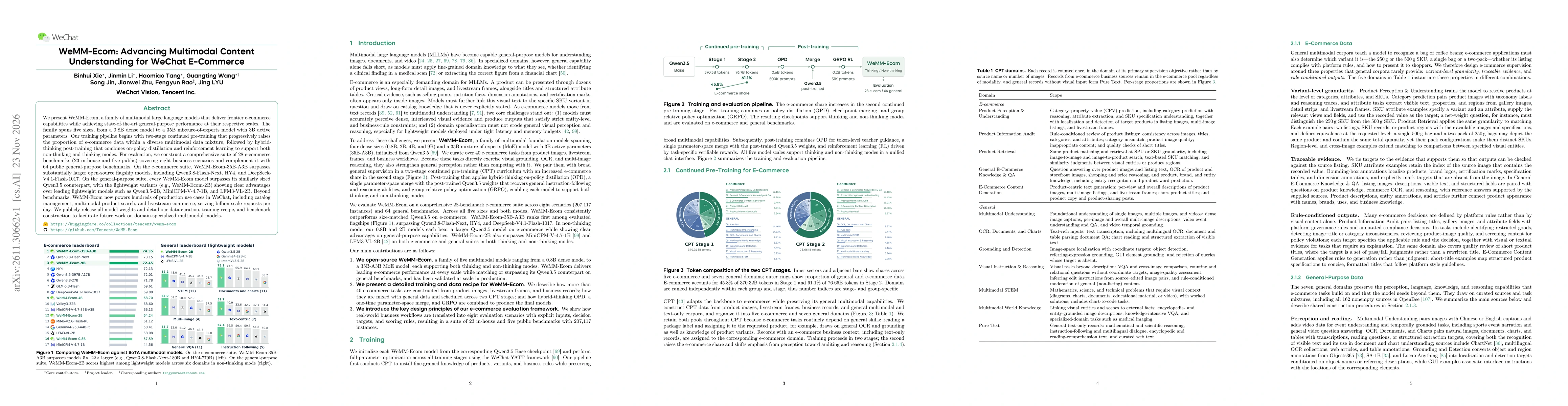
We present WeMM-Ecom, a family of multimodal large language models that deliver frontier e-commerce capabilities while achieving state-of-the-art general-purpose performance at their respective scales. The family spans five sizes, from a 0.8B dense model to a 35B mixture-of-experts model with 3B active parameters. Our training pipeline begins with two-stage continued pre-training that progressively raises the proportion of e-commerce data within a diverse multimodal data mixture, followed by hybrid-thinking post-training that combines on-policy distillation and reinforcement learning to support both non-thinking and thinking modes. For evaluation, we construct a comprehensive suite of 28 e-commerce benchmarks (23 in-house and five open-source) covering eight business scenarios and complement it with 64 public general-purpose benchmarks. On the e-commerce suite, WeMM-Ecom-35B-A3B surpasses substantially larger open-source flagship models, including Qwen3.8-Flash-Next, HY4, and DeepSeek-V4.1-Flash. On the general-purpose suite, every WeMM-Ecom model surpasses its similarly sized Qwen3.5 counterpart, with the lightweight variants (e.g., WeMM-Ecom-2B) showing clear advantages over leading lightweight models such as Qwen3.5-2B, MiniCPM-V-4.7-1B, and LFM3-VL-2B. Beyond benchmarks, WeMM-Ecom now powers hundreds of production use cases in WeChat, including catalog management, multimodal product search, and livestream commerce, serving billion-scale requests per day. We publicly release all model weights and detail our data curation, training recipe, and benchmark construction to facilitate future work on domain-specialized multimodal models. We have released the model weights and code to facilitate future research at https://github.com/Tencent/WeMM-Ecom.
Self-WSP: Can Language Models Improve Themselves Through Weight-Space Programming?
Guoming Ling, Shanshan Zhong, Kaixuan Zhang +1 more · Nov 21, 2026
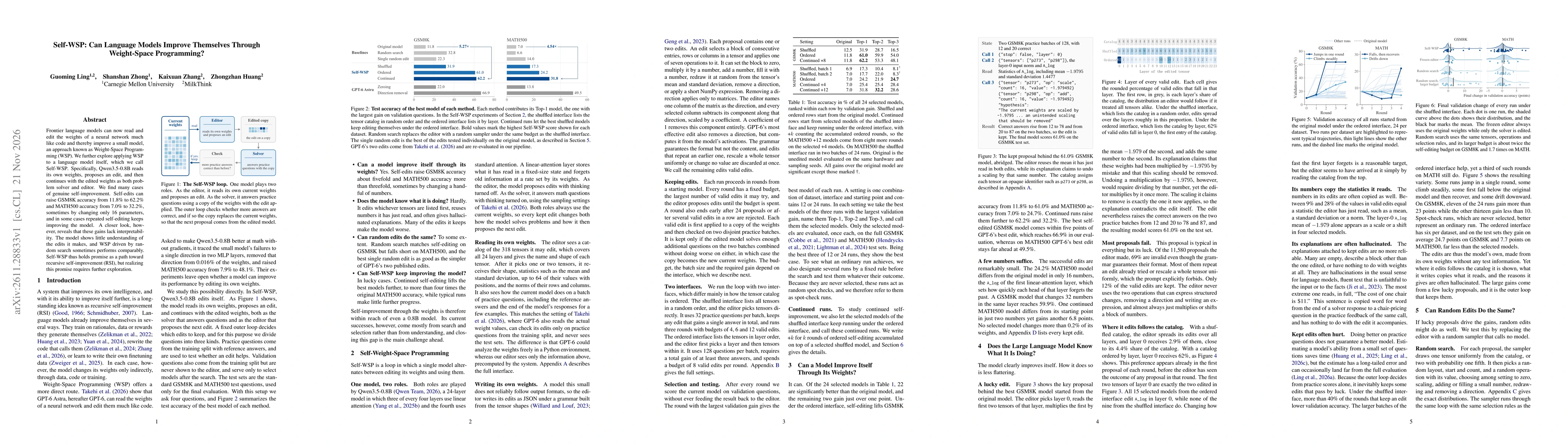
Frontier language models can now read and edit the weights of a neural network much like code and thereby improve a small model, an approach known as Weight-Space Programming (WSP). We further explore applying WSP to a language model itself, which we call Self-WSP. Specifically, Qwen3.5-0.8B reads its own weights, proposes an edit, and then continues with the edited weights as both problem solver and editor. We find many cases of genuine self-improvement. Self-edits can raise GSM8K accuracy from 11.8% to 62.2% and MATH500 accuracy from 7.0% to 32.2%, sometimes by changing only 16 parameters, and in some cases repeated self-editing keeps improving the model. A closer look, however, reveals that these gains lack interpretability. The model shows little understanding of the edits it makes, and WSP driven by random search sometimes performs comparably. Self-WSP thus holds promise as a path toward recursive self-improvement (RSI), but realizing this promise requires further exploration.
WeightCode: Installing New Capabilities into Neural Networks via Weight-Space Programming
Bo Li, Taoyong Cui, Bob Zhang +8 more · Nov 19, 2026
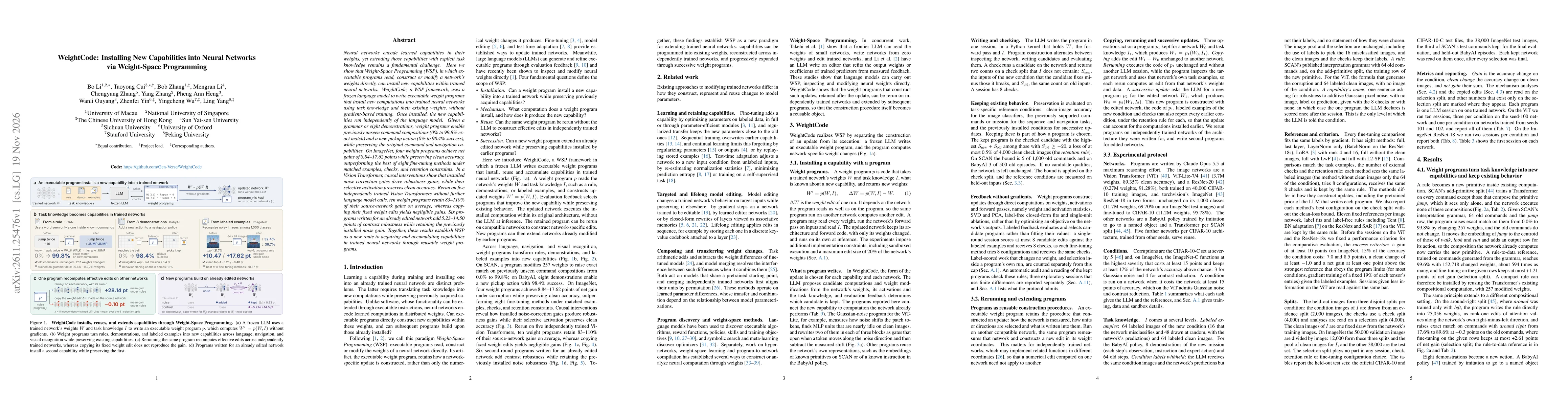
Neural networks encode learned capabilities in their weights, yet extending those capabilities with explicit task knowledge remains a fundamental challenge. Here we show that Weight-Space Programming (WSP), in which executable programs read, construct or modify a network's weights directly, can install new capabilities within trained neural networks. WeightCode, a WSP framework, uses a frozen language model to write executable weight programs that install new computations into trained neural networks using task knowledge and their existing weights, without gradient-based training. Once installed, the new capabilities run independently of the language model. Given a grammar or eight demonstrations, weight programs enable previously unseen command compositions (0% to 99.8% exact match) and a new pickup action (0% to 98.4% success), while preserving the original command and navigation capabilities. On ImageNet, four weight programs achieve net gains of 8.84-17.62 points while preserving clean accuracy, outperforming the best of eight fine-tuning methods under matched examples, checks, and retention constraints. In a Vision Transformer, causal interventions show that installed noise-correction gates drive robustness gains, while their selective activation preserves clean accuracy. Rerun on five independently trained Vision Transformers without further language model calls, ten weight programs retain 83-110% of their source-network gains on average, whereas copying their fixed weight edits yields negligible gains. Six programs written for an already edited network add 5.23-14.50 points of contrast robustness while retaining the previously installed noise gain. Together, these results establish WSP as a new route to acquiring and accumulating capabilities in trained neural networks through reusable weight programs.
Composable Soft-Prompt Distillation of RL Experts: Toward Continual Post-Training
Zhen Zhang, Changyi Yang, Xuehai He +25 more · Nov 20, 2026
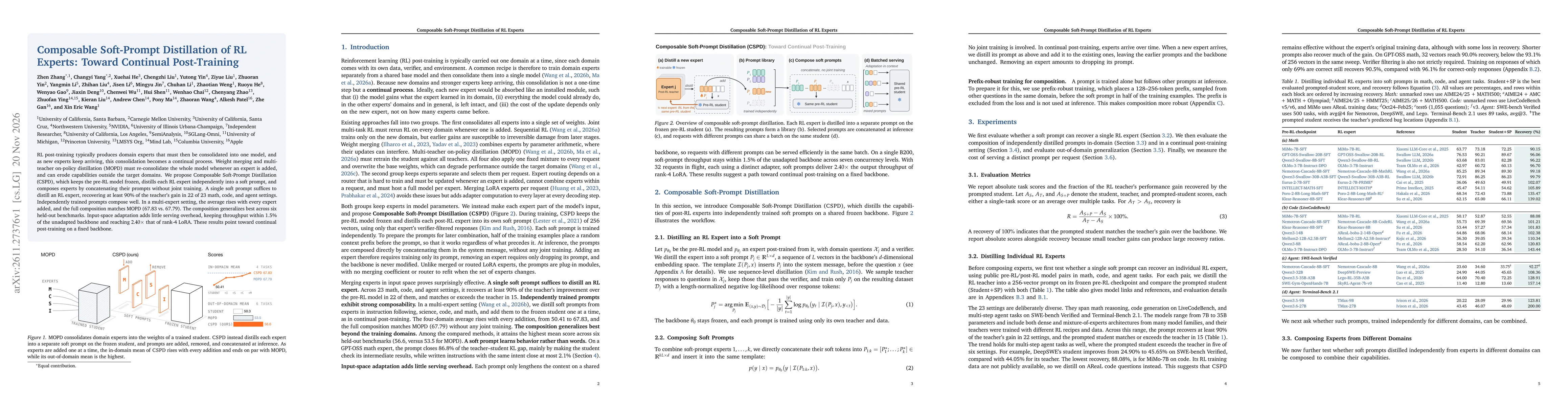
RL post-training typically produces domain experts that must then be consolidated into one model, and as new experts keep arriving, this consolidation becomes a continual process. Weight merging and multi-teacher on-policy distillation (MOPD) must re-consolidate the whole model whenever an expert is added, and can erode capabilities outside the target domains. We propose Composable Soft-Prompt Distillation (CSPD), which keeps the pre-RL model frozen, distills each RL expert independently into a soft prompt, and composes experts by concatenating their prompts without joint training. A single soft prompt suffices to distill an RL expert, recovering at least 90% of the teacher's gain in 22 of 23 math, code, and agent settings. Independently trained prompts compose well. In a multi-expert setting, the average rises with every expert added, and the full composition matches MOPD (67.83 vs. 67.79). The composition generalizes best across six held-out benchmarks. Input-space adaptation adds little serving overhead, keeping throughput within 1.5% of the unadapted backbone and reaching 2.40x that of rank-4 LoRA. These results point toward continual post-training on a fixed backbone.
HIVE-Bench: Evaluating Patch-Level Visual Representations for Egocentric Robot Manipulation
Qiwei Liang, Zhengtu Liang, Minghao Lai +13 more · Nov 23, 2026
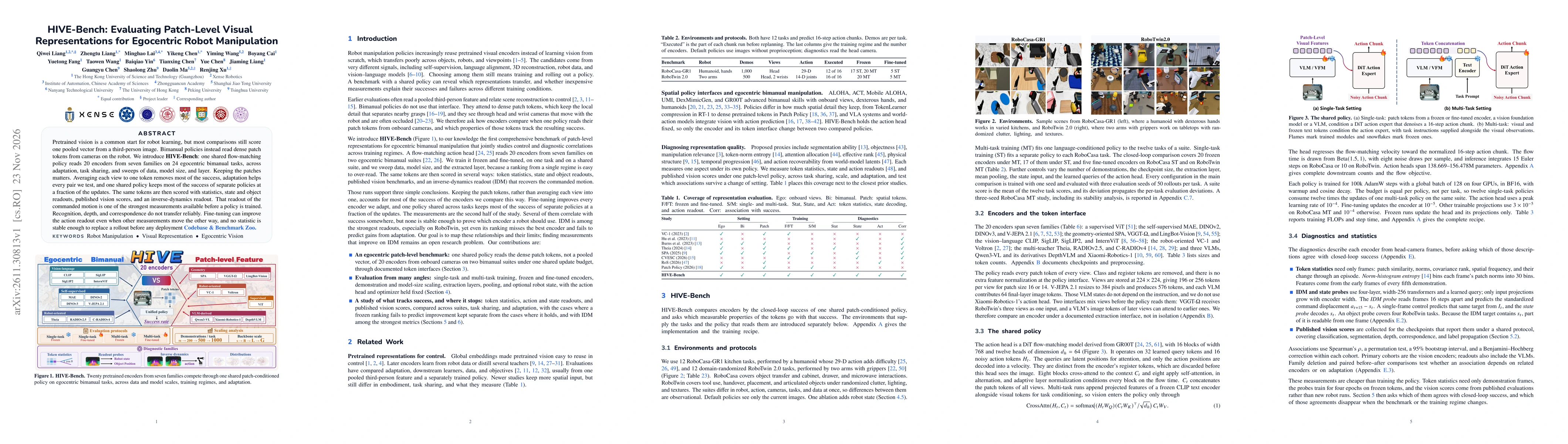
Pretrained vision is a common start for robot learning, but most comparisons still score one pooled vector from a third-person image. Bimanual policies instead read dense patch tokens from cameras on the robot. We introduce HIVE-Bench: one shared flow-matching policy reads 20 encoders from seven families on 24 egocentric bimanual tasks, across adaptation, task sharing, and sweeps of data, model size, and layer. Keeping the patches matters. Averaging each view to one token removes most of the success, adaptation helps every pair we test, and one shared policy keeps most of the success of separate policies at a fraction of the updates. The same tokens are then scored with statistics, state and object readouts, published vision scores, and an inverse-dynamics readout. That readout of the commanded motion is one of the strongest measurements available before a policy is trained. Recognition, depth, and correspondence do not transfer reliably. Fine-tuning can improve the action readout even when other measurements move the other way, and no statistic is stable enough to replace a rollout before any deployment.
Distilling Visual Agents from Limited Interaction Experience
Siyu Zhou, Jing Jiang, Chengqi Zhang +1 more · Nov 21, 2026
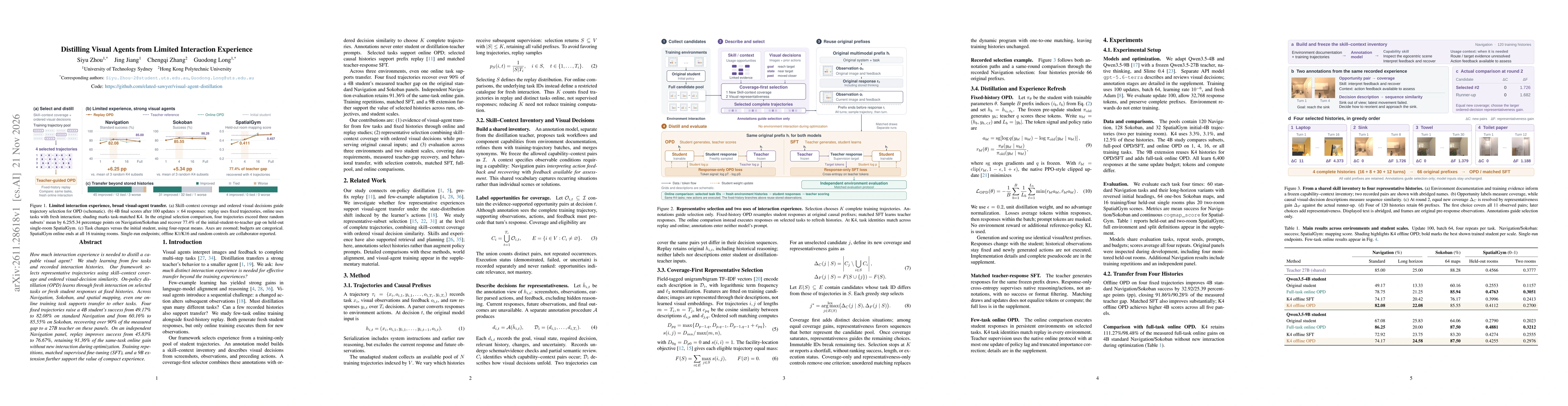
How much interaction experience is needed to distill a capable visual agent? We study learning from few tasks and recorded interaction histories. Our framework selects representative trajectories using skill-context coverage and ordered visual-decision similarity. On-policy distillation (OPD) learns through fresh interaction on selected tasks or fresh student responses at fixed histories. Across Navigation, Sokoban, and spatial mapping, even one online training task supports transfer to other tasks. Four fixed trajectories raise a 4B student's success from 49.17% to 82.08% on standard Navigation and from 60.16% to 85.55% on Sokoban, recovering over 90% of the measured gap to a 27B teacher on these panels. On an independent Navigation panel, replay improves success from 45.83% to 76.67%, retaining 91.36% of the same-task online gain without new interaction during optimization. Training repetitions, matched supervised fine-tuning (SFT), and a 9B extension further support the value of compact experience.
Embodied-Harness: Towards Recursive Self-Improvement for Robotic Manipulation
Zhenxuan Fan, Zhuoya Wang, Yuqian Yuan +5 more · Nov 23, 2026
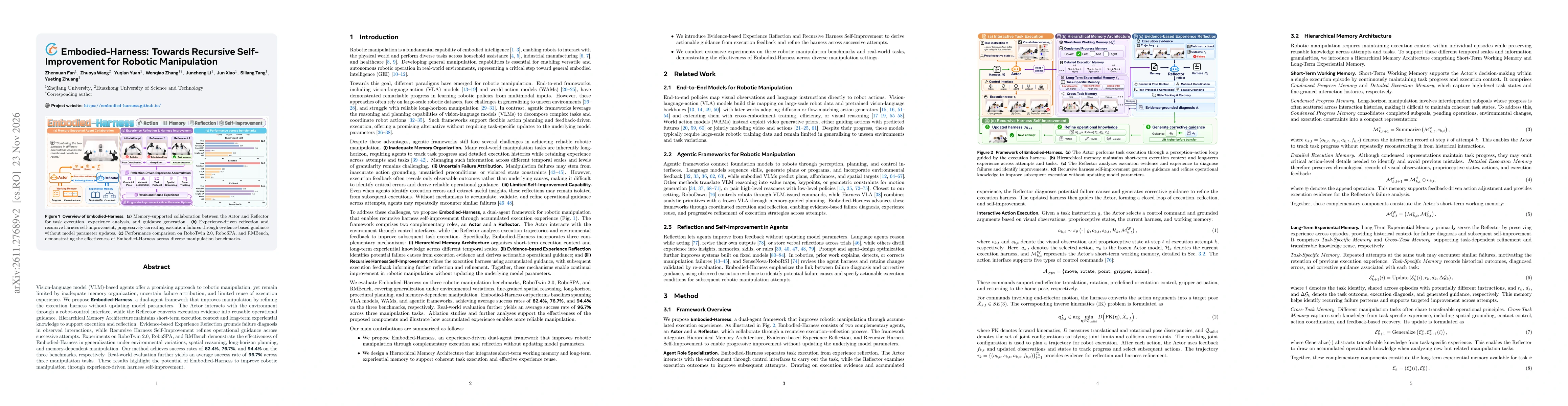
Vision-language model (VLM)-based agents offer a promising approach to robotic manipulation, yet remain limited by inadequate memory organization, uncertain failure attribution, and limited reuse of execution experience. We propose Embodied-Harness, a dual-agent framework that improves manipulation by refining the execution harness without updating model parameters. The Actor interacts with the environment through a robot-control interface, while the Reflector converts execution evidence into reusable operational guidance. Hierarchical Memory Architecture maintains short-term execution context and long-term experiential knowledge to support execution and reflection. Evidence-based Experience Reflection grounds failure diagnosis in observed interactions, while Recursive Harness Self-Improvement refines operational guidance across successive attempts. Experiments on RoboTwin 2.0, RoboSPA, and RMBench demonstrate the effectiveness of Embodied-Harness in generalization under environmental variations, spatial reasoning, long-horizon planning, and memory-dependent manipulation. Our method achieves success rates of 82.4%, 76.7%, and 94.4% on the three benchmarks, respectively. Real-world evaluation further yields an average success rate of 96.7% across three manipulation tasks. These results highlight the potential of Embodied-Harness to improve robotic manipulation through experience-driven harness self-improvement.
What Makes Good Data for Training Coding Agents? A Systematic Study on SWE-Gym
Yikai Zhang, Mai Xu, Yunbei Zhang +9 more · Nov 23, 2026
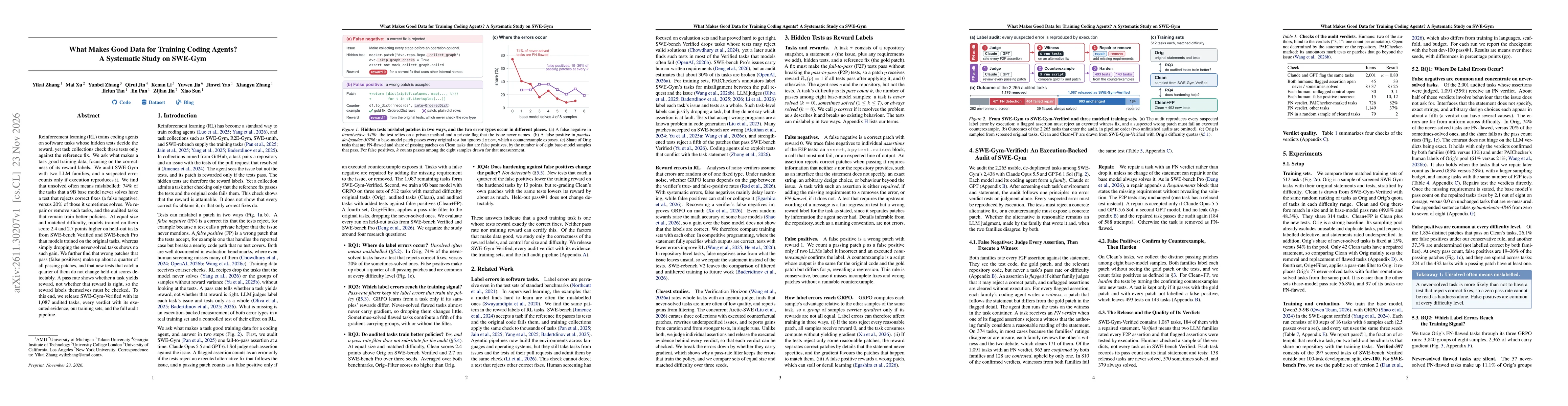
Reinforcement learning (RL) trains coding agents on software tasks whose hidden tests decide the reward, yet task collections check these tests only against the reference fix. We ask what makes a task good training data, focusing on the correctness of its reward labels. We audit SWE-Gym with two LLM families, and a suspected error counts only if execution reproduces it. We find that unsolved often means mislabelled: 74% of the tasks that a 9B base model never solves have a test that rejects correct fixes (a false negative), versus 20% of those it sometimes solves. We repair or remove such tasks, and the audited tasks that remain train better policies. At equal size and matched difficulty, models trained on them score 2.4 and 2.7 points higher on held-out tasks from SWE-bench Verified and SWE-bench Pro than models trained on the original tasks, whereas simply dropping the never-solved tasks shows no such gain. We further find that wrong patches that pass (false positives) make up about a quarter of all passing patches, and that new tests that catch a quarter of them do not change held-out scores detectably. A pass rate shows whether a task yields reward, not whether that reward is right, so the reward labels themselves must be checked. To this end, we release SWE-Gym-Verified with its 1,087 audited tasks, every verdict with its executed evidence, our training sets, and the full audit pipeline.