Trending on arXiv
Today's most upvoted papers on arXiv
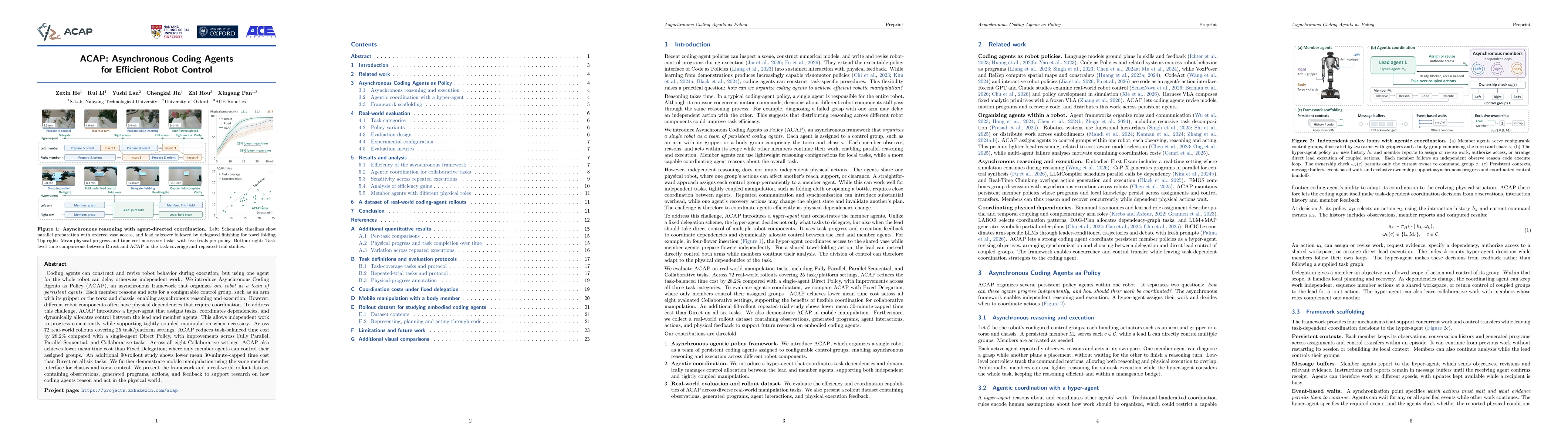
ACAP: Asynchronous Coding Agents for Efficient Robot Control
Zexin He, Rui Li, Yushi Lan +3 more · Nov 23, 2026
Coding agents can construct and revise robot behavior during execution, but using one agent for the whole robot can delay otherwise independent work. We introduce Asynchronous Coding Agents as Policy (ACAP), an asynchronous framework that organizes one robot as a team of persistent agents. Each member reasons and acts for a configurable control group, such as an arm with its gripper or the torso and chassis, enabling asynchronous reasoning and execution. However, different robot components often have physical dependencies that require coordination. To address this challenge, ACAP introduces a hyper-agent that assigns tasks, coordinates dependencies, and dynamically allocates control between the lead and member agents. This allows independent work to progress concurrently while supporting tightly coupled manipulation when necessary. Across 72 real-world rollouts covering 25 task/platform settings, ACAP reduces task-balanced time cost by 28.2% compared with a single-agent Direct Policy, with improvements across Fully Parallel, Parallel-Sequential, and Collaborative tasks. Across all eight Collaborative settings, ACAP also achieves lower mean time cost than Fixed Delegation, where only member agents can control their assigned groups. An additional 90-rollout study shows lower mean 30-minute-capped time cost than Direct on all six tasks. We further demonstrate mobile manipulation using the same member interface for chassis and torso control. We present the framework and a real-world rollout dataset containing observations, generated programs, actions, and feedback to support research on how coding agents reason and act in the physical world.
Rewirable Circuits in Transformers with Loom Attention
Da Xiao, Qingye Meng, Shengping Li +1 more · Nov 23, 2026
We propose loom attention, which allows a Transformer to dynamically rewire its circuits at every token by interweaving a head's vertical attention over the outputs of earlier heads (to obtain its query, key and value) with its horizontal attention over tokens. We instantiate vertical attention efficiently with normalized and gated linear attention over a per-token matrix memory, which stores the compressed head outputs and serves as a second residual stream. This yields LoomFormer, a dual-stream architecture that splits control and content between the vector and matrix streams. Across model sizes and training token budgets in language modeling and downstream tasks, LoomFormer matches Transformers trained with over 3x compute and recent residual-stream baselines (HC/mHC, MUDDFormer, AttnRes) trained with ~1.7-2.8x. For example, trained on the same 300B tokens with only 2% extra FLOPs, LoomPythia-2.8B achieves ~1.6x the average downstream gain of mHC-Pythia-2.8B over Pythia-2.8B, and matches (0-shot) or surpasses (5-shot) Pythia-12B. Code is available at https://github.com/Caiyun-AI/LoomFormer
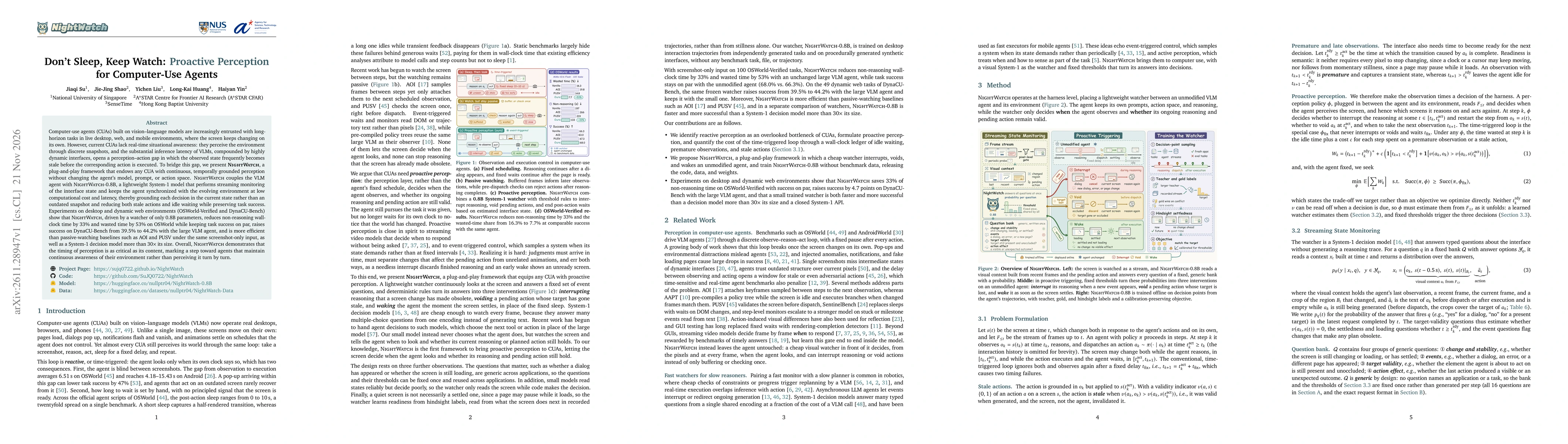
Don't Sleep, Keep Watch: Proactive Perception for Computer-Use Agents
Jiaqi Su, Jie-Jing Shao, Yichen Liu +2 more · Nov 21, 2026
Computer-use agents (CUAs) built on vision-language models are increasingly entrusted with long-horizon tasks in live desktop, web, and mobile environments, where the screen keeps changing on its own. However, current CUAs lack real-time situational awareness: they perceive the environment through discrete snapshots, and the substantial inference latency of VLMs, compounded by highly dynamic interfaces, opens a perception-action gap in which the observed state frequently becomes stale before the corresponding action is executed. To bridge this gap, we present NightWatch, a plug-and-play framework that endows any CUA with continuous, temporally grounded perception without changing the agent's model, prompt, or action space. NightWatch couples the VLM agent with NightWatch-0.8B, a lightweight System-1 model that performs streaming monitoring of the interface state and keeps the agent synchronized with the evolving environment at low computational cost and latency, thereby grounding each decision in the current state rather than an outdated snapshot and reducing both stale actions and idle waiting while preserving task success. Experiments on desktop and dynamic web environments (OSWorld-Verified and DynaCU-Bench) show that NightWatch, driven by a watcher of only 0.8B parameters, reduces non-reasoning wall-clock time by 33% and wasted time by 53% on OSWorld while keeping task success on par, raises success on DynaCU-Bench from 39.5% to 44.2% with the large VLM agent, and is more efficient than passive-watching baselines such as AOI and PUSV under the same screenshot-only input, as well as a System-1 decision model more than 30times its size. Overall, NightWatch demonstrates that the timing of perception is as critical as its content, marking a step toward agents that maintain continuous awareness of their environment rather than perceiving it turn by turn.
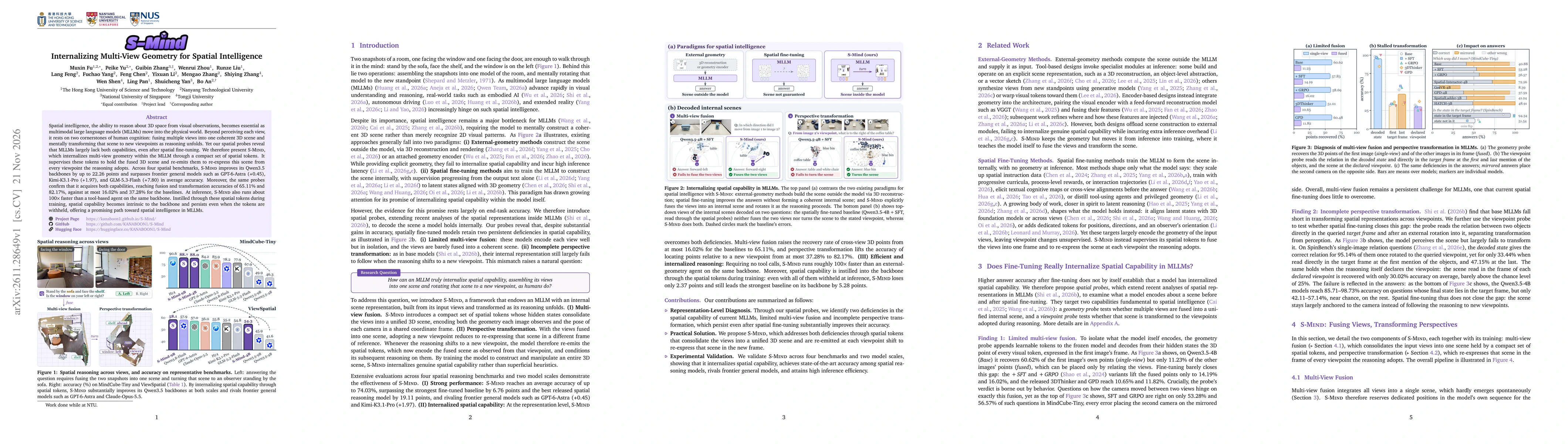
S-Mind: Internalizing Multi-View Geometry for Spatial Intelligence
Muxin Fu, Peike Yu, Guibin Zhang +12 more · Nov 21, 2026
Spatial intelligence, the ability to reason about 3D space from visual observations, becomes essential as multimodal large language models (MLLMs) move into the physical world. Beyond perceiving each view, it rests on two cornerstones of human cognition: fusing multiple views into one coherent 3D scene and mentally transforming that scene to new viewpoints as reasoning unfolds. Yet our spatial probes reveal that MLLMs largely lack both capabilities, even after spatial fine-tuning. We therefore present S-Mind, which internalizes multi-view geometry within the MLLM through a compact set of spatial tokens. It supervises these tokens to hold the fused 3D scene and re-emits them to re-express this scene from every viewpoint the reasoning adopts. Across four spatial benchmarks, S-Mind improves its Qwen3.5 backbones by up to 22.26 points and surpasses frontier general models such as GPT-6-Astra (+0.45), Kimi-K3.1-Pro (+1.97), and GLM-5.3-Flash (+7.80) in average accuracy. Moreover, the same probes confirm that it acquires both capabilities, reaching fusion and transformation accuracies of 65.11% and 82.17%, against at most 16.02% and 37.28% for the baselines. At inference, S-Mind also runs about 100x faster than a tool-based agent on the same backbone. Instilled through these spatial tokens during training, spatial capability becomes intrinsic to the backbone and persists even when the tokens are withheld, offering a promising path toward spatial intelligence in MLLMs.
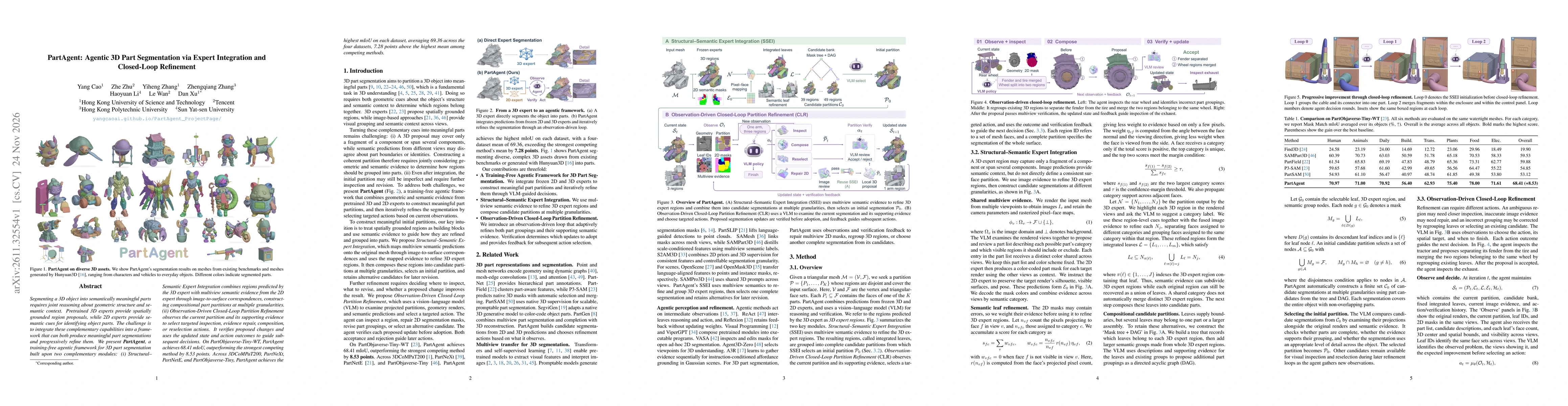
PartAgent: Agentic 3D Part Segmentation via Expert Integration and Closed-Loop Refinement
Yang Cao, Zhe Zhu, Yiheng Zhang +4 more · Nov 24, 2026
Segmenting a 3D object into semantically meaningful parts requires joint reasoning about geometric structure and semantic context. Pretrained 3D experts provide spatially grounded region proposals, while 2D experts provide semantic cues for identifying object parts. The challenge is to integrate these complementary capabilities into a framework that can both produce meaningful part segmentations and progressively refine them. We present PartAgent, a training-free agentic framework for 3D part segmentation built upon two complementary modules: (i) Structural-Semantic Expert Integration combines regions predicted by the 3D expert with multiview semantic evidence from the 2D expert through image-to-surface correspondences, constructing compositional part partitions at multiple granularities. (ii) Observation-Driven Closed-Loop Partition Refinement observes the current partition and its supporting evidence to select targeted inspection, evidence repair, composition, or reselection actions. It verifies proposed changes and uses the updated state and action outcomes to guide subsequent decisions. On PartObjaverse-Tiny-WT, PartAgent achieves 68.41 mIoU, outperforming the strongest competing method by 8.53 points. Across 3DCoMPaT200, PartNeXt, PartNetE, and PartObjaverse-Tiny, PartAgent achieves the highest mIoU on each dataset, averaging 69.36 across the four datasets, 7.28 points above the highest mean among competing methods.
Self-Evolving Evaluation Environments for Computer-Use Agents
Wenhao Wang, Panrong Tong, Quyu Kong +5 more · Nov 23, 2026
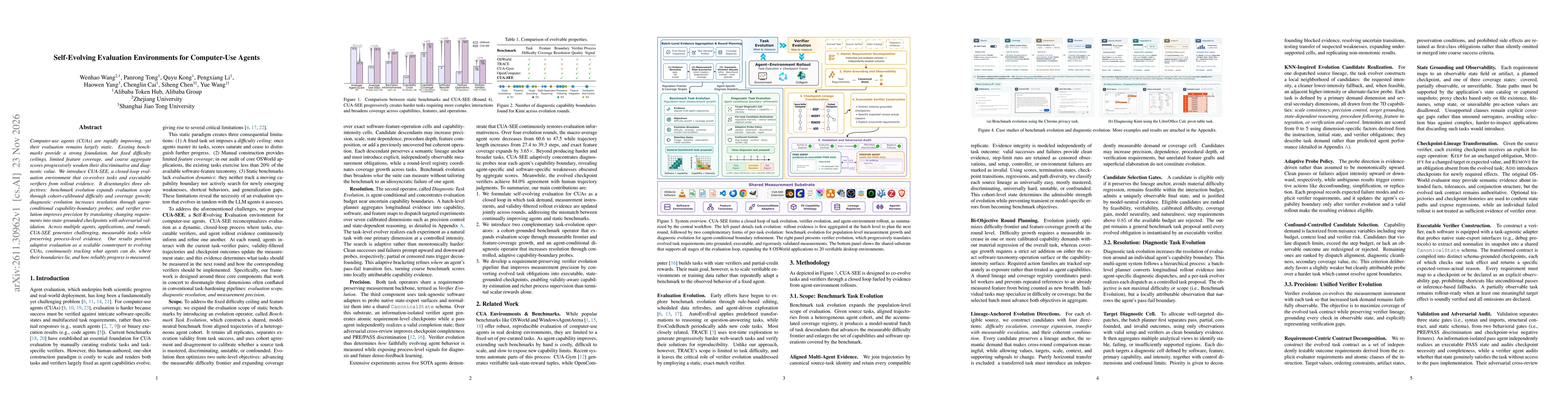
Computer-use agents (CUAs) are rapidly improving, yet their evaluation remains largely static. Existing benchmarks provide a strong foundation, but fixed difficulty ceilings, limited feature coverage, and coarse aggregate scores progressively weaken their discriminative and diagnostic value. We introduce CUA-SEE, a closed-loop evaluation environment that co-evolves tasks and executable verifiers from rollout evidence. It disentangles three objectives: benchmark evolution expands evaluation scope through cohort-calibrated difficulty and coverage growth; diagnostic evolution increases resolution through agent-conditional capability-boundary probes; and verifier evolution improves precision by translating changing requirements into state-grounded checkpoints with adversarial validation. Across multiple agents, applications, and rounds, CUA-SEE generates challenging, measurable tasks while preserving process-level evidence. Our results position adaptive evaluation as a scalable counterpart to self-evolving agents, continuously tracking what agents can do, where their boundaries lie, and how reliably progress is measured.
Lazy Agents Answer Against Their Own Beliefs: Reinforcement Learning with Verifiable Beliefs Teaches Them to Act on What They Believe
Richmond Sin Jing Xuan, Peilin Feng, Wenbin Wang +1 more · Nov 24, 2026
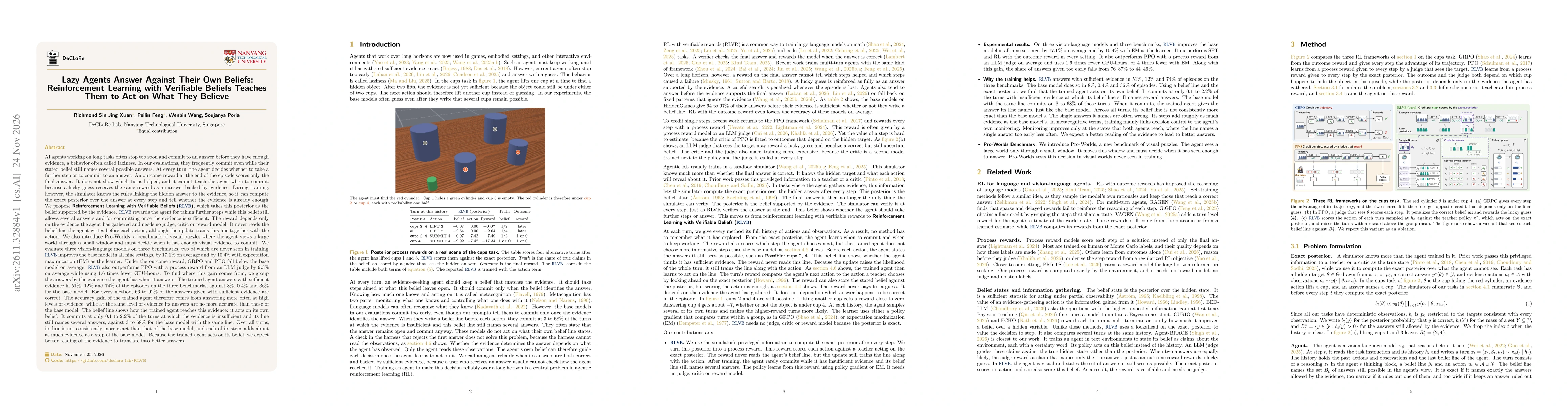
AI agents working on long tasks often commit to an answer before they have enough evidence, a behavior called laziness. In our evaluations, they frequently commit even while their stated belief still names several possible answers. An outcome reward at the end of the episode scores only the final answer, so it cannot teach the agent when to commit, because a lucky guess receives the same reward as an answer backed by evidence. During training, however, the simulator can compute the exact posterior over the answer at every step and tell whether the evidence is already enough. We propose Reinforcement Learning with Verifiable Beliefs (RLVB), which rewards the agent for taking further steps while this posterior still allows several answers and for committing once the evidence is sufficient. The reward needs no judge, critic or reward model, and it never reads the belief line the agent writes before each action. We also introduce Pro Worlds, a benchmark of visual puzzles where the agent views a large world through a small window. We evaluate three vision-language models on three benchmarks, two of which are never seen in training. RLVB improves the base model in all nine settings, by 17.1% on average. Under the outcome reward, GRPO and PPO fall below the base model on average. RLVB also outperforms PPO with a process reward from an LLM judge by 9.3% on average while using 1.6 times fewer GPU-hours. The trained agent answers with sufficient evidence in 51%, 12% and 74% of the episodes on the three benchmarks, against 8%, 0.4% and 36% for the base model. Its accuracy gain therefore comes from answering more often at high levels of evidence. The belief line shows how the agent reaches this evidence: it acts on its own belief. It commits at only 0.1 to 2.2% of the turns at which the evidence is insufficient and its line still names several answers, against 3 to 68% for the base model.
LingSante MedGuard Technical Report
LingSante MedGuard Team · Nov 19, 2026
As medical AI is increasingly used for patient consultation and clinical decision support, identifying harmful, non-compliant, or ethically problematic responses is essential for responsible deployment. Assessing these risks requires checking clinical claims against relevant evidence, verifying calculations, and applying medical requirements under their intended conditions. We introduce LingSante MedGuard, a capability-enhanced guardrail that integrates supervision from a medical guardrail teacher model and six specialized medical capability experts into a unified model. The guardrail teacher supervises risk decisions and explanations across medical safety, compliance, and ethics, while the capability experts support medical rule understanding, numerical reasoning, multimodal hallucination detection, agentic safety verification, risk localization, and multimodal entity understanding. We consolidate these sources of supervision through offline supervised fine-tuning on teacher-generated demonstrations, followed by multi-teacher on-policy distillation using feedback on student-generated responses. We further introduce LingSante MedGuardBench, a benchmark comprising 11 risk-detection subsets spanning medical safety, compliance, and ethics. At 4B, 9B, and 27B scales, LingSante MedGuard achieves mean benchmark F1 scores of 82.3%, 82.4%, and 87.4%, respectively. The 4B model also achieves 73.9% mean accuracy across MedHallu and MedHALT-NOTA under retrieval-enabled evaluation. Additional evaluations of the verification components show improvements in evidence-supported consistency, source traceability, and rule-guided rationale quality across model scales. These results support the integration of specialized medical capabilities into a unified guardrail for medical risk assessment and evidence-based medical safety verification.
Embodied AI Fails the Mirror Test: How a Simple Mirror Breaks Robot Policies
Xuanchen Liu, Hejun Zhang, Boxuan Dong +5 more · Nov 24, 2026
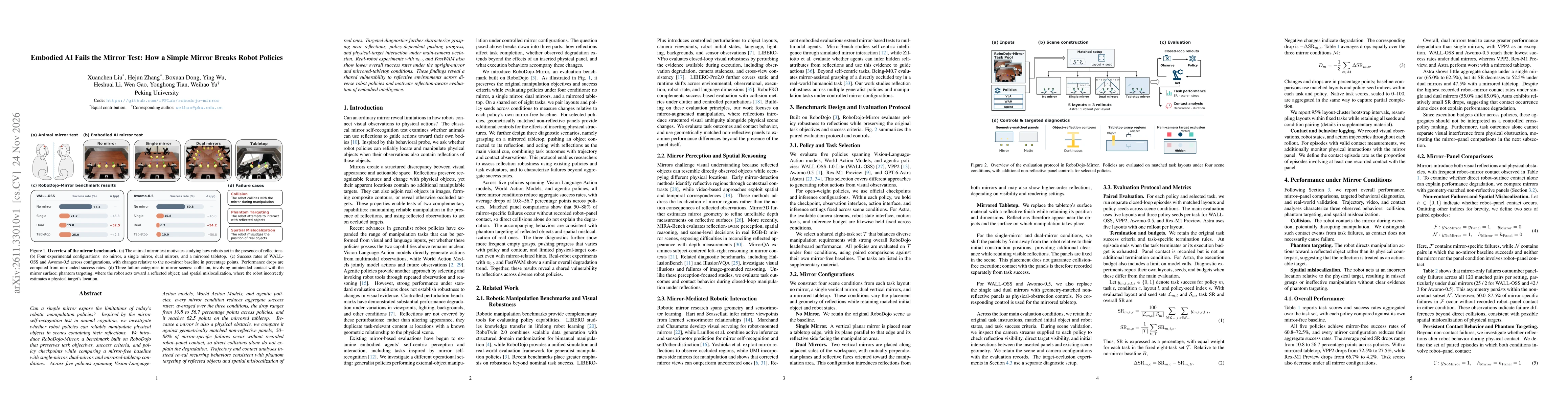
Can a simple mirror expose the limitations of today's robotic manipulation policies? Inspired by the mirror self-recognition test in animal cognition, we investigate whether robot policies can reliably manipulate physical objects in scenes containing their reflections. We introduce RoboDojo-Mirror, a benchmark built on RoboDojo that preserves task objectives, success criteria, and policy checkpoints while comparing a mirror-free baseline with single-mirror, dual-mirror, and mirrored-tabletop conditions. Across five policies spanning Vision-Language-Action models, World Action Models, and agentic policies, every mirror condition reduces aggregate success rates: averaged over the three conditions, the drop ranges from 10.8 to 56.7 percentage points across policies, and it reaches 62.5 points on the mirrored tabletop. Because a mirror is also a physical obstacle, we compare it against geometrically matched non-reflective panels; 50--88\% of mirror-specific failures occur without recorded robot--panel contact, so direct collisions alone do not explain the degradation. Trajectory and contact analyses instead reveal recurring behaviors consistent with phantom targeting of reflected objects and spatial mislocalization of real ones. Targeted diagnostics further characterize grasping near reflections, policy-dependent pushing progress, and physical-target interaction under main-camera occlusion. Real-robot experiments with π_{0.5} and FastWAM also show lower overall success rates under the upright-mirror and mirrored-tabletop conditions. These findings reveal a shared vulnerability to reflective environments across diverse robot policies and motivate reflection-aware evaluation of embodied intelligence. Code is available at https://github.com/iPPLab/robodojo-mirror.
Antom 3-in-1 Transformer: A Payment Foundation Model
Weiyu Han, Haoyu Jiang, Jie Sheng +21 more · Nov 19, 2026
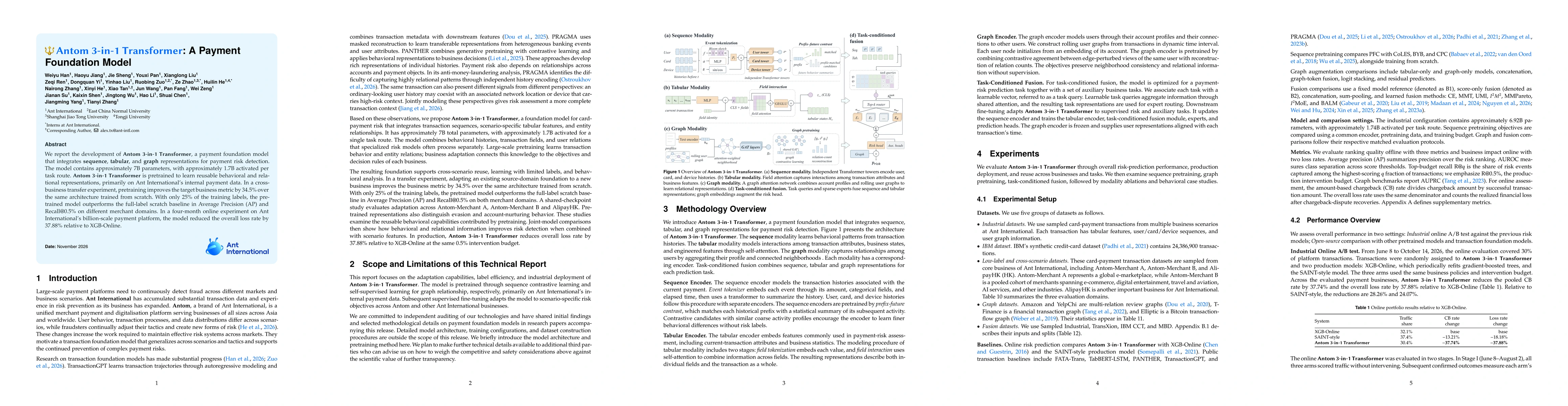
We report the development of Antom 3-in-1 Transformer, a payment foundation model that integrates sequence, tabular, and graph representations for payment risk detection. The model contains approximately 7B parameters, with approximately 1.7B activated per task route. Antom 3-in-1 Transformer is pretrained to learn reusable behavioral and relational representations, primarily on Ant International's internal payment data. In a cross-business transfer experiment, pretraining improves the target business metric by 34.5% over the same architecture trained from scratch. With only 25% of the training labels, the pretrained model outperforms the full-label scratch baseline in Average Precision (AP) and [email protected]% on different merchant domains. In a four-month online experiment on Ant International's billion-scale payment platform, the model reduced the overall loss rate by 37.88% relative to XGB-Online.
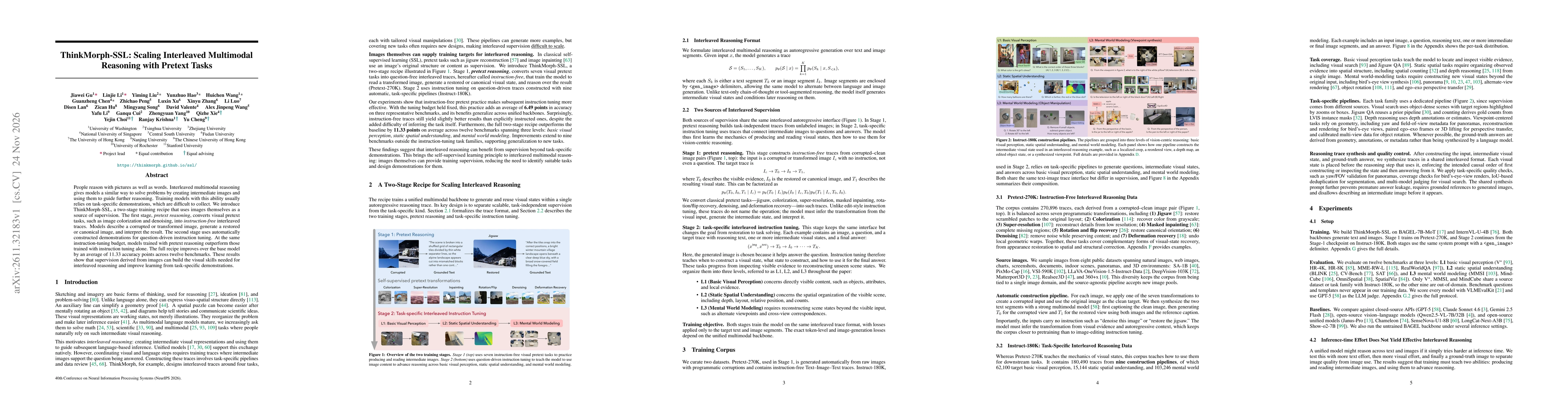
ThinkMorph-SSL: Scaling Interleaved Multimodal Reasoning with Pretext Tasks
Jiawei Gu, Linjie Li, Yiming Liu +19 more · Nov 24, 2026
People reason with pictures as well as words. Interleaved multimodal reasoning gives models a similar way to solve problems by creating intermediate images and using them to guide further reasoning. Training models with this ability usually relies on task-specific demonstrations, which are difficult to collect. We introduce ThinkMorph-SSL, a two-stage training recipe that uses images themselves as a source of supervision. The first stage, pretext reasoning, converts visual pretext tasks, such as image colorization and denoising, into instruction-free interleaved traces. Models describe a corrupted or transformed image, generate a restored or canonical image, and interpret the result. The second stage uses automatically constructed demonstrations for question-driven instruction tuning. At the same instruction-tuning budget, models trained with pretext reasoning outperform those trained with instruction tuning alone. The full recipe improves over the base model by an average of 11.33 accuracy points across twelve benchmarks. These results show that supervision derived from images can build the visual skills needed for interleaved reasoning and improve learning from task-specific demonstrations.
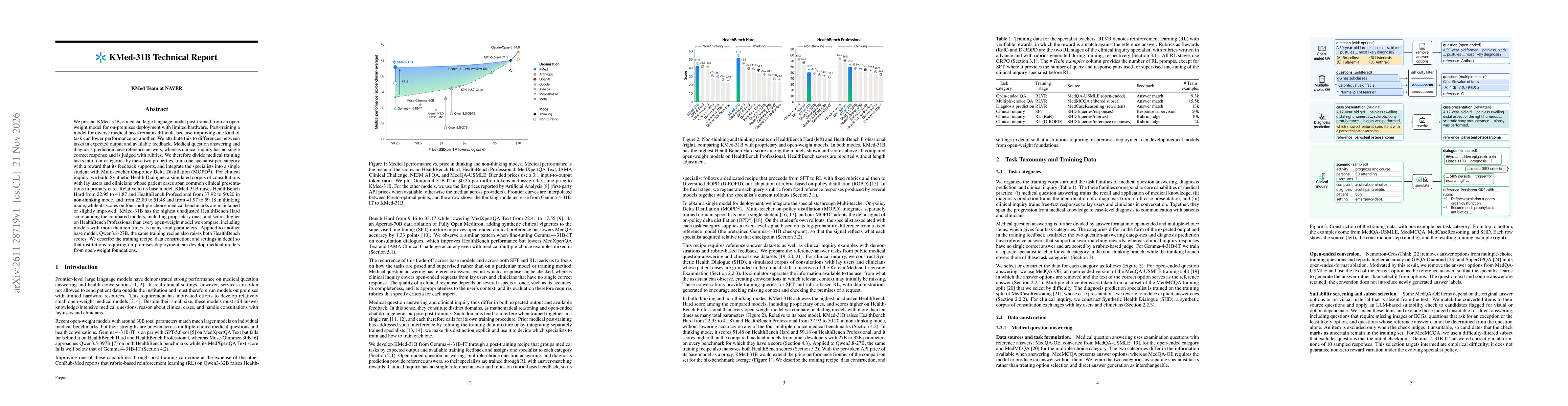
KMed-31B Technical Report
KMed Team · Nov 21, 2026
We present KMed-31B, a medical large language model post-trained from an open-weight model for on-premises deployment with limited hardware. Post-training a model for diverse medical tasks remains difficult, because improving one kind of task can lower performance on another. We attribute this to differences between tasks in expected output and available feedback. Medical question answering and diagnosis prediction have reference answers, whereas clinical inquiry has no single correct response and is judged with rubrics. We therefore divide medical training tasks into four categories by these two properties, train one specialist per category with a reward that its feedback supports, and integrate the specialists into a single student with Multi-teacher On-policy Delta Distillation (MOPD^2). For clinical inquiry, we build Synthetic Health Dialogue, a simulated corpus of consultations with lay users and clinicians whose patient cases span common clinical presentations in primary care. Relative to its base model, KMed-31B raises HealthBench Hard from 22.95 to 41.87 and HealthBench Professional from 37.92 to 50.20 in non-thinking mode, and from 23.80 to 51.48 and from 41.97 to 59.18 in thinking mode, while its scores on four multiple-choice medical benchmarks are maintained or slightly improved. KMed-31B has the highest unadjusted HealthBench Hard score among the compared models, including proprietary ones, and scores higher on HealthBench Professional than every open-weight model we compare, including models with more than ten times as many total parameters. Applied to another base model, Qwen3.8-27B, the same training recipe also raises both HealthBench scores. We describe the training recipe, data construction, and settings in detail so that institutions requiring on-premises deployment can develop medical models from open-weight foundations.
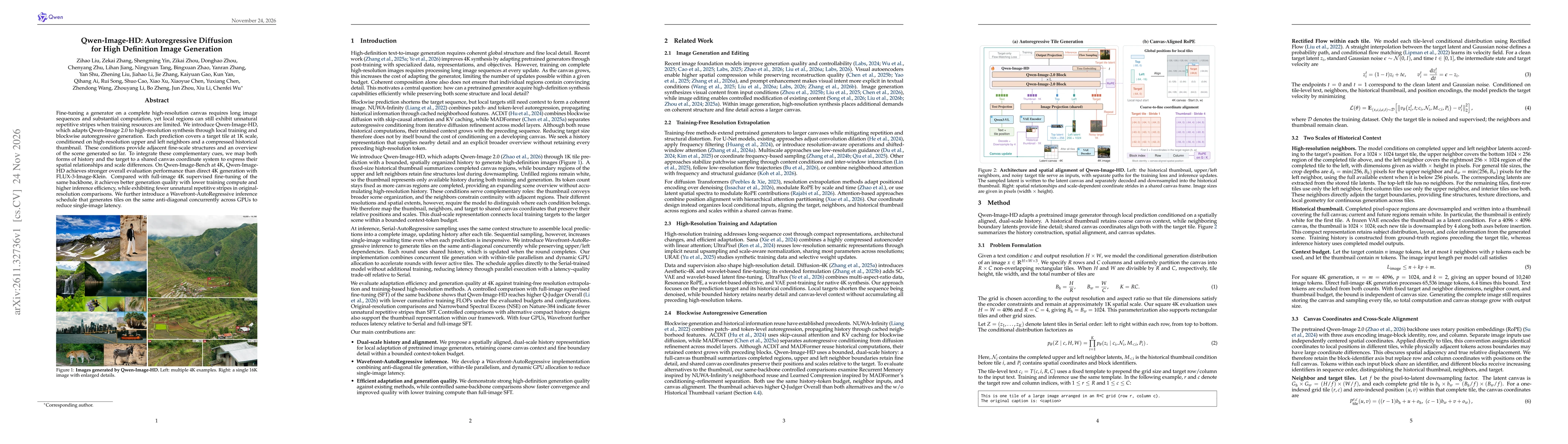
Qwen-Image-HD: Autoregressive Diffusion for High Definition Image Generation
Zihao Liu, Zekai Zhang, Shengming Yin +25 more · Nov 24, 2026
Fine-tuning a generator on a complete high-resolution canvas requires long image sequences and substantial computation, yet local regions can still exhibit unnatural repetitive stripes when training resources are limited. We introduce Qwen-Image-HD, which adapts Qwen-Image 2.0 to high-resolution synthesis through local training and blockwise autoregressive generation. Each prediction covers a target tile at 1K scale, conditioned on high-resolution upper and left neighbors and a compressed historical thumbnail. These conditions provide adjacent fine-scale structures and an overview of the scene generated so far. To integrate these complementary cues, we map both forms of history and the target to a shared canvas coordinate system to express their spatial relationships and scale differences. On Qwen-Image-Bench at 4K, Qwen-Image-HD achieves stronger overall evaluation performance than direct 4K generation with FLUX-3-Image-Klein. Compared with full-image 4K supervised fine-tuning of the same backbone, it achieves better generation quality with lower training compute and higher inference efficiency, while exhibiting fewer unnatural repetitive stripes in original-resolution comparisons. We further introduce a Wavefront-AutoRegressive inference schedule that generates tiles on the same anti-diagonal concurrently across GPUs to reduce single-image latency.
PhyCoVE: Benchmarking Physical Counterfactual Video Editing across Diverse Material Dynamics
Conghan Yue, Yuanjie Chen, Yunyan Xiao +8 more · Nov 22, 2026
Physical counterfactual video editing turns a source video and a language-specified physical edit at a given execution frame into a counterfactual video that shows how the scene would evolve after the edit. Existing evaluations with counterfactual target videos mainly cover object removal or specific rigid-body motions, although real scenes also involve elastic deformation, fluid flow, and interactions among rigid bodies, elastic solids, and fluids. We introduce PhyCoVE, a benchmark of 533 cases on 110 source videos that covers rigid, elastic, and fluid dynamics in five interaction patterns, with edits that remove an object, change a physical quantity, or insert a new object. For the simulated cases, a language model proposes scene designs, coding agents build them with solvers suited to each material and physically based rendering and then simulate each edit from the source scene state, and humans check every stage. For the real cases, we record continuously from one camera position before and after each edit. We also propose counterfactual fidelity, a metric that applies across materials and their interactions and measures how much of the physical change from the source video to the target video a generated video reproduces. We evaluate seven open-source and commercial video editing models and find that counterfactual fidelity ranks them nearly as human preference does, but even the best model reproduces only about one seventh of the physical change. The models change how a scene looks but rarely how it evolves, whereas a physical edit requires understanding the dynamics that it changes. Physical counterfactual video editing thus remains far from solved, and PhyCoVE provides a foundation for developing and evaluating methods for it.
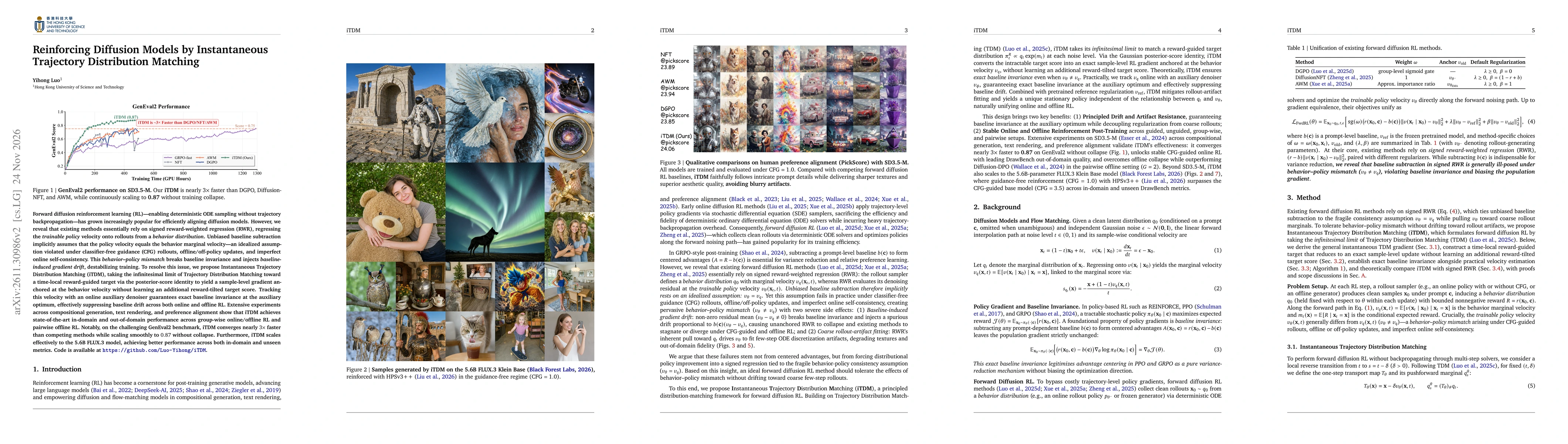
Reinforcing Diffusion Models by Instantaneous Trajectory Distribution Matching
Yihong Luo · Nov 24, 2026
Forward diffusion reinforcement learning (RL)---enabling deterministic ODE sampling without trajectory backpropagation---has grown increasingly popular for efficiently aligning diffusion models. However, we reveal that existing methods essentially rely on signed reward-weighted regression (RWR), regressing the trainable policy velocity onto rollouts from a behavior distribution. Unbiased baseline subtraction implicitly assumes that the policy velocity equals the behavior marginal velocity---an idealized assumption violated under classifier-free guidance (CFG) rollouts, offline/off-policy updates, and imperfect online self-consistency. This behavior--policy mismatch breaks baseline invariance and injects baseline-induced gradient drift, destabilizing training. To resolve this issue, we propose Instantaneous Trajectory Distribution Matching (iTDM), taking the infinitesimal limit of Trajectory Distribution Matching toward a time-local reward-guided target via the posterior-score identity to yield a sample-level gradient anchored at the behavior velocity without learning an additional reward-tilted target score. Tracking this velocity with an online auxiliary denoiser guarantees exact baseline invariance at the auxiliary optimum, effectively suppressing baseline drift across both online and offline RL. Extensive experiments across compositional generation, text rendering, and preference alignment show that iTDM achieves state-of-the-art in-domain and out-of-domain performance across group-wise online/offline RL and pairwise offline RL. Notably, on the challenging GenEval2 benchmark, iTDM converges nearly 3\times faster than competing methods while scaling smoothly to 0.87 without collapse. Furthermore, iTDM scales effectively to the 5.6B FLUX.3 model, achieving better performance across both in-domain and unseen metrics. Code is available at https://github.com/Luo-Yihong/iTDM
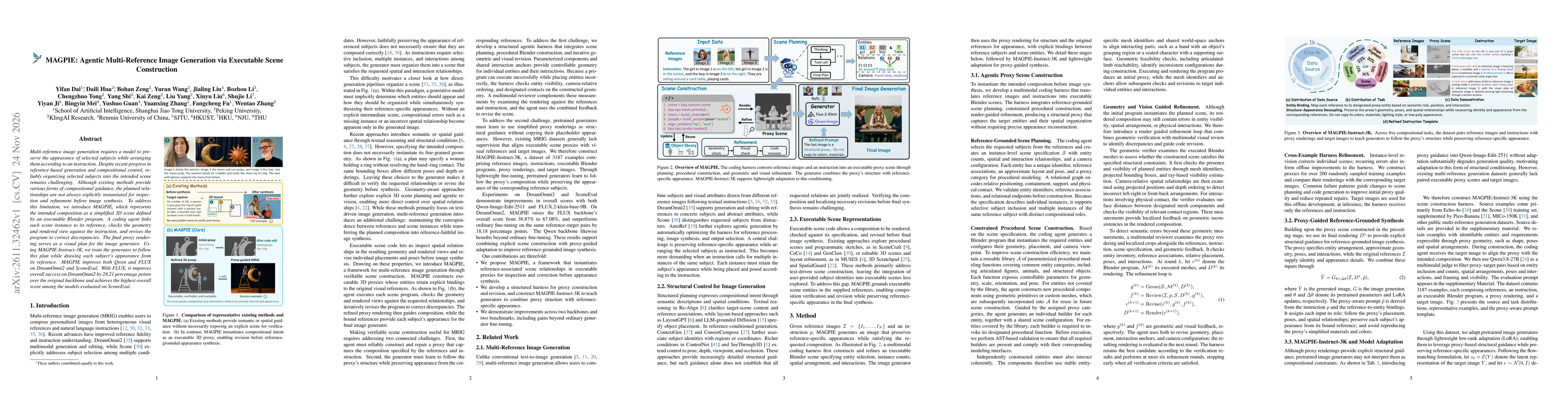
MAGPIE: Agentic Multi-Reference Image Generation via Executable Scene Construction
Yifan Dai, Daili Hua, Bohan Zeng +15 more · Nov 24, 2026
Multi-reference image generation requires a model to preserve the appearance of selected subjects while arranging them according to an instruction. Despite recent progress in reference-based generation and compositional control, reliably organizing selected subjects into the intended scene remains challenging. Although existing methods provide various forms of compositional guidance, the planned relationships are not always explicitly instantiated for inspection and refinement before image synthesis. To address this limitation, we introduce MAGPIE, which represents the intended composition as a simplified 3D scene defined by an executable Blender program. A coding agent links each scene instance to its reference, checks the geometry and rendered view against the instruction, and revises the program to correct discrepancies. The final proxy rendering serves as a visual plan for the image generator. Using MAGPIE-Instruct-3K, we train the generator to follow this plan while drawing each subject's appearance from its reference. MAGPIE improves both Qwen and FLUX on DreamOmni2 and SconeEval. With FLUX, it improves overall success on DreamOmni2 by 28.21 percentage points over the original backbone and achieves the highest overall score among the models evaluated on SconeEval.
LeadVLA: Learning Follower-Aware Route Execution for Robot Leading
Tianle Zeng, Hanjing Ye, Bingyi Xia +5 more · Nov 23, 2026
Robot leading requires executing a route while continuously adapting to a designated follower. Existing robot-leading systems often mediate follower understanding and physical route execution through explicit states, planners, or modular interfaces; directly learning this coupling through end-to-end trajectory prediction can instead entangle route execution with follower response. We introduce LeadVLA, a structured multimodal policy that preserves the route as an explicit Path reference while learning a Pace for route progress and a Residual for local follower- and scene-conditioned adaptation. To make this problem trainable and measurable, we develop LeadInfra, a configurable Unreal Engine-based closed-loop data-generation infrastructure from which we instantiate an approximately 4M-sample training corpus, and LeadBench, a standardized benchmark with 108 fully held-out closed-loop episodes. LeadVLA achieves the highest task success (39.6%) among evaluated robot policies on LeadBench while maintaining strong route fidelity and follower responsiveness, and transfers to unseen real-world environments without real-world policy fine-tuning. Project Page: https://louiszengCN.github.io/LeadVLA_PAGE/
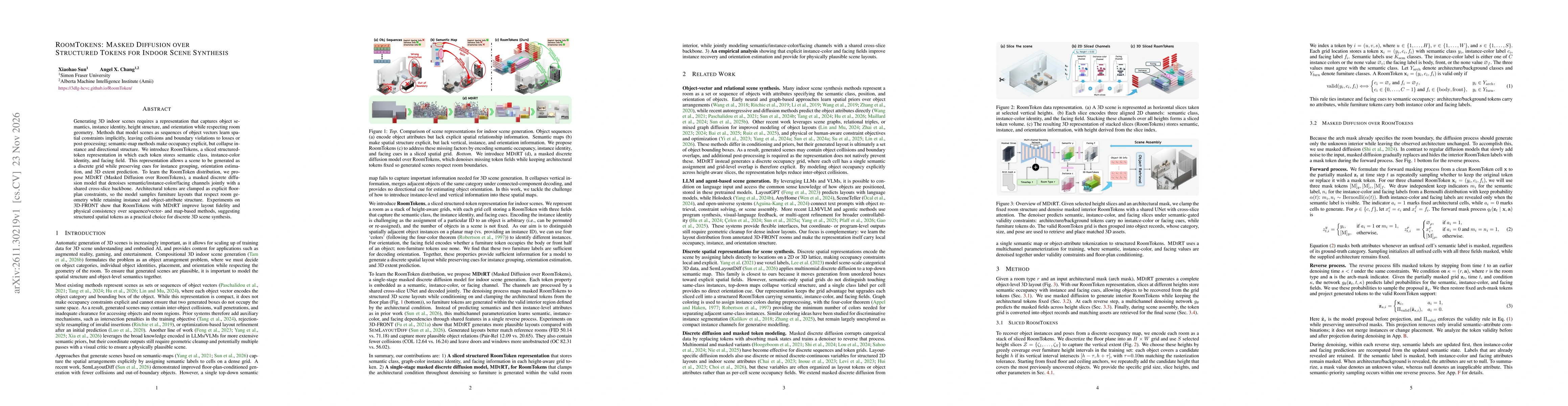
RoomTokens: Masked Diffusion over Structured Tokens for Indoor Scene Synthesis
Xiaohao Sun, Angel X. Chang · Nov 23, 2026
Generating 3D indoor scenes requires a representation that captures object semantics, instance identity, height structure, and orientation while respecting room geometry. Methods that model scenes as sequences of object vectors learn spatial constraints implicitly, leaving collisions and boundary violations to losses or post-processing; semantic-map methods make occupancy explicit, but collapse instance and directional structure. We introduce RoomTokens, a sliced structured-token representation in which each token stores semantic class, instance-color identity, and facing field. This representation allows a scene to be generated as a discrete grid while preserving cues for instance grouping, orientation estimation, and 3D extent prediction. To learn the RoomToken distribution, we propose MDIRT (Masked Diffusion over RoomTokens), a masked discrete diffusion model that denoises semantic/instance-color/facing channels jointly with a shared cross-slice backbone. Architectural tokens are clamped as explicit floor- plan constraints, so the model samples furniture layouts that respect room geometry while retaining instance and object-attribute structure. Experiments on 3D-FRONT show that RoomTokens with MDIRT improve layout fidelity and physical consistency over sequence/vector- and map-based methods, suggesting structured spatial tokens as a practical choice for discrete 3D scene synthesis.
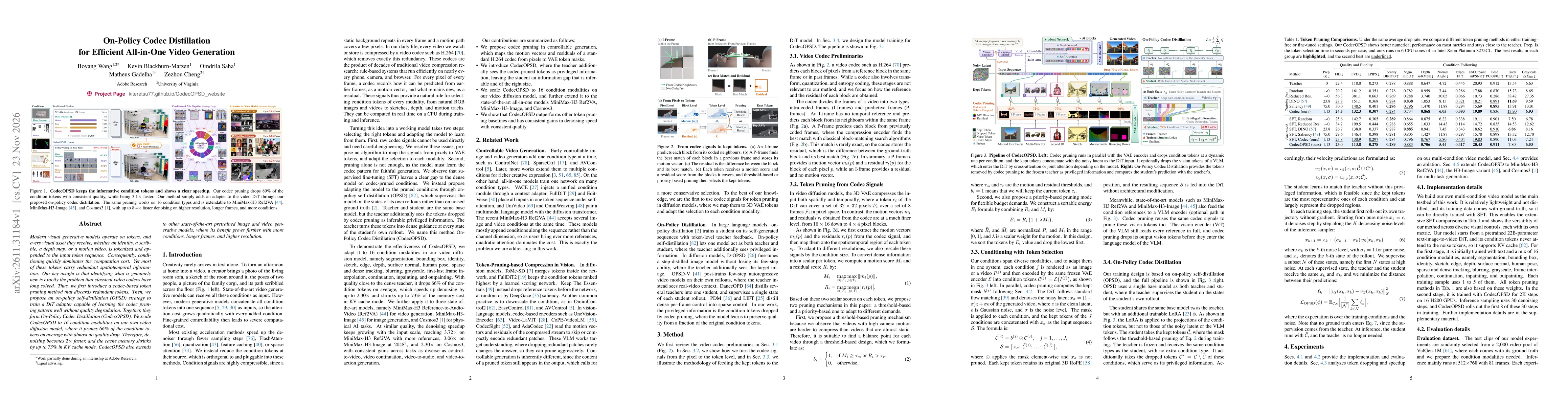
On-Policy Codec Distillation for Efficient All-in-One Video Generation
Boyang Wang, Kevin Blackburn-Matzen, Oindrila Saha +2 more · Nov 23, 2026
Modern visual generative models operate on tokens, and every visual asset they receive, whether an identity, a scribble, a depth map, or a motion video, is tokenized and appended to the input token sequence. Consequently, conditioning quickly dominates the computation cost. Yet most of these tokens carry redundant spatiotemporal information. Our key insight is that identifying what is genuinely new is exactly the problem that classical video codecs have long solved. Thus, we first introduce a codec-based token pruning method that discards redundant tokens. Then, we propose an on-policy self-distillation (OPSD) strategy to train a DiT adapter capable of learning the codec pruning pattern well without quality degradation. Together, they form On-Policy Codec Distillation (CodecOPSD). We scale CodecOPSD to 16 condition modalities on our own video diffusion model, where it prunes 66% of the condition tokens on average with almost no quality drop. Therefore, denoising becomes 2x faster, and the cache memory shrinks by up to 73% in KV cache mode. CodecOPSD also extends to other state-of-the-art pretrained image and video generative models, where its benefit grows further with more conditions, longer frames, and higher resolution.
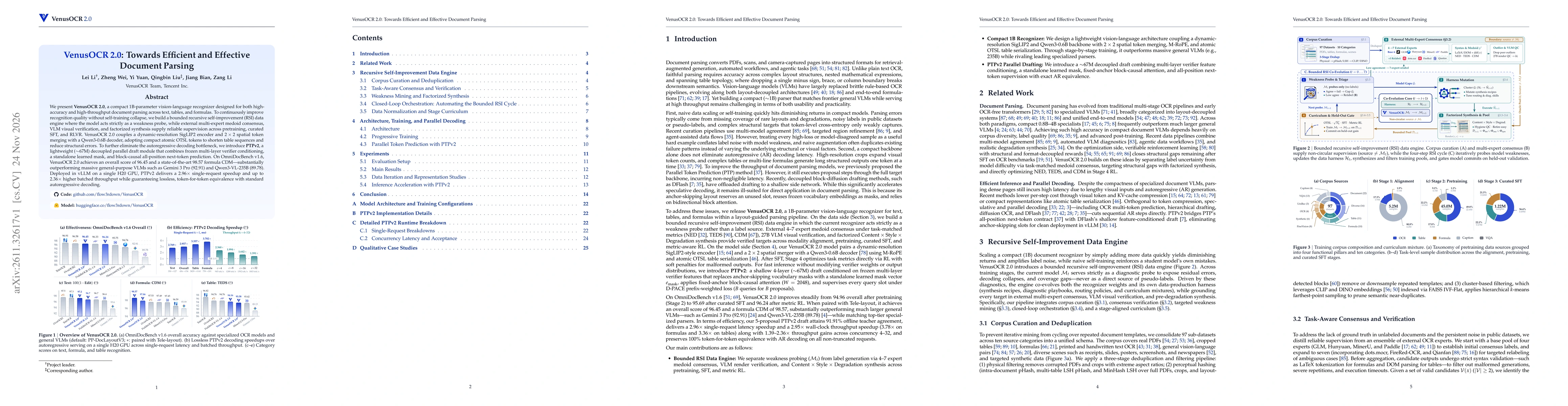
VenusOCR2.0: Towards Efficient and Effective Document Parsing
Lei Li, Zheng Wei, Yi Yuan +3 more · Nov 24, 2026
We present VenusOCR2.0, a compact 1B-parameter vision-language recognizer designed for both high-accuracy and high-throughput document parsing across text, tables, and formulas. To continuously improve recognition quality without self-training collapse, we build a bounded recursive self-improvement (RSI) data engine where the model acts strictly as a weakness probe, while external multi-expert medoid consensus, VLM visual verification, and factorized synthesis supply reliable supervision across pretraining, curated SFT, and RLVR. VenusOCR2.0 couples a dynamic-resolution SigLIP2 encoder and 2x2 spatial token merging with a Qwen3-0.6B decoder, adopting compact atomic OTSL tokens to shorten table sequences and reduce structural errors. To further eliminate the autoregressive decoding bottleneck, we introduce PTPv2, a lightweight (sim67M) decoupled parallel draft module that combines frozen multi-layer verifier conditioning, a standalone learned mask, and block-causal all-position next-token prediction. On OmniDocBenchv1.6, VenusOCR2.0 achieves an overall score of 96.45 and a state-of-the-art 98.57 formula CDM, substantially outperforming massive general-purpose VLMs such as Gemini-3-Pro (92.91) and Qwen3-VL-235B (89.78). Deployed in vLLM on a single H20 GPU, PTPv2 delivers a 2.96x single-request speedup and up to 2.36x higher batched throughput while guaranteeing lossless, token-for-token equivalence with standard autoregressive decoding.