Trending on arXiv
Today's most upvoted papers on arXiv
Residual Guidance for Real-Time Interactive Video Generation
NaHyeon Park, Kyeong-Hwan Moon, Youjin Jeon +1 more · Nov 24, 2026
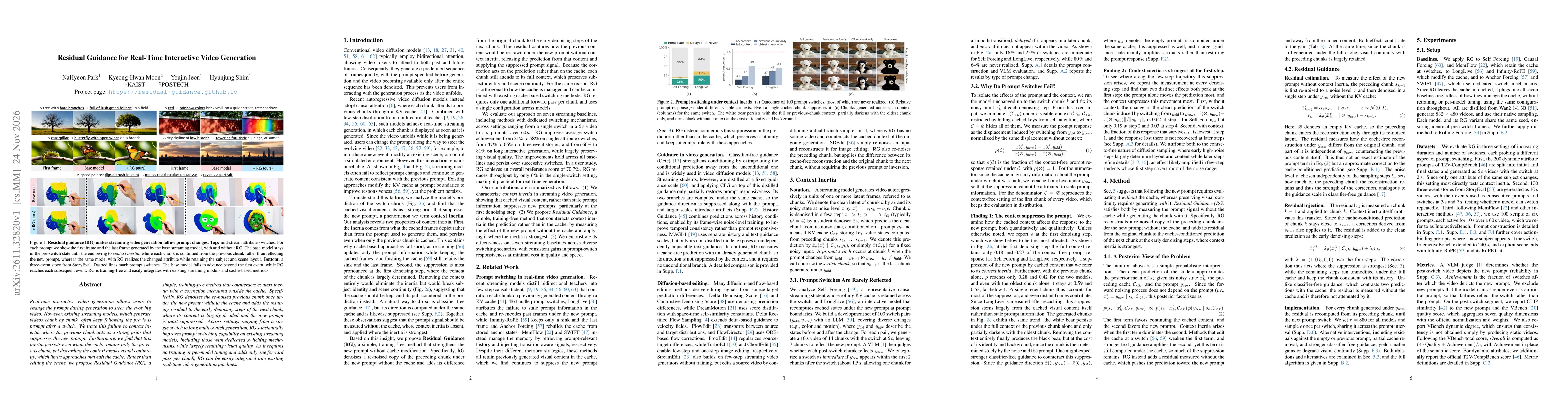
Real-time interactive video generation allows users to change the prompt during generation to steer the evolving video. However, existing streaming models, which generate videos chunk by chunk, often keep following the previous prompt after a switch. We trace this failure to context inertia, where the previous chunk acts as a strong prior that suppresses the new prompt. Furthermore, we find that this inertia persists even when the cache retains only the previous chunk, yet discarding the context breaks visual continuity, which limits approaches that edit the cache. Rather than editing the cache, we propose Residual Guidance (RG), a simple, training-free method that counteracts context inertia with a correction measured outside the cache. Specifically, RG denoises the re-noised previous chunk once under the new prompt without the cache and adds the resulting residual to the early denoising steps of the next chunk, where its content is largely decided and the new prompt is most suppressed. Across settings ranging from a single switch to long multi-switch generation, RG substantially improves prompt switching capability on existing streaming models, including those with dedicated switching mechanisms, while largely retaining visual quality. As it requires no training or per-model tuning and adds only one forward pass per chunk, RG can be easily integrated into existing real-time video generation pipelines.
LoopDVR: Looped Transformer for Efficient Dense Visual Recognition
Sirui Liang, Xuanlong Yu, Longfei Liu +2 more · Nov 24, 2026
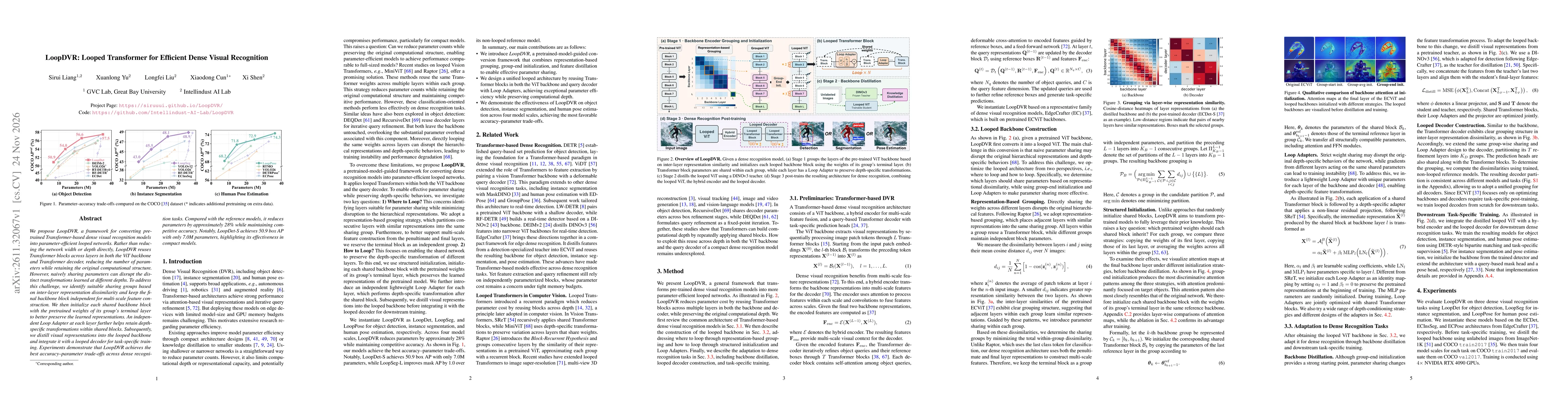
We propose LoopDVR, a framework for converting pretrained Transformer-based dense visual recognition models into parameter-efficient looped networks. Rather than reducing the network width or depth directly, LoopDVR reuses Transformer blocks across layers in both the ViT backbone and Transformer decoder, reducing the number of parameters while retaining the original computational structure. However, naively sharing parameters can disrupt the distinct transformations learned at different depths. To address this challenge, we identify suitable sharing groups based on inter-layer representation dissimilarity and keep the final backbone block independent for multi-scale feature construction. We then initialize each shared backbone block with the pretrained weights of its group's terminal layer to better preserve the learned representations. An independent Loop Adapter at each layer further helps retain depth-specific transformations within shared blocks. Subsequently, we distill visual representations into the looped backbone and integrate it with a looped decoder for task-specific training. Experiments demonstrate that LoopDVR achieves the best accuracy--parameter trade-offs across dense recognition tasks. Compared with the reference models, it reduces parameters by approximately 28% while maintaining competitive accuracy. Notably, LoopDet-S achieves 50.9 box AP with only 7.0M parameters, highlighting its effectiveness in compact models.
PINE: Point, Instance and Normal Estimation in One-Step Diffusion Model
Zeyu Ren, Jie Ni, Rui Qian +4 more · Nov 22, 2026
Understanding a scene requires both geometry and semantics: geometry recovers its spatial structure, and semantics separates it into objects. Current models obtain the two from separate networks or separate passes. We present PINE, a one-step Omni Diffusion Transformer that predicts the point map, the surface normals, and the instance map of an image in one forward pass. PINE treats each map as a token stream, and a stream mask decides which streams interact. A camera-aware ray encoding positions every token by its camera ray rather than its pixel. Grounding attention adds the affinity of pretrained DINOv3 features to the attention logits. Trained on only 139K synthetic images for geometry, PINE achieves state-of-the-art point maps whether or not intrinsics are given and the best average rank on surface normals. It also exceeds SAM on large objects with less than 1 percent of its training images, and it predicts all three maps 5.7x faster than MoGe-3 with SAM.
AdProducer: Towards Agentic Advertising Video Generation
Kunyang Li, Chaoyang Wang, Mubarak Shah +1 more · Nov 23, 2026
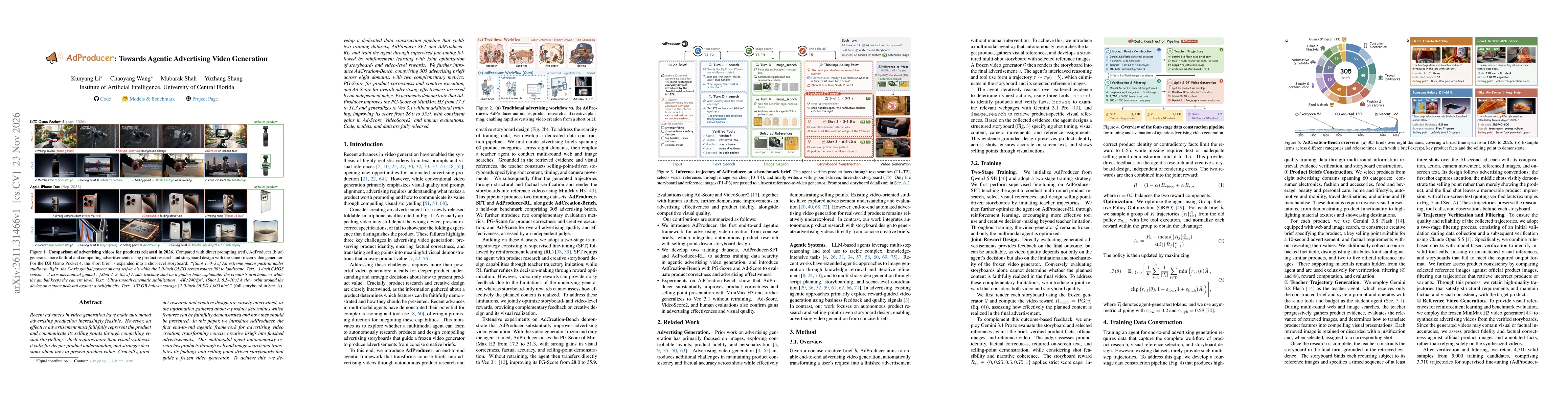
Recent advances in video generation have made automated advertising production increasingly feasible. However, an effective advertisement must faithfully represent the product and communicate its selling points through compelling visual storytelling, which requires more than visual synthesis: it calls for deeper product understanding and strategic decisions about how to present product value. Crucially, product research and creative design are closely intertwined, as the information gathered about a product determines which features can be faithfully demonstrated and how they should be presented. In this paper, we introduce AdProducer, the first end-to-end agentic framework for advertising video creation, transforming concise creative briefs into finished advertisements. Our multimodal agent autonomously researches products through web and image search and translates its findings into selling-point-driven storyboards that guide a frozen video generator. To achieve this, we develop a dedicated data construction pipeline that yields two training datasets, AdProducer-SFT and AdProducer-RL, and train the agent through supervised fine-tuning followed by reinforcement learning with joint optimization of storyboard- and video-level rewards. We further introduce AdCreation-Bench, comprising 305 advertising briefs across eight domains, with two complementary metrics: PG-Score for product correctness and creative execution, and Ad-Score for overall advertising effectiveness assessed by an independent judge. Experiments demonstrate that AdProducer improves the PG-Score of MiniMax H3 from 17.3 to 51.3 and generalizes to Veo 3.1 without additional training, improving its score from 28.0 to 35.9, with consistent gains in Ad-Score, VideoScore2, and human evaluations. Code, models, and data are released.
LoopedWAM: Looped World Action Models for Elastic Inference
Anh Dao, Xinxin Liu, Hang Yu +2 more · Nov 19, 2026
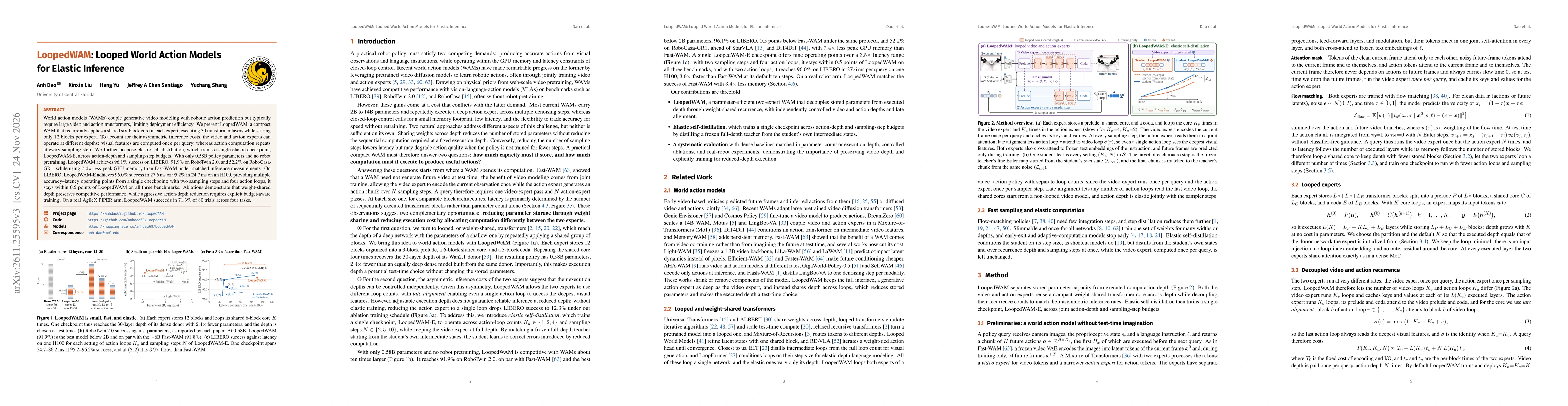
World action models (WAMs) couple generative video modeling with robotic action prediction but typically require large video and action transformers, limiting deployment efficiency. We present LoopedWAM, a compact WAM that recurrently applies a shared six-block core in each expert, executing 30 transformer layers while storing only 12 blocks per expert. To account for their asymmetric inference costs, the video and action experts can operate at different depths: visual features are computed once per query, whereas action computation repeats at every sampling step. We further propose elastic self-distillation, which trains a single elastic checkpoint, LoopedWAM-E, across action-depth and sampling-step budgets. With only 0.58B policy parameters and no robot pretraining, LoopedWAM achieves 96.1% success on LIBERO, 91.9% on RoboTwin 2.0, and 52.2% on RoboCasaGR1, while using 7.4times less peak GPU memory than Fast-WAM under matched inference measurements. On LIBERO, LoopedWAM-E achieves 96.0% success in 27.6 ms or 95.2% in 24.7 ms on an H100, providing multiple accuracy-latency operating points from a single checkpoint; with two sampling steps and four action loops, it stays within 0.5 points of LoopedWAM on all three benchmarks. Ablations demonstrate that weight-shared depth preserves competitive performance, while aggressive action-depth reduction requires explicit budget-aware training. On a real AgileX PiPER arm, LoopedWAM succeeds in 71.3% of 80 trials across four tasks.
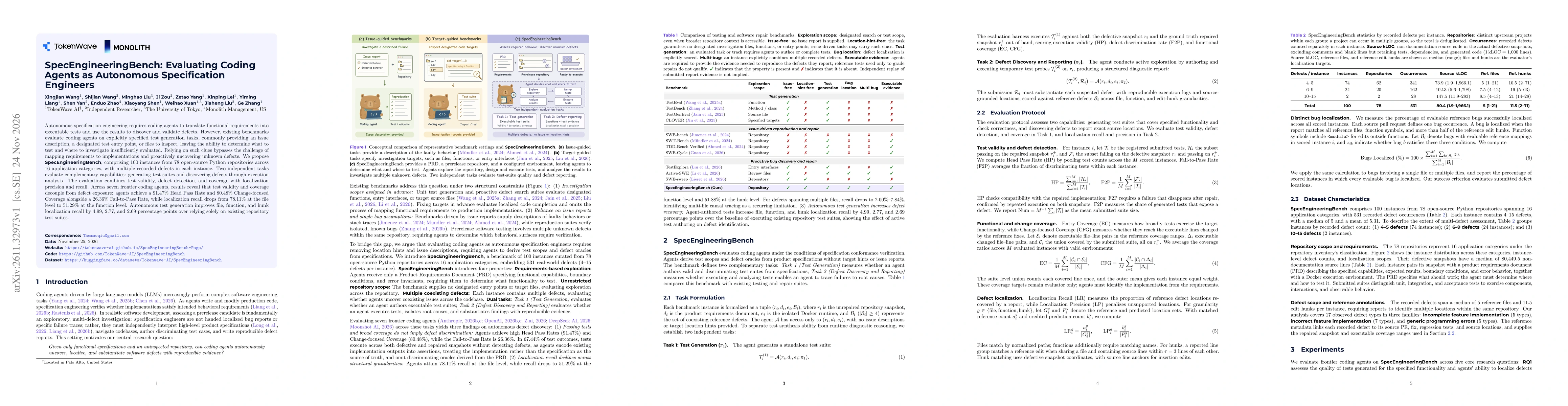
SpecEngineeringBench: Evaluating Coding Agents as Autonomous Specification Engineers
Xingjian Wang, Shijian Wang, Minghao Liu +10 more · Nov 24, 2026
Autonomous specification engineering requires coding agents to translate functional requirements into executable tests and use the results to discover and validate defects. However, existing benchmarks evaluate coding agents on explicitly specified test generation tasks, commonly providing an issue description, a designated test entry point, or files to inspect, leaving the ability to determine what to test and where to investigate insufficiently evaluated. Relying on such clues bypasses the challenge of mapping requirements to implementations and proactively uncovering unknown defects. We propose SpecEngineeringBench, comprising 100 instances from 78 open-source Python repositories across 16 application categories, with multiple recorded defects in each instance. Two independent tasks evaluate complementary capabilities: generating test suites and discovering defects through execution analysis. The evaluation combines test validity, defect detection, and coverage with localization precision and recall. Across seven frontier coding agents, results reveal that test validity and coverage decouple from defect exposure: agents achieve a 91.47% Head Pass Rate and 80.48% Change-focused Coverage alongside a 26.36% Fail-to-Pass Rate, while localization recall drops from 78.11% at the file level to 51.29% at the function level. Autonomous test generation improves file, function, and hunk localization recall by 4.99, 2.77, and 2.69 percentage points over relying solely on existing repository test suites.
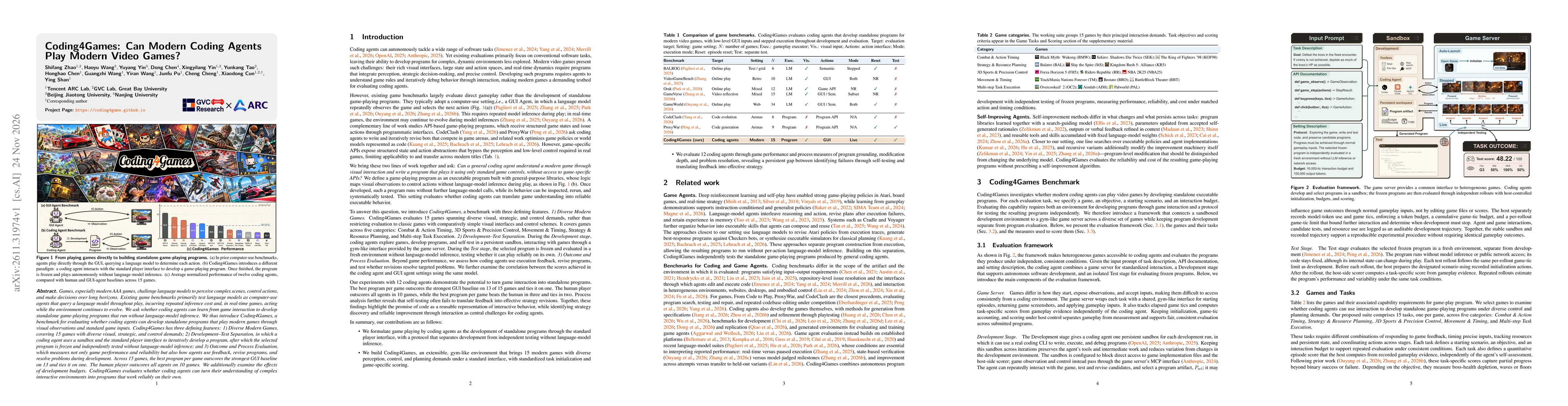
Coding4Games: Can Modern Coding Agents Play Modern Video Games?
Shifang Zhao, Haoyu Wang, Yuyang Yin +10 more · Nov 24, 2026
Games, especially modern AAA games, challenge language models to perceive complex scenes, control actions, and make decisions over long horizons. Existing game benchmarks primarily test language models as computer-use agents that query a language model throughout play, incurring repeated inference cost and, in real-time games, acting while the environment continues to evolve. We ask whether coding agents can learn from game interaction to develop standalone game-playing programs that run without language model inference. We thus introduce Coding4Games, a benchmark for evaluating whether coding agents can develop standalone programs that play modern games through visual observations and standard game inputs. Coding4Games has three defining features: 1) Diverse Modern Games, covering 15 games with diverse visual, strategic, and control demands; 2) Development-Test Separation, in which a coding agent uses a sandbox and the standard player interface to iteratively develop a program, after which the selected program is frozen and independently tested without language-model inference; and 3) Outcome and Process Evaluation, which measures not only game performance and reliability but also how agents use feedback, revise programs, and resolve problems during development. Across 15 games, the best program per game outscores the strongest GUI baseline on 13 and ties it on one. The human player outscores all agents on 10 games. We additionally examine the effects of development budgets. Coding4Games evaluates whether coding agents can turn their understanding of complex interactive environments into programs that work reliably on their own.
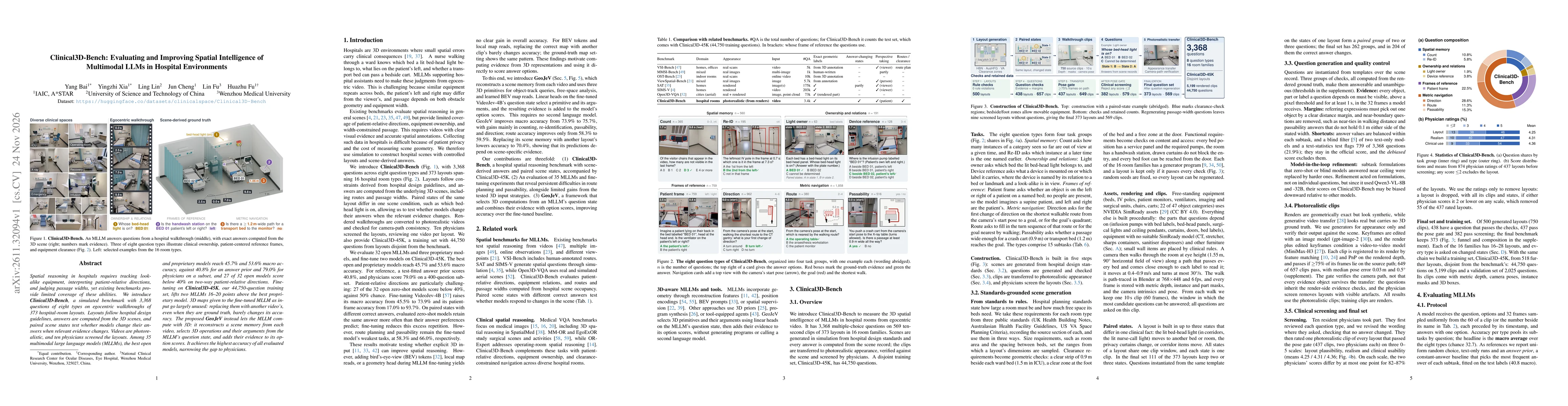
Clinical3D-Bench: Evaluating and Improving Spatial Intelligence of Multimodal LLMs in Hospital Environments
Yang Bai, Yingzhi Xia, Ling Lin +3 more · Nov 24, 2026
Spatial reasoning in hospitals requires tracking look-alike equipment, interpreting patient-relative directions, and judging passage widths, yet existing benchmarks provide limited coverage of these abilities. We introduce Clinical3D-Bench, a simulated benchmark with 3,368 questions of eight types on egocentric walkthroughs of 373 hospital-room layouts. Layouts follow hospital design guidelines, answers are computed from the 3D scenes, and paired scene states test whether models change their answers when relevant evidence changes. Videos are photorealistic, and ten physicians screened the layouts. Among 35 multimodal large language models (MLLMs), the best open and proprietary models reach 45.7% and 53.6% macro accuracy, against 40.8% for an answer prior and 79.0% for physicians on a subset, and 27 of 32 open models score below 40% on two-way patient-relative directions. Fine-tuning on Clinical3D-45K, our 44,750-question training set, lifts two MLLMs 16-20 points above the best proprietary model. 3D maps given to the fine-tuned MLLM as input go largely unused: replacing them with another video's, even when they are ground truth, barely changes its accuracy. The proposed GeoJeV instead lets the MLLM compute with 3D: it reconstructs a scene memory from each video, selects 3D operations and their arguments from the MLLM's question state, and adds their evidence to its option scores. It achieves the highest accuracy of all evaluated models, narrowing the gap to physicians.
Interpretable Prototype-Conditioned Adaptation for Weather Forecasting
Zhixuan Li, Hao Jiang, Chen Hui +2 more · Nov 19, 2026
Data-driven weather forecasting requires distinguishing local states and their temporal evolution. However, learned patterns remain implicit in neural forecasters, making their influence difficult to interpret. Failing to distinguish local evolution can lead to similar forecasts for locations that develop differently, increasing prediction error. This motivates explicit references for distinguishing and interpreting local patterns. Prototypes provide explicit pattern references, but sample- or task-level conditioning leaves open how to adapt to distinct locations and variable groups. To deal with this problem, we design ProtoCast, which uses group-specific prototype banks to adapt local features while accounting for cross-variable dependencies. Specifically, (1) we combine each group's historical features and temporal change with forecast context from cross-variable attention for evolution-aware prototype matching. (2) Sparse mixtures of prototype-specific low-rank operators tailor corrections to each group and location. A gated attention block then exchanges the corrected features across groups before prediction. Each group's correction decomposes into explicit prototype contributions before this fusion. (3) We jointly train the forecasting network and operators from scratch and refit each group's prototypes before every training epoch. Slot tracking preserves prototype-operator associations, making each prototype's contribution to local corrections more interpretable. Experiments on GlobalForecast and TyphoonTracking show improved forecasting accuracy, while prototype deletion links local feature contributions to changes in prediction error. This work advances the development of more accurate and interpretable data-driven weather forecasting models. Project page: https://zhixuanli.github.io/projects/li2026protocast
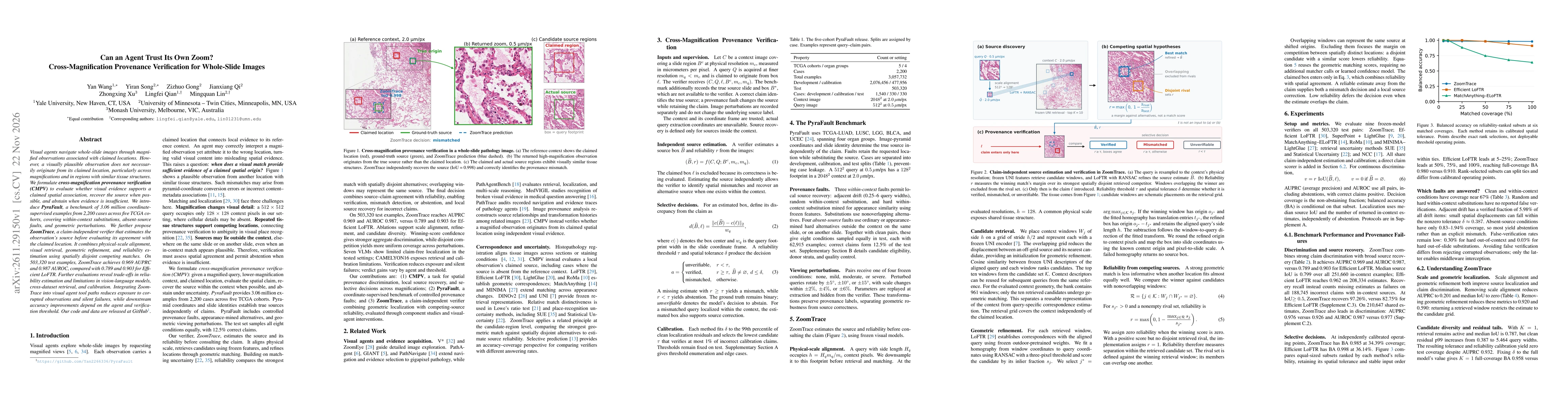
Can an Agent Trust Its Own Zoom? Cross-Magnification Provenance Verification for Whole-Slide Images
Yan Wang, Yiran Song, Zizhuo Gong +4 more · Nov 22, 2026
Visual agents navigate whole-slide images through magnified observations associated with claimed locations. However, a visually plausible observation does not necessarily originate from its claimed location, particularly across magnifications and in regions with similar tissue structures. We formulate cross-magnification provenance verification (CMPV) to evaluate whether visual evidence supports a claimed spatial association, recover the source when possible, and abstain when evidence is insufficient. We introduce PyraFault, a benchmark of 3.06 million coordinate-supervised examples from 2,200 cases across five TCGA cohorts, covering within-context substitutions, absent-source faults, and geometric perturbations. We further propose ZoomTrace, a claim-independent verifier that estimates the observation's source before evaluating its agreement with the claimed location. It combines physical-scale alignment, visual retrieval, geometric refinement, and reliability estimation using spatially disjoint competing matches. On 503,320 test examples, ZoomTrace achieves 0.969 AUPRC and 0.987 AUROC, compared with 0.789 and 0.903 for Efficient LoFTR. Further evaluations reveal trade-offs in reliability estimation and limitations in vision-language models, cross-dataset retrieval, and calibration. Integrating ZoomTrace into visual agent tool paths reduces exposure to corrupted observations and silent failures, while downstream accuracy improvements depend on the agent and verification threshold.
GRAPE-Bench: When Vision Degrades, Does Video Reasoning Hold?
Ce Zhang, Junyi He, Tianshi Ming +15 more · Nov 24, 2026
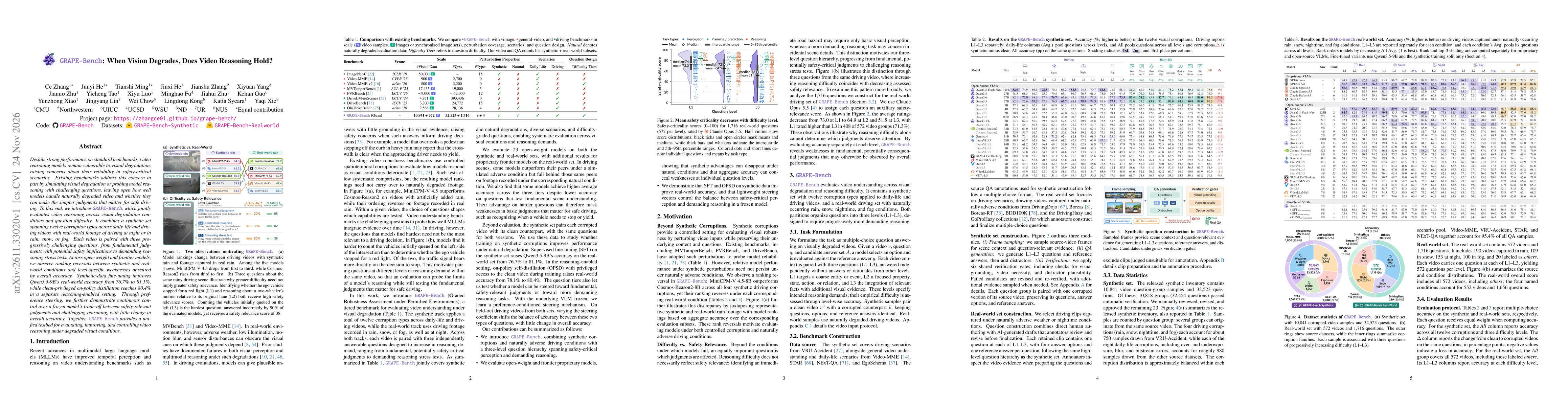
Despite strong performance on standard benchmarks, video reasoning models remain vulnerable to visual degradation, raising concerns about their reliability in safety-critical scenarios. Existing benchmarks address this concern in part by simulating visual degradation or probing model reasoning with challenging questions, leaving open how well models handle naturally degraded video and whether they can make the simpler judgments that matter for safe driving. To this end, we introduce GRAPE-Bench, which jointly evaluates video reasoning across visual degradation conditions and question difficulty. It combines a synthetic set spanning twelve corruption types across daily-life and driving videos with real-world footage of driving at night or in rain, snow, or fog. Each video is paired with three progressively challenging questions, from fundamental judgments with potential safety implications to demanding reasoning stress tests. Across open-weight and frontier models, we observe ranking reversals between synthetic and real-world conditions and level-specific weaknesses obscured by overall accuracy. Synthetic-data fine-tuning improves Qwen3.5-9B's real-world accuracy from 76.7% to 81.1%, while clean-privileged on-policy distillation reaches 80.4% in a separate reasoning-enabled setting. Through preference steering, we further demonstrate continuous control over a frozen model's trade-off between safety-relevant judgments and challenging reasoning, with little change in overall accuracy. Together, GRAPE-Bench provides a unified testbed for evaluating, improving, and controlling video reasoning under degraded visual conditions.
Factorized Context Attention: From Emulated to Native Grid Probing
Mohamed Eltahir, Manar Eyad, Yara Alzahrani +4 more · Nov 24, 2026
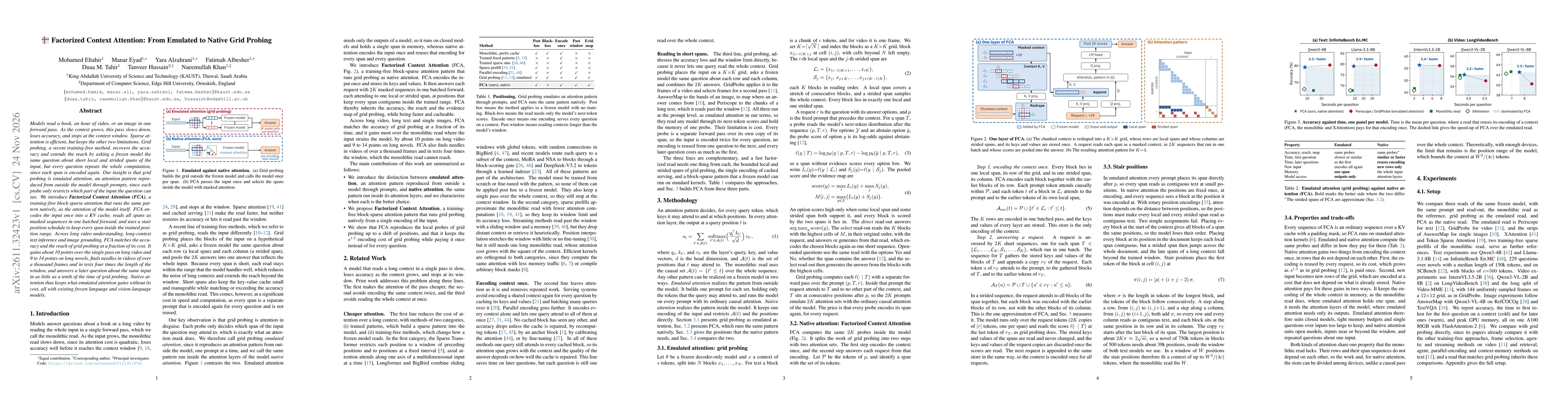
Models read a book, an hour of video, or an image in one forward pass. As the context grows, this pass slows down, loses accuracy, and stops at the context window. Sparse attention is efficient, but keeps the other two limitations. Grid probing, a recent training-free method, recovers the accuracy and extends the reach by asking a frozen model the same question about short local and strided spans of the input, but every question repeats the whole computation, since each span is encoded again. Our insight is that grid probing is emulated attention, an attention pattern reproduced from outside the model through prompts, since each probe only restricts which part of the input the question can see. We introduce Factorized Context Attention (FCA), a training-free block-sparse attention that runs the same pattern natively, as the attention of the model itself. FCA encodes the input once into a KV cache, reads all spans as masked sequences in one batched forward, and uses a stair position schedule to keep every span inside the trained position range. Across long video understanding, long-context text inference and image grounding, FCA matches the accuracy and the reach of grid probing at a fraction of its cost. It gains about 10 points over the single pass on long video and 9 to 14 points on long novels, finds needles in videos of over a thousand frames and in texts four times the length of the window, and answers a later question about the same input in as little as a tenth of the time of grid probing. Native attention thus keeps what emulated attention gains without its cost, all with existing frozen language and vision-language models.
Align the Pair, Not the Sample: Representation Alignment for Faster and Better One-Step Generato
Mingxiao Li, Xuantuo Huang, Encheng Su +4 more · Nov 22, 2026
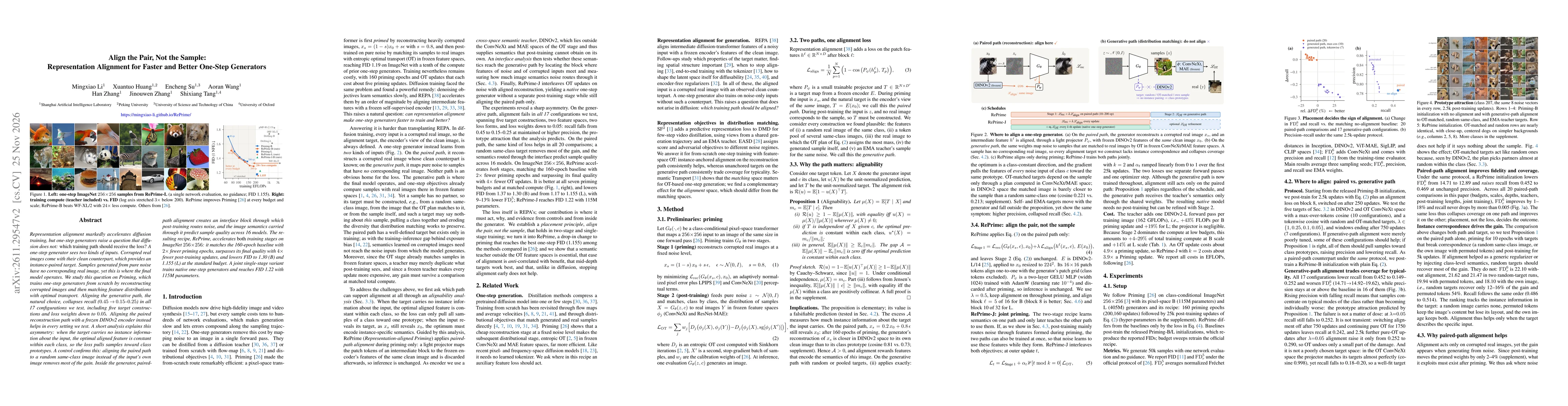
Representation alignment markedly accelerates diffusion training, but one-step generators raise a question that diffusion does not: which training path should receive the loss? A one-step generator sees two kinds of inputs. Corrupted real images come with their clean counterpart, which provides an instance-paired target. Samples generated from pure noise have no corresponding real image, yet this is where the final model operates. We study this question on Priming, which trains one-step generators from scratch by reconstructing corrupted images and then matching feature distributions with optimal transport. Aligning the generative path, the natural choice, collapses recall (0.45!to!0.15--0.25) in all 17 configurations we test, including five target constructions and loss weights down to 0.05. Aligning the paired reconstruction path with a frozen DINOv2 encoder instead helps in every setting we test. A short analysis explains this asymmetry: when the target carries no instance information about the input, the optimal aligned feature is constant within each class, so the loss pulls samples toward class prototypes. A control confirms this: aligning the paired path to a random same-class image instead of the input's own image removes most of the gain. Inside the generator, paired-path alignment creates an interface block through which post-training routes noise, and the image semantics carried through it predict sample quality across 16 models. The resulting recipe, \method, accelerates both training stages on ImageNet 256!times!256: it matches the 160-epoch baseline with 2times fewer priming epochs, surpasses its final quality with 4times fewer post-training updates, and lowers FID to 1.30 (B) and 1.155 (L) at the standard budget. A joint single-stage variant trains native one-step generators and reaches FID 1.22 with 115M parameters.
Escriba-OCR: A 1B Vision-Language Model for Error-Preserving Transcription of Handwritten Portuguese Essays
Tardelli Ronan Coelho Stekel · Nov 23, 2026
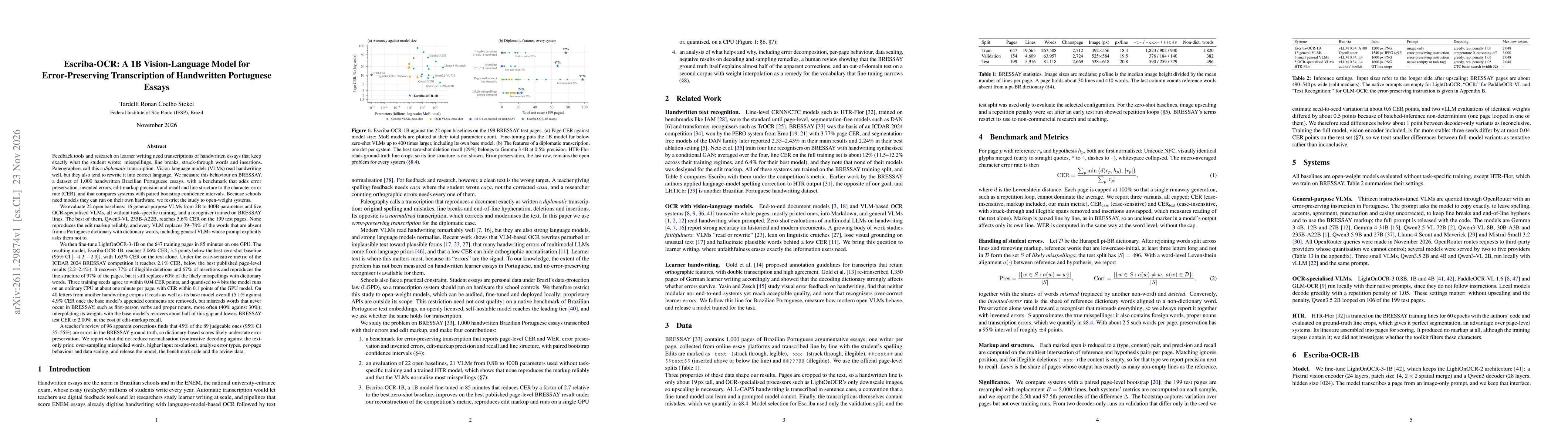
Feedback tools and research on learner writing need transcriptions of handwritten essays that keep exactly what the student wrote: misspellings, line breaks, struck-through words and insertions. Vision-language models (VLMs) read handwriting well, but they also tend to rewrite it into correct language. We measure this on BRESSAY, 1,000 handwritten Brazilian Portuguese essays, with a benchmark that adds error preservation, invented errors, edit-markup precision and recall and line structure to the character error rate (CER) and uses paired bootstrap confidence intervals. We restrict the study to open-weight models that schools can run on their own hardware. Of 22 open baselines, the best, Qwen3-VL 235B-A22B, reaches 5.6% CER on the 199 test pages; none reproduces the edit markup reliably, and every VLM replaces 39-78% of the words absent from a Portuguese dictionary with dictionary words. We fine-tune LightOnOCR-3-1B on the 647 training pages in 85 minutes on one GPU. The resulting Escriba-OCR-1B reaches 2.06% CER, 3.5 points below the best baseline (95% CI [-4.2, -2.9]); under the ICDAR 2024 competition metric it reaches 2.1% CER, below the best published page-level results (2.2-2.4%). It recovers 67% of insertions and 77% of illegible deletions, and reproduces the line structure of 97% of the pages, but still normalises 60% of likely misspellings. Three seeds agree within 0.04 CER points, and quantised to 4 bits the model runs on an ordinary CPU at about one minute per page. On 40 letters of another corpus it matches its base model (without that model's appended comments) but misreads unseen words more often; weight interpolation recovers half the gap. A teacher's review finds that 45% of the judgeable apparent corrections are errors in the BRESSAY ground truth, so dictionary-based scores likely understate preservation. We release the model, the benchmark code and the review data.
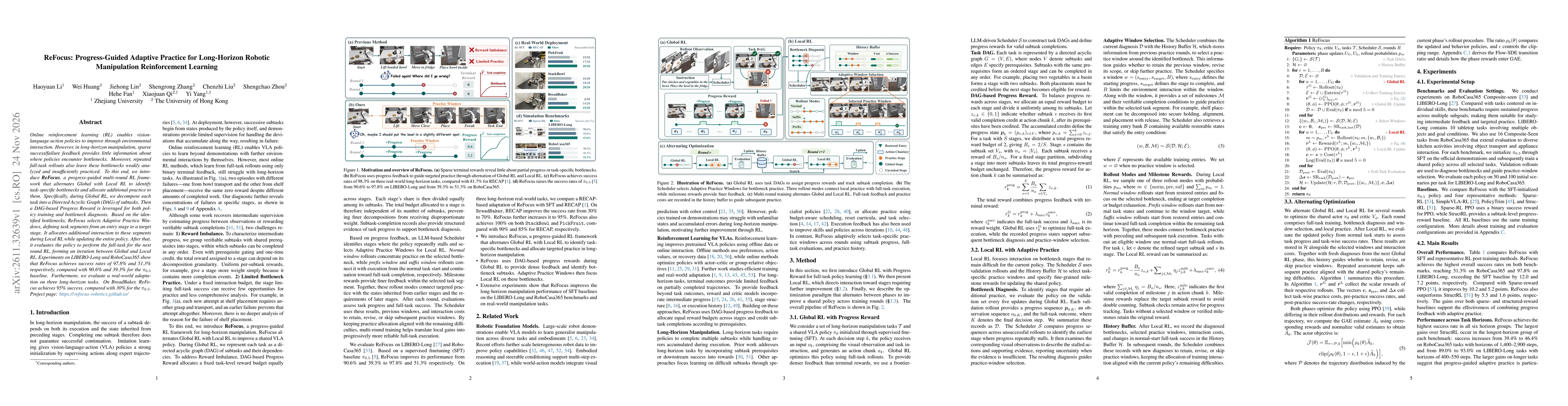
ReFocus: Progress-Guided Adaptive Practice for Long-Horizon Robotic Manipulation Reinforcement Learning
Haoyuan Li, Wei Huang, Jiehong Lin +6 more · Nov 24, 2026
Online reinforcement learning (RL) enables vision-language-action policies to improve through environmental interaction. However, in long-horizon manipulation, sparse success/failure feedback provides little information about where policies encounter bottlenecks. Moreover, repeated full-task rollouts also leave these bottlenecks weakly analyzed and insufficiently practiced. To this end, we introduce ReFocus, a progress-guided multi-round RL framework that alternates between Global and Local RL to identify task-specific bottlenecks and allocate additional practice to them. Specifically, during Global RL, we decompose each task into a Directed Acyclic Graph (DAG) of subtasks. Then a DAG-based Progress Reward is leveraged for both policy training and bottleneck diagnosis. Based on the identified bottlenecks, ReFocus selects Adaptive Practice Windows, defining task segments from an entry stage to a target stage. It allocates additional interaction to these segments during Local RL while updating the entire policy. After that, it evaluates the policy to perform the full task for the next round of RL, forming an iteration between Global and Local RL. Experiments on LIBERO-Long and RoboCasa365 show that ReFocus achieves success rates of 97.8% and 51.3%, respectively, compared with 90.6% and 39.3% for the π_{0.5} baseline. Furthermore, we evaluate a real-world adaptation on three long-horizon tasks. On BreadBaker, ReFocus achieves 95% success, compared with 30% for the π_{0.5}. Project page: https://refocus-robotics.github.io.
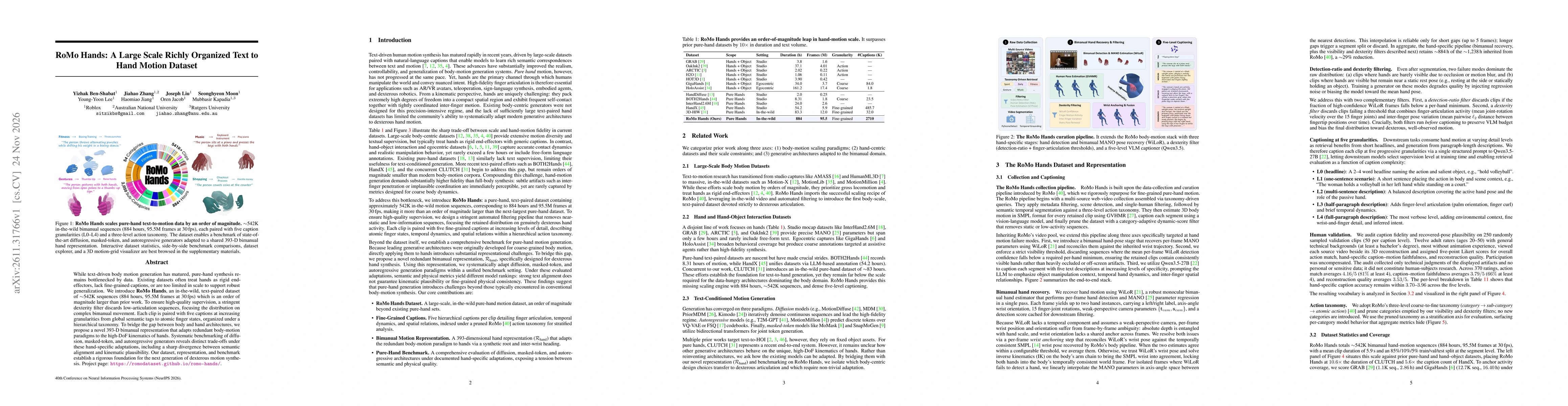
RoMo Hands: A Large Scale Richly Organized Text to Hand Motion Dataset
Yizhak Ben-Shabat, Jiahao Zhang, Joseph Liu +5 more · Nov 24, 2026
While text-driven body motion generation has matured, pure-hand synthesis remains bottlenecked by data. Existing datasets often treat hands as rigid end-effectors, lack fine-grained captions, or are too limited in scale to support robust generalization. We introduce RoMo Hands, an in-the-wild, text-paired dataset of ~542K sequences (884 hours, 95.5M frames at 30 fps) which is an order of magnitude larger than prior work. To ensure high-quality supervision, a stringent dexterity filter discards low-articulation sequences, focusing the distribution on complex bimanual movement. Each clip is paired with five captions at increasing granularities from global semantic tags to atomic finger states, organized under a hierarchical taxonomy. To bridge the gap between body and hand architectures, we propose a novel 393-D bimanual representation that adapts redundant body-motion paradigms to the high-DoF kinematics of hands. Systematic benchmarking of diffusion, masked-token, and autoregressive generators reveals distinct trade-offs under these hand-specific adaptations, including a sharp divergence between semantic alignment and kinematic plausibility. Our dataset, representation, and benchmark establish a rigorous foundation for the next generation of dexterous motion synthesis. Project page: https://romodataset.github.io/romo-hands/.
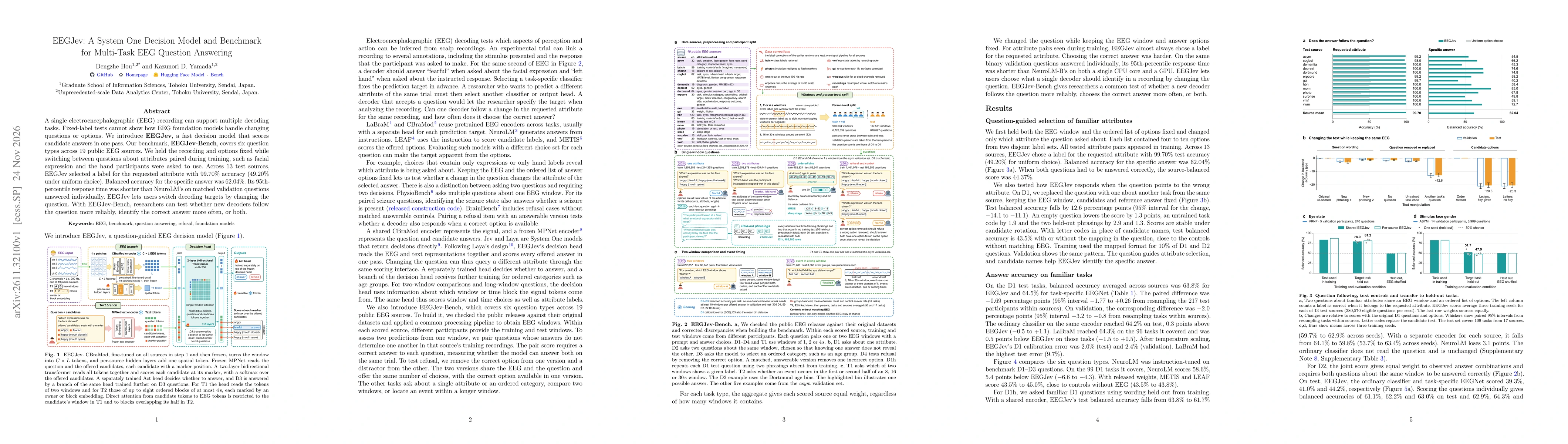
EEGJev: A System One Decision Model and Benchmark for Multi-Task EEG Question Answering
Dengzhe Hou, Kazunori D. Yamada · Nov 24, 2026
A single electroencephalographic (EEG) recording can support multiple decoding tasks. Fixed-label tests cannot show how EEG foundation models handle changing questions or options. We introduce EEGJev, a fast decision model that scores candidate answers in one pass. Our benchmark, EEGJev-Bench, covers six question types across 19 public EEG sources. We held the recording and options fixed while switching between questions about attributes paired during training, such as facial expression and the hand participants were asked to use. Across 13 test sources, EEGJev selected a label for the requested attribute with 99.70% accuracy (49.20% under uniform choice). Balanced accuracy for the specific answer was 62.04%. Its 95th-percentile response time was shorter than NeuroLM's on matched validation questions answered individually. EEGJev lets users switch decoding targets by changing the question. With EEGJev-Bench, researchers can test whether new decoders follow the question more reliably, identify the correct answer more often, or both.
Small Learned Projections for Semantic-Reversal-Aware Retrieval with Spectral Acceleration: A Four-Domain Empirical Study
Sayed Amir Karim · Nov 23, 2026
Dense-embedding retrievers can fail adversarially: when a query is answered by a document A and reversed by a near-copy B that differs from A by a small meaning-changing edit (a "trap"), raw cosine over E5-Large-v2 places B in the top-10 for 82-100% of queries at a pool of 5,000. We study two things. First, a small learned projection W: R^1024 -> R^d (d in {11, 32}), trained by a deterministic recipe on a declared set of cases, that suppresses the trap: for the declared cases, HN@10 = 0.0000 (no trap in the top-10) in all twelve (domain, pool-size) settings across four independent domains (legal, medical, patent, financial) and pools up to 100,000, while the correct paraphrase is retained for 93-99% of cases, under exact nearest-neighbour search. Second, a boundary-conditioned accelerator that serves the projection at that scale: an acceleration of spectral graph retrieval (SpectRAG) that replaces a dense eigendecomposition with a boundary-value solve, holding HN@10 = 0.0000 at n = 100,000 in every domain and retrieving the ~300-query suite in 0.6-1.1 s (~2-4 ms per query on average). Because the lens's output is the stored representation (a few floats per document), a hardened, specialised index per domain or tenant is ~90x smaller and dimension-proportionally faster than the full embedding, making many small declared indexes a practical alternative to one large vector store. The claim is scoped to the declared cases on the measured pools, with no probabilistic bound; the correct-answer rate drops for a reworded query against an unchanged corpus (about 0.79, trap suppression still holding). A projection transfers only partly to other domains, which we report in full. The recipe, lenses, trap sets and evaluation harness are released under AGPL-3.0; the accelerator's implementation is a reserved commercial component, and every HN number is reproducible under exact search.
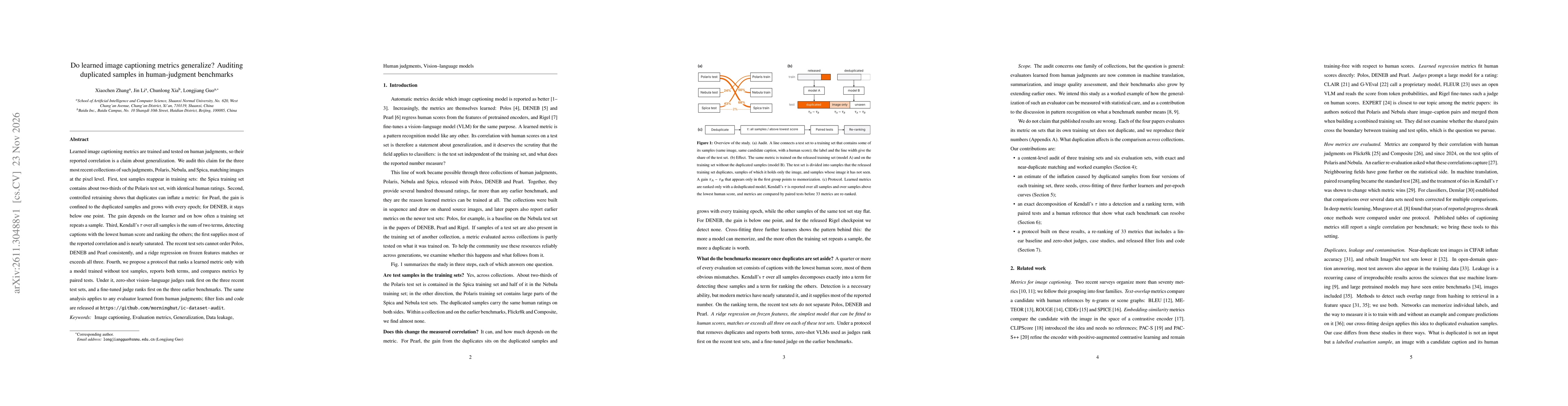
Do learned image captioning metrics generalize? Auditing duplicated samples in human-judgment benchmarks
Xiaochen Zhang, Jin Li, Chunlong Xia +1 more · Nov 23, 2026
Learned image captioning metrics are trained and tested on human judgments, so their reported correlation is a claim about generalization. We audit this claim for the three most recent collections of such judgments, Polaris, Nebula, and Spica, matching images at the pixel level. First, test samples reappear in training sets: the Spica training set contains about two-thirds of the Polaris test set, with identical human ratings. Second, controlled retraining shows that duplicates can inflate a metric: for Pearl, the gain is confined to the duplicated samples and grows with every epoch; for DENEB, it stays below one point. The gain depends on the learner and on how often a training set repeats a sample. Third, Kendall's τ over all samples is the sum of two terms, detecting captions with the lowest human score and ranking the others; the first supplies most of the reported correlation and is nearly saturated. The recent test sets cannot order Polos, DENEB and Pearl consistently, and a ridge regression on frozen features matches or exceeds all three. Fourth, we propose a protocol that ranks a learned metric only with a model trained without test samples, reports both terms, and compares metrics by paired tests. Under it, zero-shot vision--language judges rank first on the three recent test sets, and a fine-tuned judge ranks first on the three earlier benchmarks. The same analysis applies to any evaluator learned from human judgments; filter lists and code are released at https://github.com/morninghut/ic-dataset-audit .