Trending on arXiv
Today's most upvoted papers on arXiv
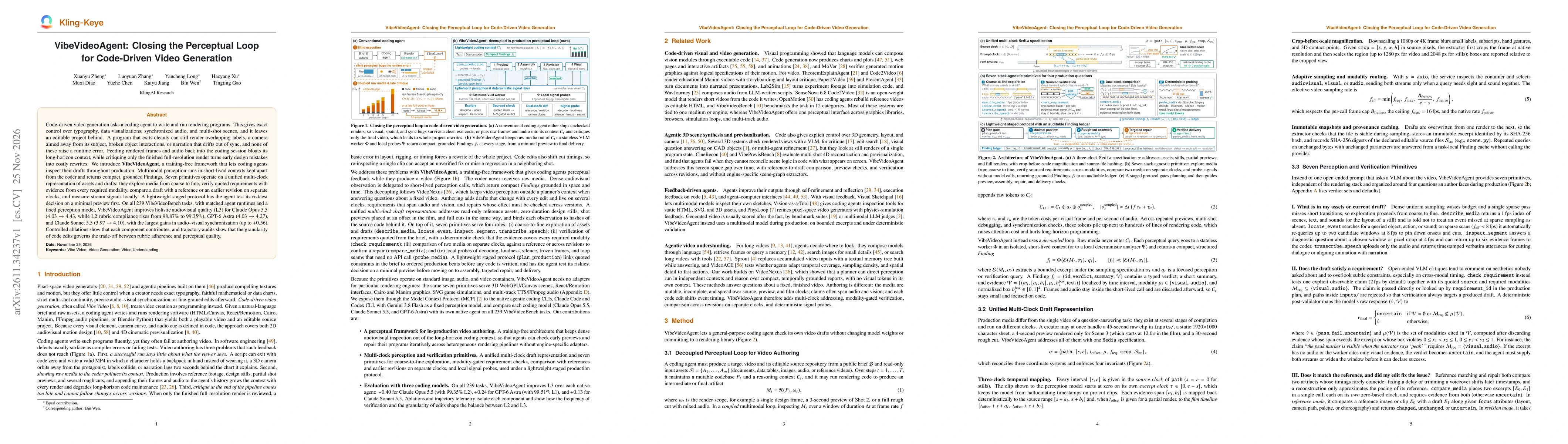
VibeVideoAgent: Closing the Perceptual Loop for Code-Driven Video Generation
Xuanyu Zheng, Luoyuan Zhang, Yancheng Long +6 more · Nov 25, 2026
Code-driven video generation asks a coding agent to write and run rendering programs. This gives exact control over typography, data visualizations, synchronized audio, and multi-shot scenes, and it leaves an editable project behind. A program that exits cleanly can still render overlapping labels, a camera aimed away from its subject, broken object interactions, or narration that drifts out of sync, and none of these raise a runtime error. Feeding rendered frames and audio back into the coding session bloats its long-horizon context, while critiquing only the finished full-resolution render turns early design mistakes into costly rewrites. We introduce VibeVideoAgent, a training-free framework that lets coding agents inspect their drafts throughout production. Multimodal perception runs in short-lived contexts kept apart from the coder and returns compact, grounded Findings. Seven primitives operate on a unified multi-clock representation of assets and drafts: they explore media from coarse to fine, verify quoted requirements with evidence from every required modality, compare a draft with a reference or an earlier revision on separate clocks, and measure stream signals locally. A lightweight staged protocol has the agent test its riskiest decision on a minimal preview first. On all 239 VibeVideoBench tasks, with matched agent runtimes and a fixed perception model, VibeVideoAgent improves holistic audiovisual quality (L3) for Claude Opus 5.5 (4.03 -> 4.43, while L2 rubric compliance rises from 98.87% to 99.35%), GPT-6 Astra (4.03 -> 4.27), and Claude Sonnet 5.5 (3.97 -> 4.10), with the largest gains in audio-visual synchronization (up to +0.56). Controlled ablations show that each component contributes, and trajectory audits show that the granularity of code edits governs the trade-off between rubric adherence and perceptual quality.
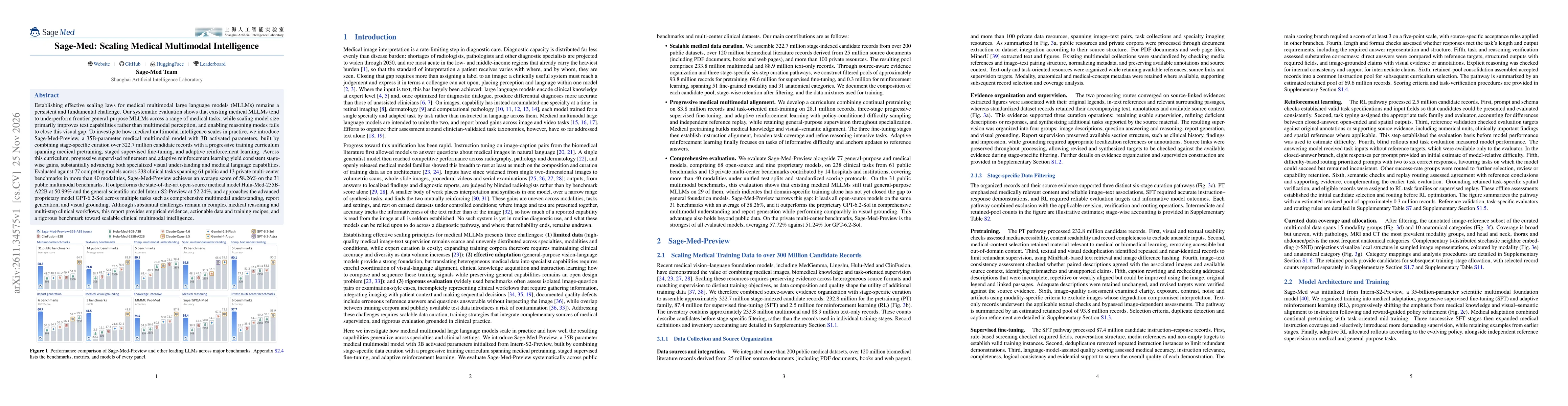
Sage-Med: Scaling Medical Multimodal Intelligence
Med Team, Ming Hu, Cheng Tang +105 more · Nov 25, 2026
Establishing effective scaling laws for medical multimodal large language models (MLLMs) remains a persistent and fundamental challenge. Our systematic evaluation shows that existing medical MLLMs tend to underperform frontier general-purpose MLLMs across a range of medical tasks, while scaling model size primarily improves text capabilities rather than multimodal perception, and enabling reasoning modes fails to close this visual gap. To investigate how medical multimodal intelligence scales in practice, we introduce Sage-Med-Preview, a 35B-parameter medical multimodal model with 3B activated parameters, built by combining stage-specific curation over 322.7 million candidate records with a progressive training curriculum spanning medical pretraining, staged supervised fine-tuning, and adaptive reinforcement learning. Across this curriculum, progressive supervised refinement and adaptive reinforcement learning yield consistent stage-wise gains, substantially advancing both specialized visual understanding and medical language capabilities. Evaluated against 77 competing models across 238 clinical tasks spanning 61 public and 13 private multi-center benchmarks in more than 40 modalities, Sage-Med-Preview achieves an average score of 58.26% on the 31 public multimodal benchmarks. It outperforms the state-of-the-art open-source medical model Hulu-Med-235B-A22B at 50.99% and the general scientific model Intern-S2-Preview at 52.24%, and approaches the advanced proprietary model GPT-6.2-Sol across multiple tasks such as comprehensive multimodal understanding, report generation, and visual grounding. Although substantial challenges remain in complex medical reasoning and multi-step clinical workflows, this report provides empirical evidence, actionable data and training recipes, and a rigorous benchmark toward scalable clinical multimodal intelligence.
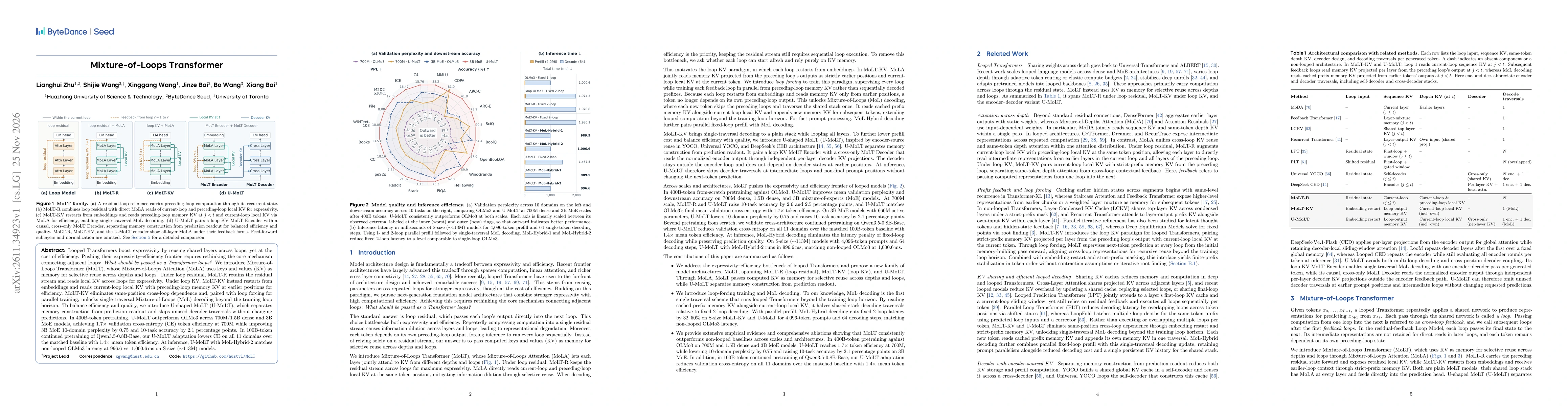
Mixture-of-Loops Transformer
Lianghui Zhu, Shijie Wang, Xinggang Wang +3 more · Nov 25, 2026
Looped Transformers boost expressivity by reusing shared layers across loops, yet at the cost of efficiency. Pushing their expressivity-efficiency frontier requires rethinking the core mechanism connecting adjacent loops: What should be passed as a Transformer loops? We introduce Mixture-of-Loops Transformer (MoLT), whose Mixture-of-Loops Attention (MoLA) uses keys and values (KV) as memory for selective reuse across depths and loops. Under loop residual, MoLT-R retains the residual stream and reads local KV across loops for expressivity. Under loop KV, MoLT-KV instead restarts from embeddings and reads current-loop local KV with preceding-loop memory KV at earlier positions for efficiency. MoLT-KV eliminates same-position cross-loop dependence and, paired with loop forcing for parallel training, unlocks single-traversal Mixture-of-Loops (MoL) decoding beyond the training loop horizon. To balance efficiency and quality, we introduce U-shaped MoLT (U-MoLT), which separates memory construction from prediction readout and skips unused decoder traversals without changing predictions. In 400B-token pretraining, U-MoLT outperforms OLMo3 across 700M/1.5B dense and 3B MoE models, achieving 1.7x validation cross-entropy (CE) token efficiency at 700M while improving 3B MoE 10-domain perplexity by 0.75 and 10-task accuracy by 2.1 percentage points. In 100B-token continued pretraining of Qwen3.5-0.8B-Base, our U-MoLT adaptation lowers CE on all 11 domains over the matched baseline with 1.4x mean token efficiency. At inference, U-MoLT with MoL-Hybrid-2 matches non-looped OLMo3 latency at 996.6 vs. 1,000.6 ms on S-size (~113M) models. Code is available at https://github.com/hustvl/MoLT
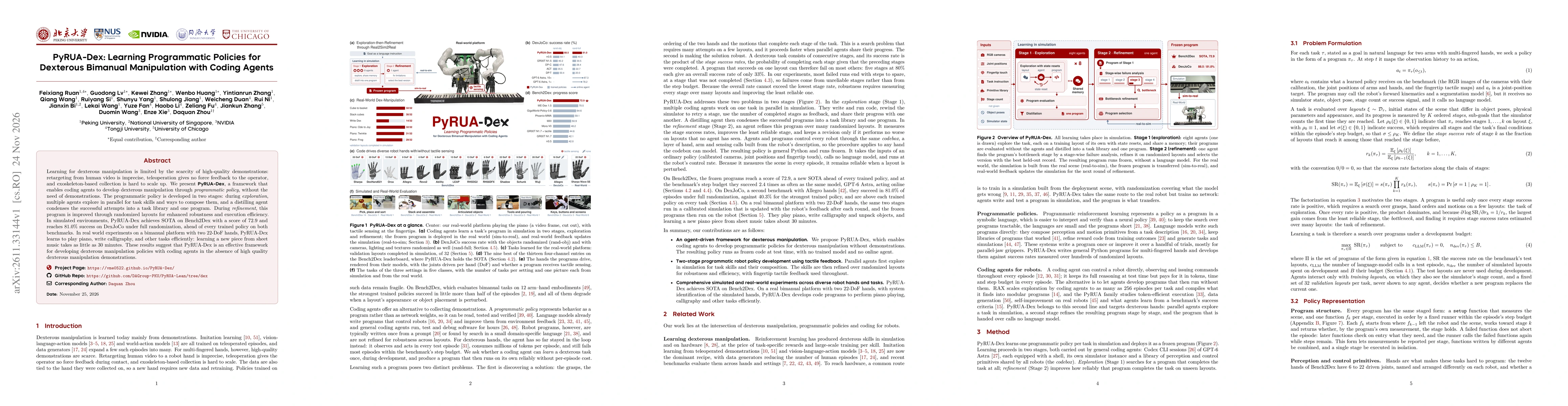
PyRUA-Dex: Learning Programmatic Policies for Dexterous Bimanual Manipulation with Coding Agents
Feixiang Ruan, Guodong Lv, Kewei Zhang +17 more · Nov 24, 2026
Learning for dexterous manipulation is limited by the scarcity of high-quality demonstrations: retargeting from human video is imprecise, teleoperation gives no force feedback to the operator, and exoskeleton-based collection is hard to scale up. We present PyRUA-Dex, a framework that enables coding agents to develop dexterous manipulation through programmatic policy, without the need of demonstrations. The programmatic policy is developed in two stages: during exploration, multiple agents explore in parallel for task skills and ways to compose them, and a distilling agent condenses the successful attempts into a task library and one program. During refinement, this program is improved through randomized layouts for enhanced robustness and execution efficiency. In simulated environments, PyRUA-Dex achieves SOTA on Bench2Dex with a score of 72.9 and reaches 81.0% success on DexJoCo under full randomization, ahead of every trained policy on both benchmarks. In real world experiments on a bimanual platform with two 22-DoF hands, PyRUA-Dex learns to play piano, write calligraphy, and other tasks efficiently: learning a new piece from sheet music takes as little as 30 minutes. These results suggest that PyRUA-Dex is an effective framework for developing dexterous manipulation policies with coding agents in the absence of high quality dexterous manipulation demonstrations.
Improving and Expanding Video Editing Capabilities Without Videos
Ji Xie, Yanhao Jia, Xiangpeng Yang +4 more · Nov 25, 2026
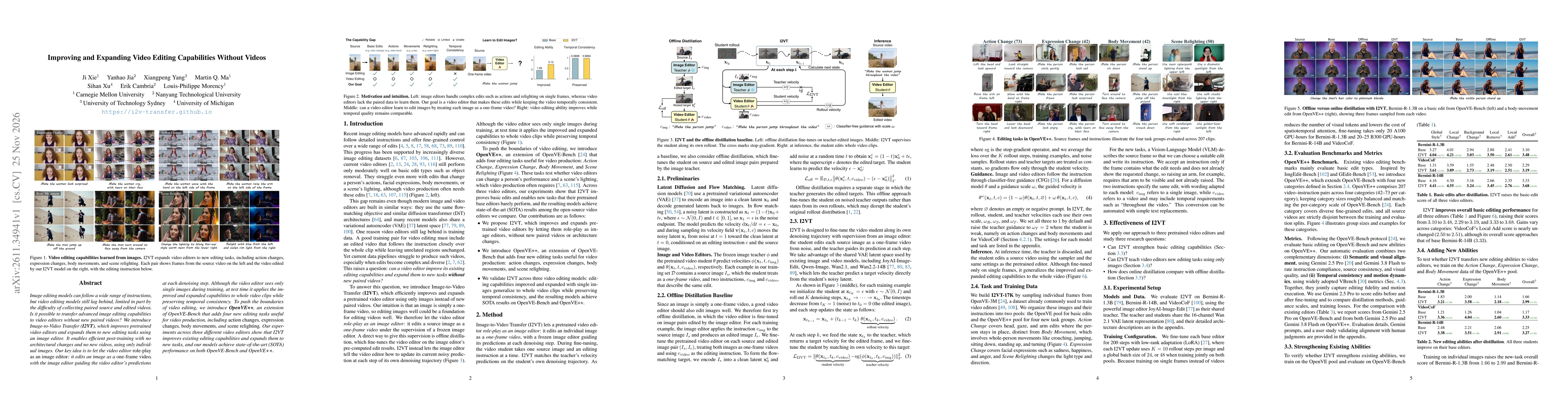
Image editing models can follow a wide range of instructions, but video editing models still lag behind, limited in part by the difficulty of collecting paired source and edited videos. Is it possible to transfer advanced image editing capabilities to video editors without new paired videos? We introduce Image-to-Video Transfer (I2VT), which improves pretrained video editors and expands them to new editing tasks using an image editor. It enables efficient post-training with no architectural changes and no new videos, using only individual images. Our key idea is to let the video editor role-play as an image editor: it edits an image as a one-frame video, with the image editor guiding the video editor's predictions at each denoising step. Although the video editor sees only single images during training, at test time it applies the improved and expanded capabilities to whole video clips while preserving temporal consistency. To push the boundaries of video editing, we introduce OpenVE++, an extension of OpenVE-Bench that adds four new editing tasks useful for video production, including action changes, expression changes, body movements, and scene relighting. Our experiments across three different video editors show that I2VT improves existing editing capabilities and expands them to new tasks, and our models achieve state-of-the-art (SOTA) performance on both OpenVE-Bench and OpenVE++.
DyLoMo-DiT: Dynamic Looped Mixture-of-Experts Diffusion Transformers
Lernie Li, Yuanliu Liu, Pengfei Xiong +1 more · Nov 23, 2026
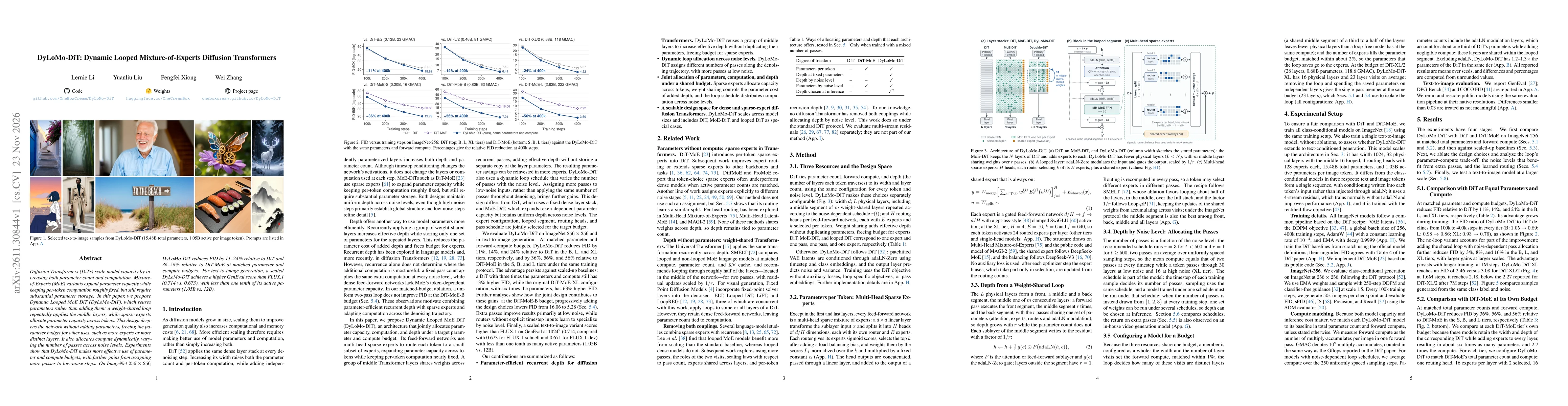
Diffusion Transformers (DiTs) scale model capacity by increasing both parameter count and computation. Mixture-of-Experts (MoE) variants expand parameter capacity while keeping per-token computation roughly fixed, but still require substantial parameter storage. In this paper, we propose Dynamic Looped MoE DiT (DyLoMo-DiT), which reuses parameters rather than adding them: a weight-shared loop repeatedly applies the middle layers, while sparse experts allocate parameter capacity across tokens. This design deepens the network without adding parameters, freeing the parameter budget for other uses, such as more experts or more distinct layers. It also allocates compute dynamically, varying the number of passes across noise levels. Experiments show that DyLoMo-DiT makes more effective use of parameter and compute budgets, with further gains from assigning more passes to low-noise steps. On ImageNet 256times256, DyLoMo-DiT reduces FID by 11-24% relative to DiT and 36-56% relative to DiT-MoE at matched parameter and compute budgets. For text-to-image generation, a scaled DyLoMo-DiT achieves a higher GenEval score than FLUX.1 (0.714 vs. 0.673), with less than one tenth of its active parameters (1.05B vs. 12B).
DocSEAM: Bidirectional Cross-Page Encoding for Multi-Page Document Understanding
Hoang-Nhat Nguyen, Chen Change Loy · Nov 25, 2026
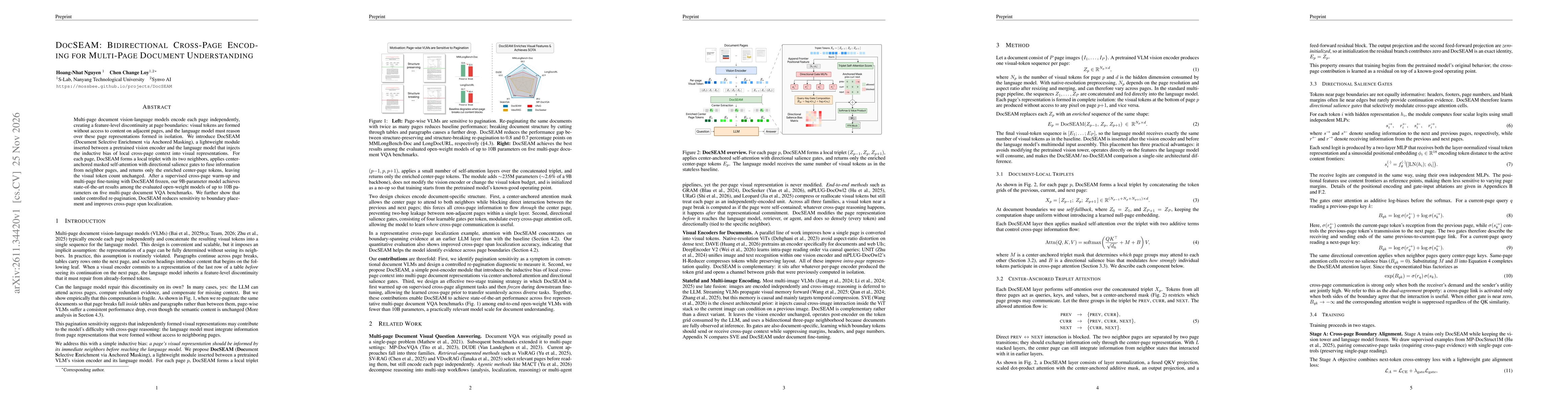
Multi-page document vision-language models encode each page independently, creating a feature-level discontinuity at page boundaries: visual tokens are formed without access to content on adjacent pages, and the language model must reason over these page representations formed in isolation. We introduce DocSEAM (Document Selective Enrichment via Anchored Masking), a lightweight module inserted between a pretrained vision encoder and the language model that injects the inductive bias of local cross-page context into visual representations. For each page, DocSEAM forms a local triplet with its two neighbors, applies center-anchored masked self-attention with directional salience gates to fuse information from neighbor pages, and returns only the enriched center-page tokens, leaving the visual token count unchanged. After a supervised cross-page warm-up and multi-page fine-tuning with DocSEAM frozen, our 9B-parameter model achieves state-of-the-art results among the evaluated open-weight models of up to 10B parameters on five multi-page document VQA benchmarks. We further show that under controlled re-pagination, DocSEAM reduces sensitivity to boundary placement and improves cross-page span localization
HOG-WAM: Improving Visual Robustness through Future Gradient Prediction
Boxuan Dong, Yupeng Qian, Ying Wu +5 more · Nov 25, 2026
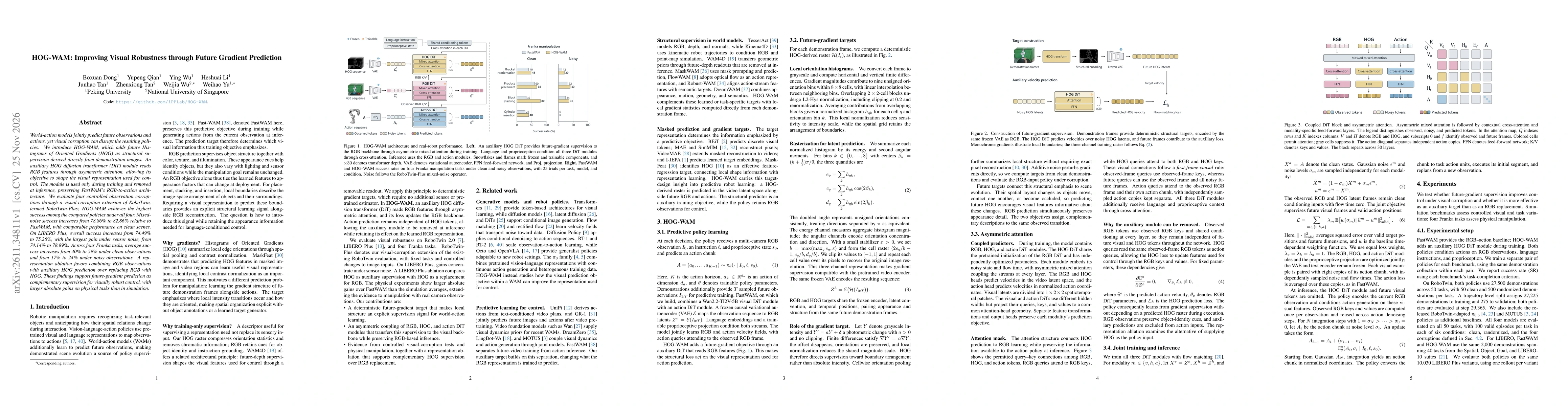
World-action models jointly predict future observations and actions, yet visual corruption can disrupt the resulting policies. We introduce HOG-WAM, which adds future Histograms of Oriented Gradients (HOG) as structural supervision derived directly from demonstration images. An auxiliary HOG diffusion transformer (DiT) module reads RGB features through asymmetric attention, allowing its objective to shape the visual representation used for control. The module is used only during training and removed at inference, preserving FastWAM's RGB-to-action architecture. We evaluate four controlled observation corruptions through a visual-corruption extension of RoboTwin, termed RoboTwin-Plus; HOG-WAM achieves the highest success among the compared policies under all four. Mixed-noise success increases from 78.86% to 82.86% relative to FastWAM, with comparable performance on clean scenes. On LIBERO Plus, overall success increases from 74.49% to 75.26%, with the largest gain under sensor noise, from 74.14% to 78.89%. Across four Franka tasks, average success increases from 40% to 59% under clean observations and from 17% to 24% under noisy observations. A representation ablation favors combining RGB observations with auxiliary HOG prediction over replacing RGB with HOG. These findings support future-gradient prediction as complementary supervision for visually robust control, with larger absolute gains on physical tasks than in simulation. Code is available at https://github.com/iPPLab/HOG-WAM.
AIRIS: Benchmarking Social Embodied Intelligence in Egocentric Streaming Videos
Yuchen Zhou, Hongsheng Wu, Jiayu Tang +8 more · Nov 25, 2026
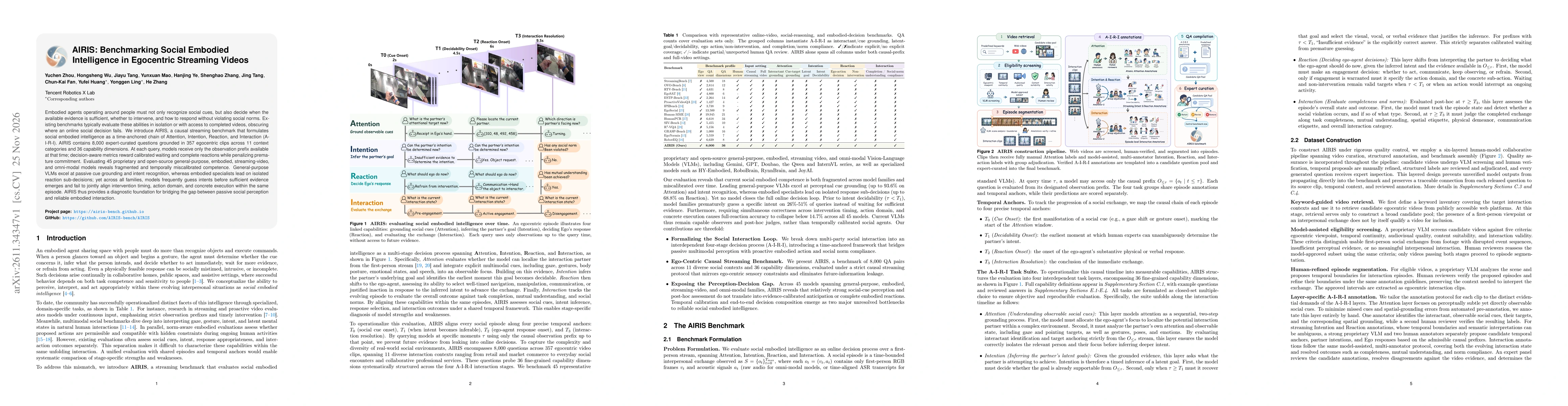
Embodied agents operating around people must not only recognize social cues, but also decide when the available evidence is sufficient, whether to intervene, and how to respond without violating social norms. Existing benchmarks typically evaluate these abilities in isolation or with access to completed videos, obscuring where an online social decision fails. We introduce AIRIS, a causal streaming benchmark that formulates social embodied intelligence as a time-anchored chain of Attention, Intention, Reaction, and Interaction (A-I-R-I). AIRIS contains 8,000 expert-curated questions grounded in 357 egocentric clips across 11 context categories and 36 capability dimensions. At each query, models receive only the observation prefix available at that time; decision-aware metrics reward calibrated waiting and complete reactions while penalizing premature commitment. Evaluating 45 proprietary and open-source general-purpose, embodied, streaming-video, and omni-modal models reveals fragmented and temporally miscalibrated competence. General-purpose VLMs excel at passive cue grounding and intent recognition, whereas embodied specialists lead on isolated reaction sub-decisions; yet across all families, models frequently guess intents before sufficient evidence emerges and fail to jointly align intervention timing, action domain, and concrete execution within the same episode. AIRIS thus provides a diagnostic foundation for bridging the gap between passive social perception and reliable embodied interaction.
FoundSurface: Feedforward Ray-Based 3D Scene Surface Reconstruction from Unposed Images
Shenxing Wei, Jinxi Li, Zihui Zhang +3 more · Nov 25, 2026
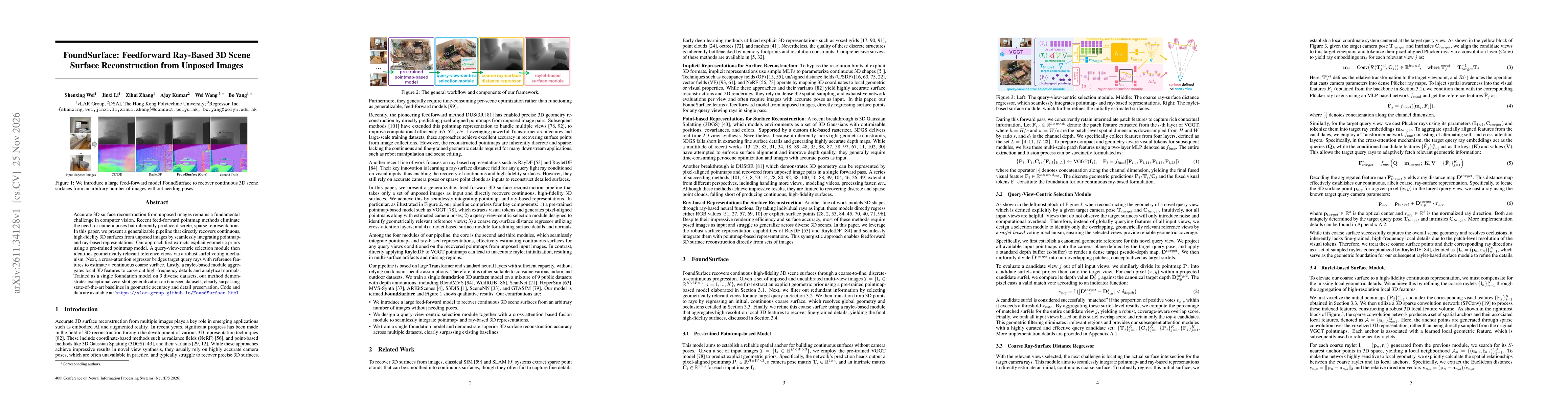
Accurate 3D surface reconstruction from unposed images remains a fundamental challenge in computer vision. Recent feed-forward pointmap methods eliminate the need for camera poses but inherently produce discrete, sparse representations. In this paper, we present a generalizable pipeline that directly recovers continuous, high-fidelity 3D surfaces from unposed images by seamlessly integrating pointmap- and ray-based representations. Our approach first extracts explicit geometric priors using a pre-trained pointmap model. A query-view-centric selection module then identifies geometrically relevant reference views via a robust surfel voting mechanism. Next, a cross-attention regressor bridges target query rays with reference features to estimate a continuous coarse surface. Lastly, a raylet-based module aggregates local 3D features to carve out high-frequency details and analytical normals. Trained as a single foundation model on 9 diverse datasets, our method demonstrates exceptional zero-shot generalization on 6 unseen datasets, clearly surpassing state-of-the-art baselines in geometric accuracy and detail preservation.
Agentic LongLive: Asynchronous Agentic Memory for Long Video Generation
Shaoteng Liu, Shuai Yang, Wei Huang +3 more · Nov 25, 2026
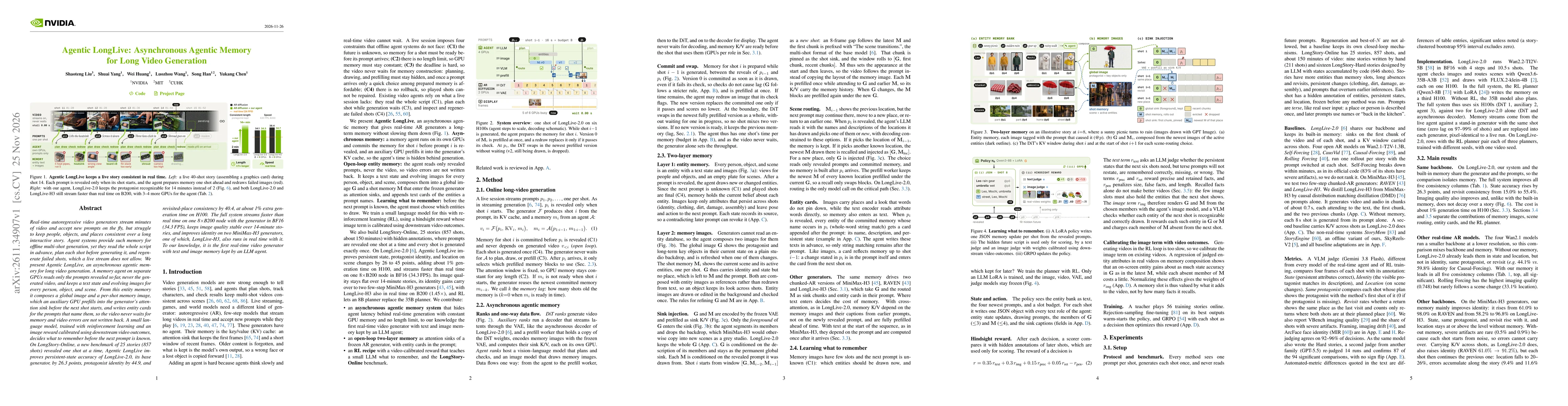
Real-time autoregressive video generators stream minutes of video and accept new prompts on the fly, but struggle to keep people, objects, and places consistent over a long interactive story. Agent systems provide such memory for offline multi-shot generation, yet they read the whole script in advance, plan each shot before generating it, and regenerate failed shots, which a live stream does not allow. We present Agentic LongLive, an asynchronous agentic memory for long video generation. A memory agent on separate GPUs reads only the prompts revealed so far, never the generated video, and keeps a text state and evolving images for every person, object, and scene. From this entity memory it composes a global image and a per-shot memory image, which an auxiliary GPU prefills into the generator's attention sink before the next shot starts, and writes entity cards for the prompts that name them, so the video never waits for memory and video errors are not written back. A small language model, trained with reinforcement learning and an image reward calibrated using downstream video outcomes, decides what to remember before the next prompt is known. On LongStory-Online, a new benchmark of 25 stories (857 shots) revealed one shot at a time, Agentic LongLive improves persistent-state accuracy of LongLive-2.0, its base generator, by 26.3 points, protagonist identity by 44.9, and revisited-place consistency by 40.4, at about 1% extra generation time on H100. The full system streams faster than real time on one 8xB200 node with the generator in BF16 (34.3 FPS), keeps image quality stable over 14-minute stories, and improves identity on two MiniMax-H3 generators, one of which, LongLive-H3, also runs in real time with it. To our knowledge, it is the first real-time video generator with text and image memory kept by an LLM agent.
Target-Part Preference Optimization for Part-Aware 3D Generation
Zishan Qin, Rui Li, Zeyu Zhang +3 more · Nov 23, 2026
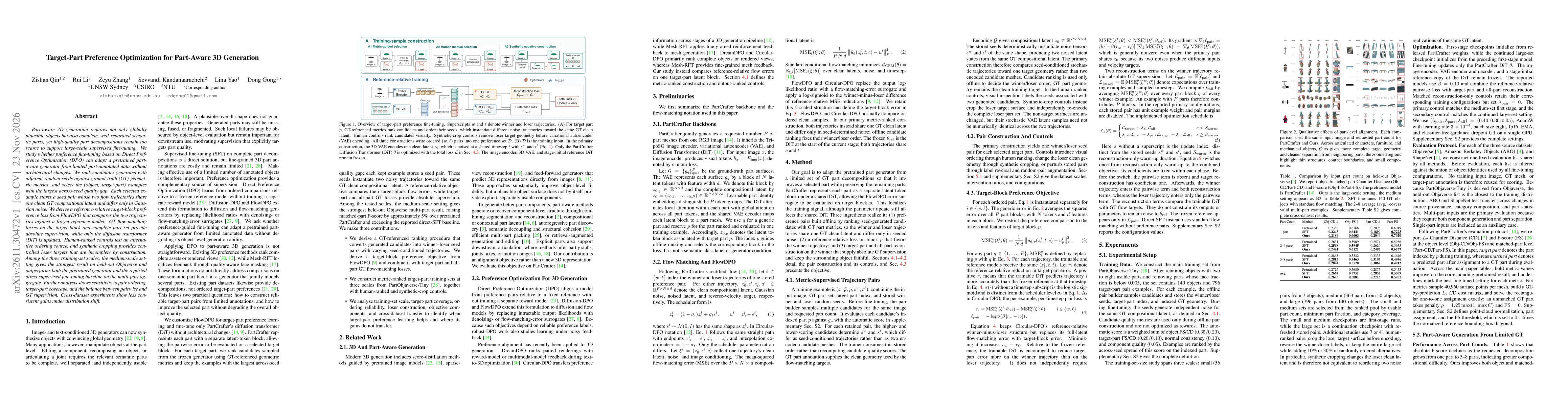
Part-aware 3D generation requires not only globally plausible objects but also complete, well-separated semantic parts, yet high-quality part decompositions remain too scarce to support large-scale supervised fine-tuning. We study whether preference fine-tuning based on Direct Preference Optimization (DPO) can adapt a pretrained part-aware generator from limited part-annotated data without architectural changes. We rank candidates generated with different random seeds against ground-truth (GT) geometric metrics, and select the (object, target-part) examples with the largest across-seed quality gap. Each selected example stores a seed pair whose two flow trajectories share one clean GT compositional latent and differ only in Gaussian noise. We derive a reference-relative target-block preference loss from FlowDPO that compares the two trajectories against a frozen reference model. GT flow-matching losses on the target block and complete part set provide absolute supervision, while only the diffusion transformer (DiT) is updated. Human-ranked controls test an alternative ordering source, and synthetic cropping provides controlled loser targets that are incomplete by construction. Among the three training-set scales, the medium-scale setting gives the strongest result on held-out Objaverse and outperforms both the pretrained generator and the reported direct supervised fine-tuning baseline on the multi-part aggregate. Further analysis shows sensitivity to pair ordering, target-part coverage, and the balance between pairwise and GT supervision. Cross-dataset experiments show less consistent gains under distribution shift.
Let Vision-Language Models Generate Images through Their Representations
JB Kim, Byungwoo Jeon, Kyungmin Lee +5 more · Nov 23, 2026
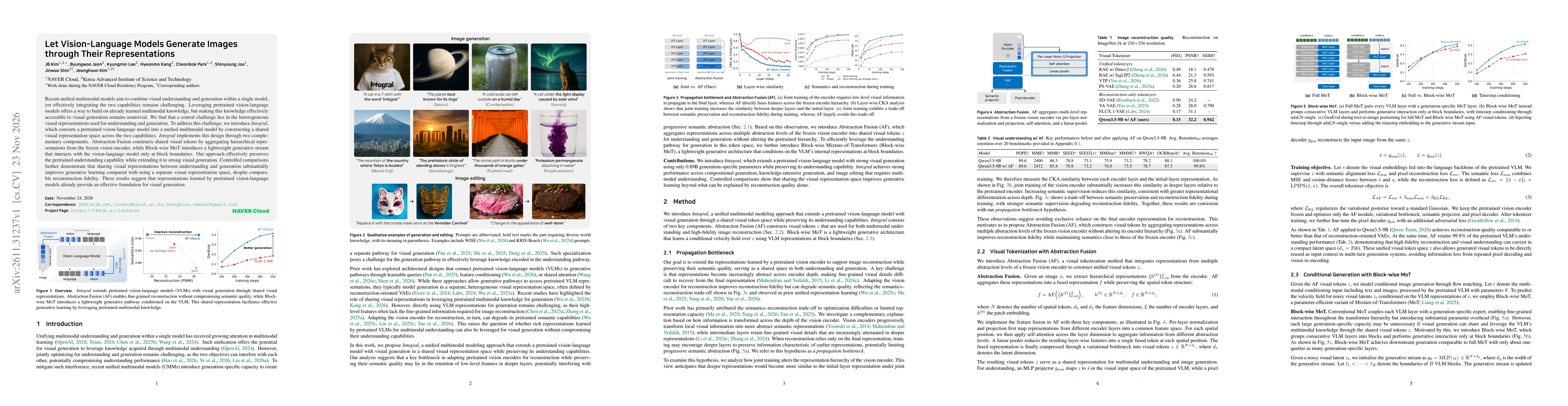
Recent unified multimodal models aim to combine visual understanding and generation within a single model, yet effectively integrating the two capabilities remains challenging. Leveraging pretrained vision-language models offers a way to build on already learned multimodal knowledge, but making this knowledge effectively accessible to visual generation remains nontrivial. We find that a central challenge lies in the heterogeneous visual representations used for understanding and generation. To address this challenge, we introduce Integral, which converts a pretrained vision-language model into a unified multimodal model by constructing a shared visual representation space across the two capabilities. Integral implements this design through two complementary components. Abstraction Fusion constructs shared visual tokens by aggregating hierarchical representations from the frozen vision encoder, while Block-wise MoT introduces a lightweight generative stream that interacts with the vision-language model only at block boundaries. Our approach effectively preserves the pretrained understanding capability while extending it to strong visual generation. Controlled comparisons further demonstrate that sharing visual representations between understanding and generation substantially improves generative learning compared with using a separate visual representation space, despite comparable reconstruction fidelity. These results suggest that representations learned by pretrained vision-language models already provide an effective foundation for visual generation.
Playfulness as Feedback for Agentic Game Development
Weijia Mao, Kevin Qinghong Lin, Zhen Fang +3 more · Nov 24, 2026
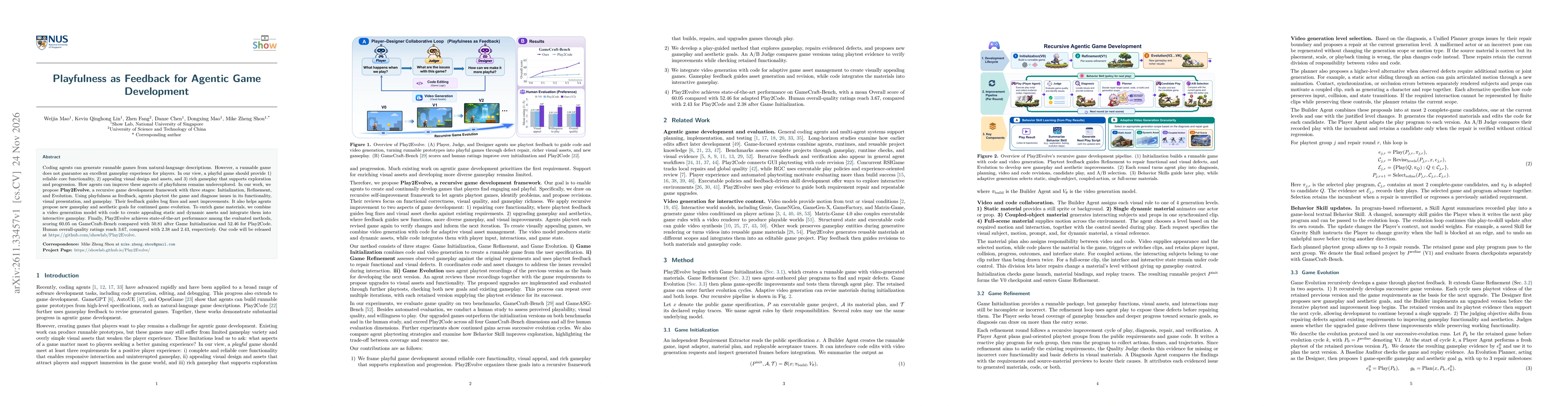
Coding agents can generate runnable games from natural-language descriptions. However, a runnable game does not guarantee an excellent gameplay experience for players. In our view, a playful game should provide 1) reliable core functionality, 2) appealing visual design and assets, and 3) rich gameplay that supports exploration and progression. How agents can improve these aspects of playfulness remains underexplored. In our work, we propose Play2Evolve, a recursive game development framework with three stages: Initialization, Refinement, and Evolution. Using playfulness as feedback, agents playtest the game and diagnose issues in its functionality, visual presentation, and gameplay. Their feedback guides bug fixes and asset improvements. It also helps agents propose new gameplay and aesthetic goals for continued game evolution. To enrich game materials, we combine a video generation model with code to create appealing static and dynamic assets and integrate them into interactive gameplay. Finally, Play2Evolve achieves state-of-the-art performance among the evaluated methods, scoring 60.05 on GameCraft-Bench compared with 50.81 after Game Initialization and 52.46 for Play2Code. Human overall-quality ratings reach 3.67, compared with 2.38 and 2.43, respectively. Our code will be released at https://github.com/showlab/Play2Evolve.
EgoUseBench: Benchmarking Computer-Use Agents under Evolving First-Person Contexts
Yurun Chen, Biao Yi, Qihang Yu +2 more · Nov 25, 2026
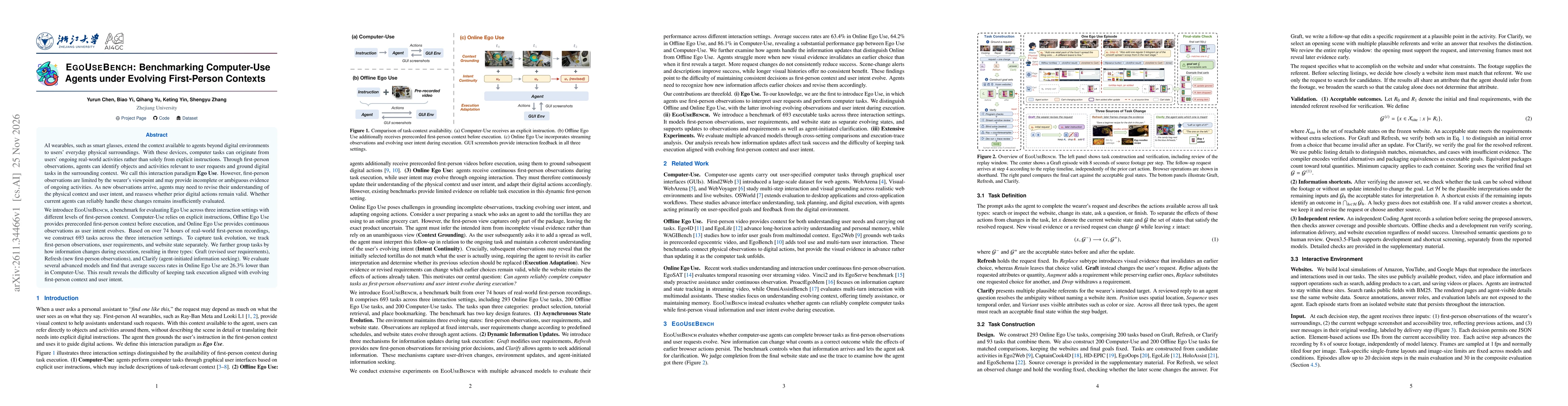
AI wearables, such as smart glasses, extend the context available to agents beyond digital environments to users' physical surroundings. With these devices, computer tasks can originate from users' ongoing activities rather than solely from explicit instructions. Through first-person observations, agents can identify objects and activities relevant to user requests and ground digital tasks in the surrounding context. We call this interaction paradigm Ego Use. However, first-person observations are limited by the wearer's viewpoint and may provide incomplete or ambiguous evidence of ongoing activities. As new observations arrive, agents may need to revise their understanding of the physical context and user intent, and reassess whether prior digital actions remain valid. Whether current agents can reliably handle these changes remains insufficiently evaluated. We introduce EgoUseBench, a benchmark for evaluating Ego Use across three interaction settings with different levels of first-person context. Computer-Use relies on explicit instructions, Offline Ego Use provides prerecorded first-person context before execution, and Online Ego Use provides continuous observations as user intent evolves. Based on over 74 hours of real-world first-person recordings, we construct 693 tasks across the three interaction settings. To capture task evolution, we track first-person observations, user requirements, and website state separately. We further group tasks by how information changes during execution, resulting in three types: Graft (revised user requirements), Refresh (new first-person observations), and Clarify (agent-initiated information seeking). We evaluate advanced models and find that average success rates in Online Ego Use are 26.3% lower than in Computer-Use. This result reveals the difficulty of keeping task execution aligned with evolving first-person context and user intent.
Beyond Self-Consistency: Recursive Self-Improvement at Test Time
Jianyu Wu, Yizhou Wang, Encheng Su +7 more · Nov 23, 2026
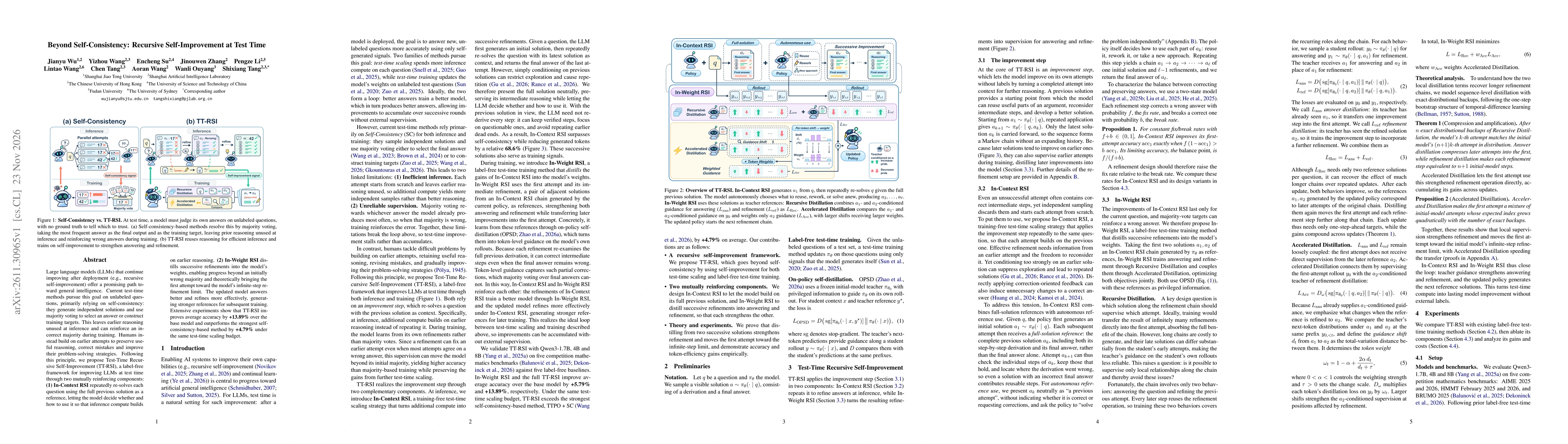
Large language models (LLMs) that continue improving after deployment (e.g., recursive self-improvement) offer a promising path toward general intelligence. Current test-time methods pursue this goal on unlabeled questions, primarily relying on self-consistency: they generate independent solutions and use majority voting to select an answer or construct training targets. This leaves earlier reasoning unused at inference and can reinforce an incorrect majority during training. Humans instead build on earlier attempts to preserve useful reasoning, correct mistakes and improve their problem-solving strategies. Following this principle, we propose Test-Time Recursive Self-Improvement (TT-RSI), a label-free framework for improving LLMs at test time through two mutually reinforcing components: (1) In-Context RSI repeatedly re-solves each question using the full previous solution as a reference, letting the model decide whether and how to use it so that inference compute builds on earlier reasoning. (2) In-Weight RSI distills successive refinements into the model's weights, enabling progress beyond an initially wrong majority and theoretically bringing the first attempt toward the model's infinite-step refinement limit. The updated model answers better and refines more effectively, generating stronger references for subsequent training. Extensive experiments show that TT-RSI improves average accuracy by +13.89% over the base model and outperforms the strongest self-consistency-based method by +4.79% under the same test-time scaling budget.
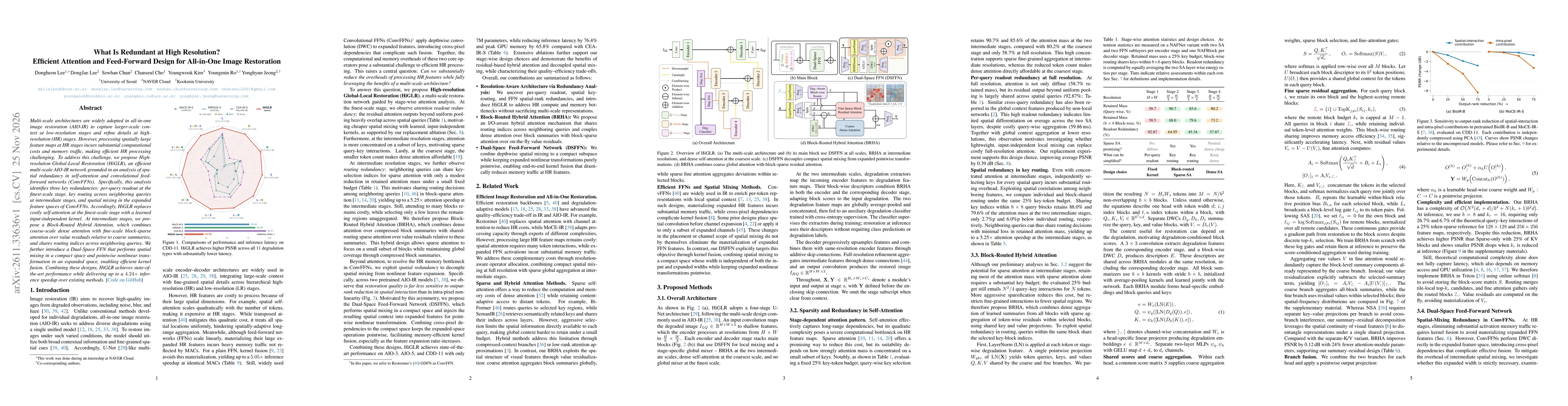
What Is Redundant at High Resolution? Efficient Attention and Feed-Forward Design for All-in-One Image Restoration
Dongheon Lee, DongJae Lee, Sewhan Chun +4 more · Nov 25, 2026
Multi-scale architectures are widely adopted in all-in-one image restoration (AIO-IR) to capture larger-scale context at low-resolution stages and refine details at high-resolution (HR) stages. However, processing spatially large feature maps at HR stages incurs substantial computational costs and memory traffic, making efficient HR processing challenging. To address this challenge, we propose High-resolution Global-Local Restoration (HiGLR), an efficient multi-scale AIO-IR network grounded in an analysis of spatial redundancy in self-attention and convolutional feed-forward networks (ConvFFNs). Specifically, this analysis identifies three key redundancies: per-query readout at the finest-scale stage, key routing across neighboring queries at intermediate stages, and spatial mixing in the expanded feature spaces of ConvFFNs. Accordingly, HiGLR replaces costly self-attention at the finest-scale stage with a learned input-independent kernel. At intermediate stages, we propose a Block-Routed Hybrid Attention, which combines coarse-scale dense attention with fine-scale block-sparse attention over value residuals relative to coarse summaries, and shares routing indices across neighboring queries. We further introduce a Dual-Space FFN that performs spatial mixing in a compact space and pointwise nonlinear transformation in an expanded space, enabling efficient kernel fusion. Combining these designs, HiGLR achieves state-of-the-art performance while delivering up to a 4.24times inference speedup over existing methods.
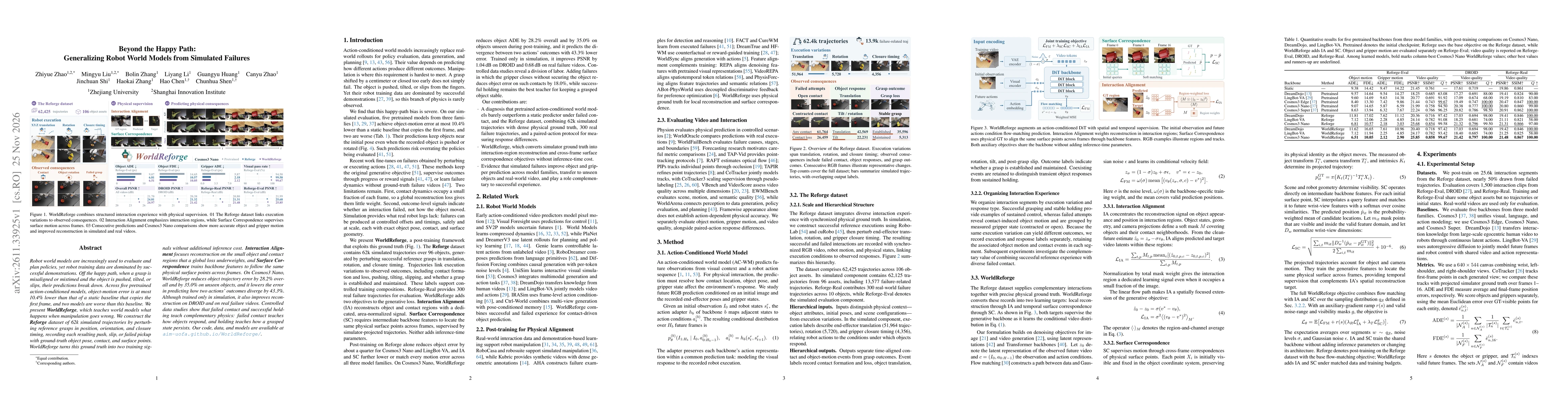
Beyond the Happy Path: Generalizing Robot World Models from Simulated Failures
Zhiyue Zhao, Mingyu Liu, Bolin Zhang +7 more · Nov 25, 2026
Robot world models are increasingly used to evaluate and plan policies, yet robot training data are dominated by successful demonstrations. Off the happy path, when a grasp is misaligned or mistimed and the object is pushed, tilted, or slips, their predictions break down. Across five pretrained action-conditioned models, object-motion error is at most 10.4% lower than that of a static baseline that copies the first frame, and two models are worse than this baseline. We present WorldReforge, which teaches world models what happens when manipulation goes wrong. We construct the Reforge dataset of 62k simulated trajectories by perturbing reference grasps in position, orientation, and closure timing, recording each resulting push, slip, or failed pickup with ground-truth object pose, contact, and surface points. WorldReforge turns this ground truth into two training signals without additional inference cost. Interaction Alignment focuses reconstruction on the small object and contact regions that a global loss underweights, and Surface Correspondence trains backbone features to follow the same physical surface points across frames. On Cosmos3 Nano, WorldReforge reduces object trajectory error by 28.2% overall and by 35.0% on unseen objects, and it lowers the error in predicting how two actions' outcomes diverge by 43.3%. Although trained only in simulation, it also improves reconstruction on DROID and on real failure videos. Controlled data studies show that failed contact and successful holding teach complementary physics: failed contact teaches how objects respond, and holding teaches how a grasped state persists. Our code, data, and models are available at aim-uofa.github.io/WorldReforge/.
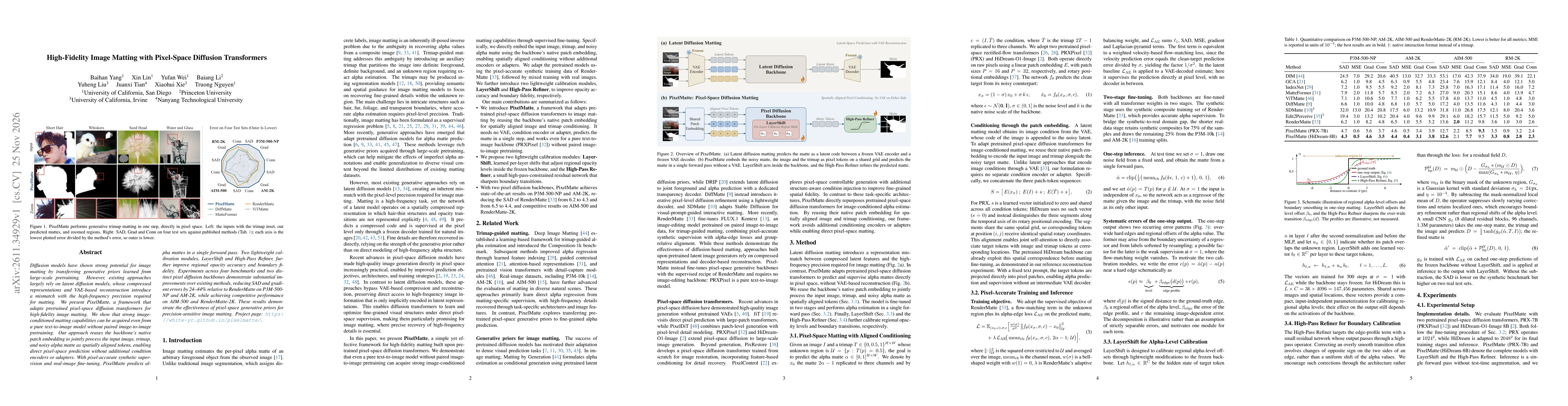
High-Fidelity Image Matting with Pixel-Space Diffusion Transformers
Baihan Yang, Xin Lin, Yufan Wei +5 more · Nov 25, 2026
Diffusion models have shown strong potential for image matting by transferring generative priors learned from large-scale pretraining. However, existing approaches largely rely on latent diffusion models, whose compressed representations and VAE-based reconstruction introduce a mismatch with the high-frequency precision required for matting. We present PixelMatte, a framework that adapts pretrained pixel-space diffusion transformers for high-fidelity image matting. We show that strong image-conditioned matting capabilities can be acquired even from a pure text-to-image model without paired image-to-image pretraining. Our approach reuses the backbone's native patch embedding to jointly process the input image, trimap, and noisy alpha matte as spatially aligned tokens, enabling direct pixel-space prediction without additional condition encoders or adapters. With pixel-accurate synthetic supervision and real-image fine-tuning, PixelMatte predicts alpha mattes in a single forward pass. Two lightweight calibration modules, LayerShift and High-Pass Refiner, further improve regional opacity accuracy and boundary fidelity. Experiments across four benchmarks and two distinct pixel diffusion backbones demonstrate substantial improvements over existing methods, reducing SAD and gradient errors by 24-44% relative to RenderMatte on P3M-500-NP and AM-2K, while achieving competitive performance on AIM-500 and RenderMatte-2K. These results demonstrate the effectiveness of pixel-space generative priors for precision-sensitive image matting. Project page: https://white-yc.github.io/pixelmatte/.
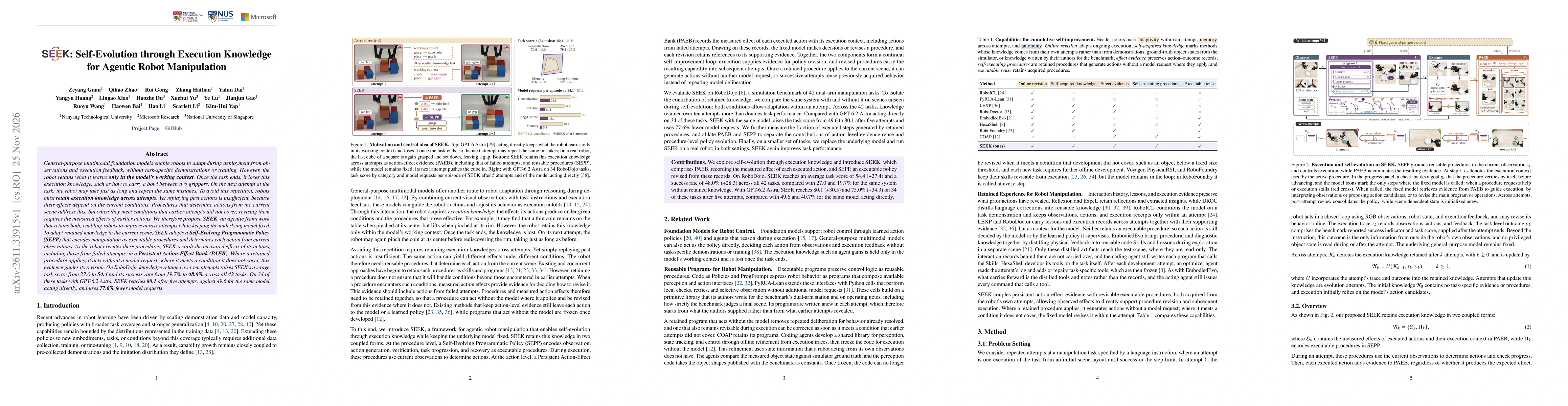
SEEK: Self-Evolution through Execution Knowledge for Agentic Robot Manipulation
Zeyang Guan, Qihao Zhao, Rui Gong +13 more · Nov 25, 2026
General-purpose multimodal foundation models enable robots to adapt during deployment from observations and execution feedback, without task-specific demonstrations or training. However, the robot retains what it learns only in the model's working context. Once the task ends, it loses this execution knowledge, such as how to carry a bowl between two grippers. On the next attempt at the task, the robot may take just as long and repeat the same mistakes. To avoid this repetition, robots must retain execution knowledge across attempts. Yet replaying past actions is insufficient, because their effects depend on the current conditions. Procedures that determine actions from the current scene address this, but when they meet conditions that earlier attempts did not cover, revising them requires the measured effects of earlier actions. We therefore propose SEEK, an agentic framework that retains both, enabling robots to improve across attempts while keeping the underlying model fixed. To adapt retained knowledge to the current scene, SEEK adopts a Self-Evolving Programmatic Policy (SEPP) that encodes manipulation as executable procedures and determines each action from current observations. As the robot executes these procedures, SEEK records the measured effects of its actions, including those from failed attempts, in a Persistent Action-Effect Bank (PAEB). Where a retained procedure applies, it acts without a model request; where it meets a condition it does not cover, this evidence guides its revision. On RoboDojo, knowledge retained over ten attempts raises SEEK's average task score from 27.0 to 54.4 and its success rate from 19.7% to 48.0% across all 42 tasks. On 34 of these tasks with GPT-6.2 Astra, SEEK reaches 80.1 after five attempts, against 49.6 for the same model acting directly, and uses 77.6% fewer model requests. https://zeyangguan.github.io/SEEK-Agentic-Robot-Manipulation/