Trending on arXiv
Today's most upvoted papers on arXiv
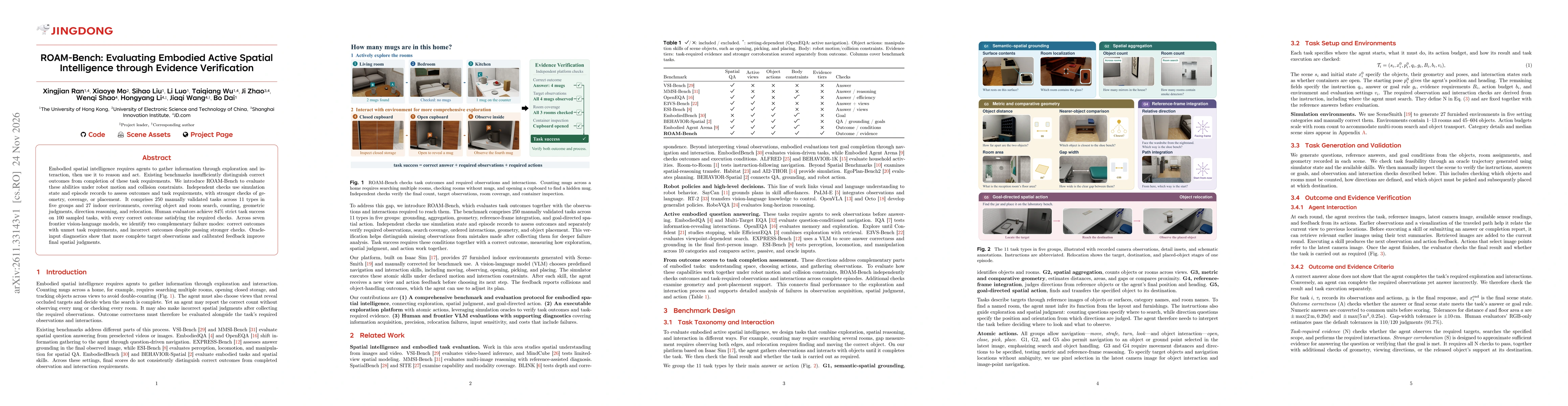
ROAM-Bench: Evaluating Embodied Active Spatial Intelligence through Evidence Verification
Xingjian Ran, Xiaoye Mo, Sihao Liu +7 more · Nov 24, 2026
Embodied spatial intelligence requires agents to gather information through exploration and interaction, then use it to reason and act. Existing benchmarks insufficiently distinguish correct outcomes from completion of these task requirements. We introduce ROAM-Bench to evaluate these abilities under robot motion and collision constraints. Independent checks use simulation state and episode records to assess outcomes and task requirements, with stronger checks of geometry, coverage, or placement. It comprises 250 manually validated tasks across 11 types in five groups and 27 indoor environments, covering object and room search, counting, geometric judgments, direction reasoning, and relocation. Human evaluators achieve 84% strict task success on 100 sampled tasks, with every correct outcome satisfying the required checks. Across seven frontier vision-language models, we identify two complementary failure modes: correct outcomes with unmet task requirements, and incorrect outcomes despite passing stronger checks. Oracle-input diagnostics show that more complete target observations and calibrated feedback improve final spatial judgments.
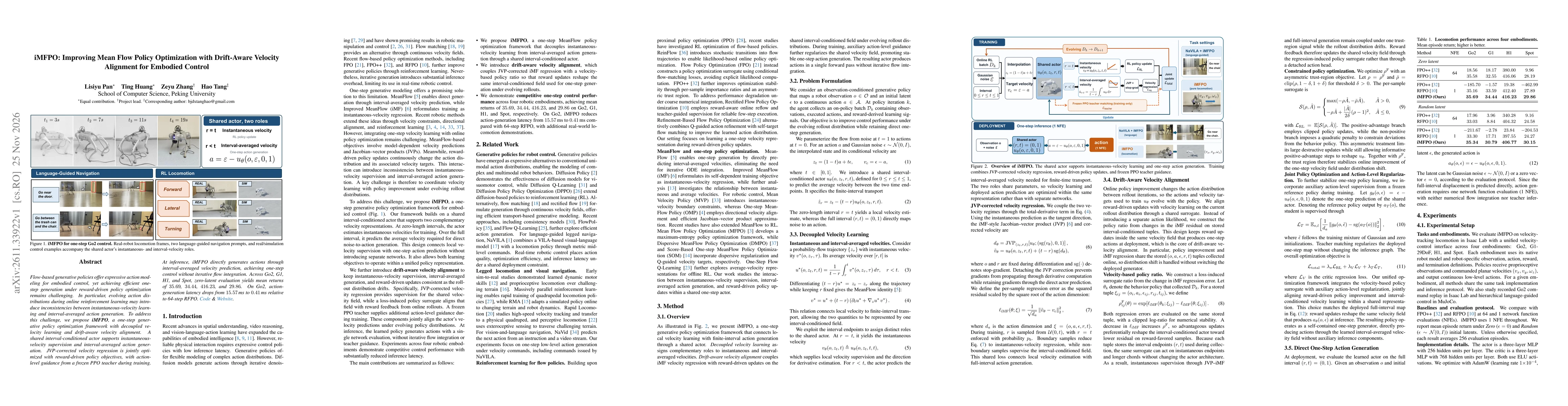
iMFPO: Improving Mean Flow Policy Optimization with Drift-Aware Velocity Alignment for Embodied Control
Lisiyu Pan, Ting Huang, Zeyu Zhang +1 more · Nov 25, 2026
Flow-based generative policies offer expressive action modeling for embodied control, yet achieving efficient one-step generation under reward-driven policy optimization remains challenging. In particular, evolving action distributions during online reinforcement learning may introduce inconsistencies between instantaneous-velocity learning and interval-averaged action generation. To address this challenge, we propose iMFPO, a one-step generative policy optimization framework with decoupled velocity learning and drift-aware velocity alignment. A shared interval-conditioned actor supports instantaneous-velocity supervision and interval-averaged action generation. JVP-corrected velocity regression is jointly optimized with reward-driven policy objectives, with action-level guidance from a frozen PPO teacher during training. At inference, iMFPO directly generates actions through interval-averaged velocity prediction, achieving one-step control without iterative flow integration. Across Go2, G1, H1, and Spot, zero-latent evaluation yields mean returns of 35.69, 34.44, 416.23, and 29.86. On Go2, action-generation latency drops from 15.57 ms to 0.41 ms relative to 64-step RFPO. Code: https://github.com/AIGeeksGroup/iMFPO. Website: https://aigeeksgroup.github.io/iMFPO.
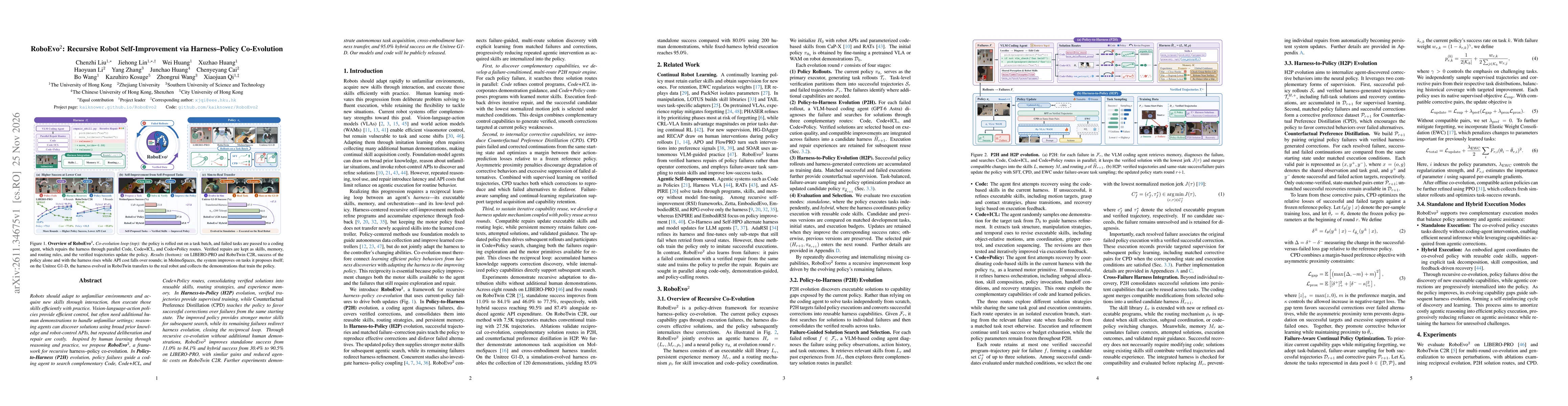
RoboEvo^2: Recursive Robot Self-Improvement via Harness-Policy Co-Evolution
Chenzhi Liu, Jiehong Lin, Wei Huang +9 more · Nov 25, 2026
Robots should adapt to unfamiliar environments and acquire new skills through interaction, then execute those skills efficiently with practice. Vision-language-action policies provide efficient control, but often need additional human demonstrations to handle unfamiliar settings; reasoning agents can discover solutions using broad prior knowledge and robot-control APIs, but repeated deliberation and repair are costly. Inspired by human learning through reasoning and practice, we propose RoboEvo^2, a framework for recursive harness-policy co-evolution. In Policy-to-Harness (P2H) evolution, policy failures guide a coding agent to search complementary Code, Code+ICL, and Code+Policy routes, consolidating verified solutions into reusable skills, routing strategies, and experience memory. In Harness-to-Policy (H2P) evolution, verified trajectories provide supervised training, while Counterfactual Preference Distillation (CPD) teaches the policy to favor successful corrections over failures from the same starting state. The improved policy provides stronger motor skills for subsequent search, while its remaining failures redirect harness evolution, closing the reciprocal loop. Through recursive co-evolution without additional human demonstrations, RoboEvo^2 improves standalone success from 11.0% to 84.1% and hybrid success from 30.4% to 90.5% on LIBERO-PRO, with similar gains and reduced agentic costs on RoboTwin C2R. Further experiments demonstrate autonomous task acquisition, cross-embodiment harness transfer, and 95.0% hybrid success on the Unitree G1-D. Our models and code will be publicly released.
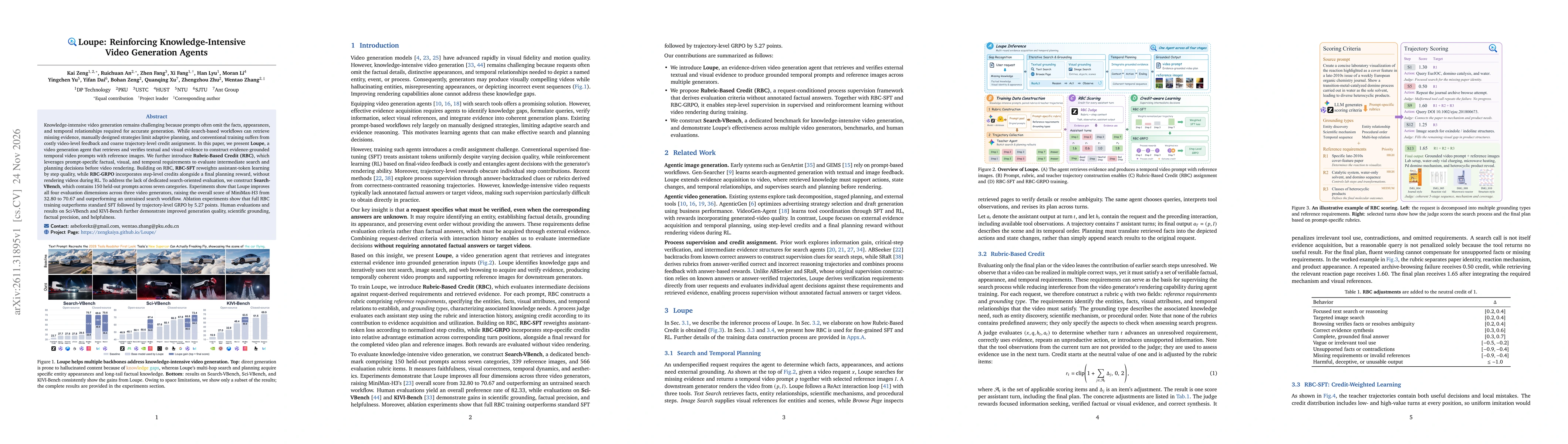
Loupe: Reinforcing Knowledge-Intensive Video Generation Agents
Kai Zeng, Ruichuan An, Zhen Fang +9 more · Nov 24, 2026
Knowledge-intensive video generation remains challenging because prompts often omit the facts, appearances, and temporal relationships required for accurate generation. While search-based workflows can retrieve missing evidence, manually designed strategies limit adaptive planning, and conventional training suffers from costly video-level feedback and coarse trajectory-level credit assignment. In this paper, we present Loupe, a video generation agent that retrieves and verifies textual and visual evidence to construct evidence-grounded temporal video prompts with reference images. We further introduce Rubric-Based Credit (RBC), which leverages prompt-specific factual, visual, and temporal requirements to evaluate intermediate search and planning decisions before video rendering. Building on RBC, RBC-SFT reweights assistant-token learning by step quality, while RBC-GRPO incorporates step-level credits alongside a final planning reward, without rendering videos during RL. To address the lack of dedicated search-oriented evaluation, we construct Search-VBench, which contains 150 held-out prompts across seven categories. Experiments show that Loupe improves all four evaluation dimensions across three video generators, raising the overall score of MiniMax-H3 from 32.80 to 70.67 and outperforming an untrained search workflow. Ablation experiments show that full RBC training outperforms standard SFT followed by trajectory-level GRPO by 5.27 points. Human evaluations and results on Sci-VBench and KIVI-Bench further demonstrate improved generation quality, scientific grounding, factual precision, and helpfulness. Our project page is available at https://zengkaiya.github.io/Loupe/.
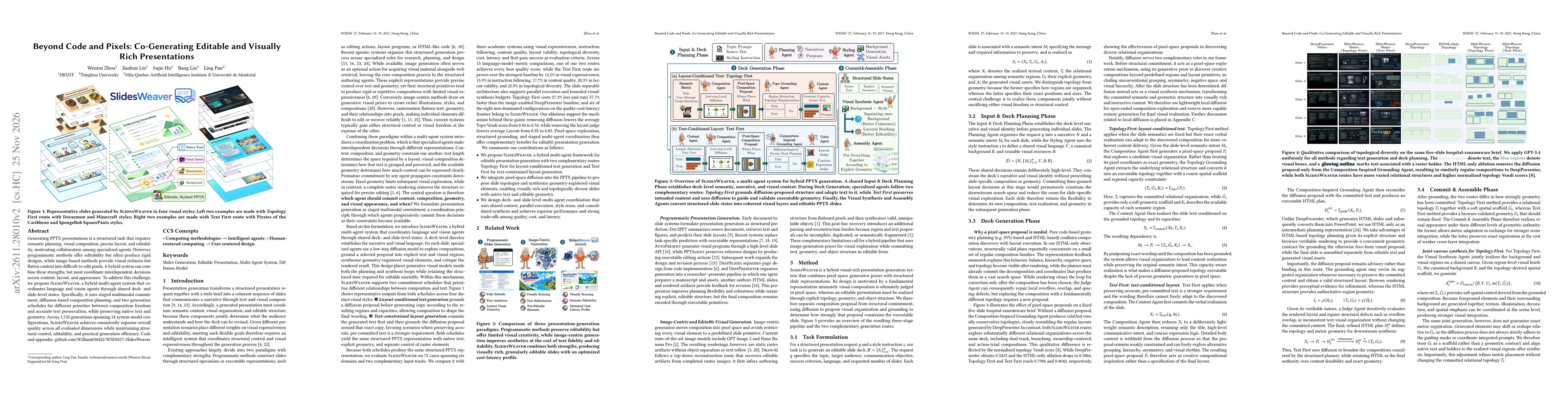
Beyond Code and Pixels: Co-Generating Editable and Visually Rich Presentations
Wenrui Zhou, Jiashun Liu, Sujie Hu +2 more · Nov 25, 2026
Generating PPTX presentations is a structured task that requires semantic planning, visual composition, precise layout, and editability, motivating collaboration among specialized agents. However, programmatic methods offer editability but often produce rigid designs, while image-based methods provide visual richness but flatten content into difficult-to-edit pixels. A hybrid system can combine these strengths, but must coordinate interdependent decisions across content, layout, and appearance. To address this challenge, we propose SlidesWeaver, a hybrid multi-agent system that coordinates language and vision agents through shared deck- and slide-level states. Specifically, it uses staged multimodal commitment, diffusion-based composition planning, and two generation schedules for different priorities between composition freedom and accurate text preservation, while preserving native text and geometry. Across 1,728 generations spanning 24 system-model configurations, SlidesWeaver achieves consistently superior overall quality across all evaluated dimensions while maintaining structural control, editability, and practical generation efficiency.
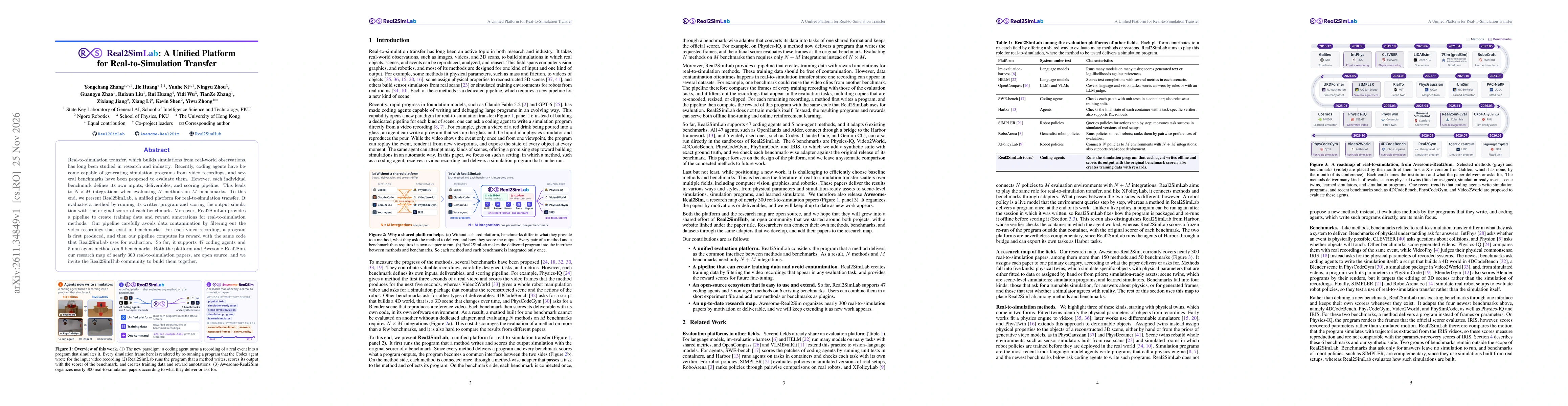
Real2SimLab: A Unified Platform for Real-to-Simulation Transfer
Yongchang Zhang, Jie Huang, Yunhe Ni +10 more · Nov 25, 2026
Real-to-simulation transfer, which builds simulations from real-world observations, has long been studied in research and industry. Recently, coding agents have become capable of generating simulation programs from video recordings, and several benchmarks have been proposed to evaluate them. However, each individual benchmark defines its own inputs, deliverables, and scoring pipeline. This leads to N times M integrations when evaluating N methods on M benchmarks. To this end, we present Real2SimLab, a unified platform for real-to-simulation transfer. It evaluates a method by running its written program and scoring the output simulation with the original scorer of each benchmark. Moreover, Real2SimLab provides a pipeline to create training data and reward annotations for real-to-simulation methods. Our pipeline carefully avoids data contamination by filtering out the video recordings that exist in benchmarks. For each video recording, a program is first produced, and then our pipeline computes its reward with the same code that Real2SimLab uses for evaluation. So far, it supports 47 coding agents and 5 non-agent methods on 6 benchmarks. Both the platform and Awesome-Real2Sim, our research map of nearly 300 real-to-simulation papers, are open source, and we invite the Real2SimHub community to build them together.
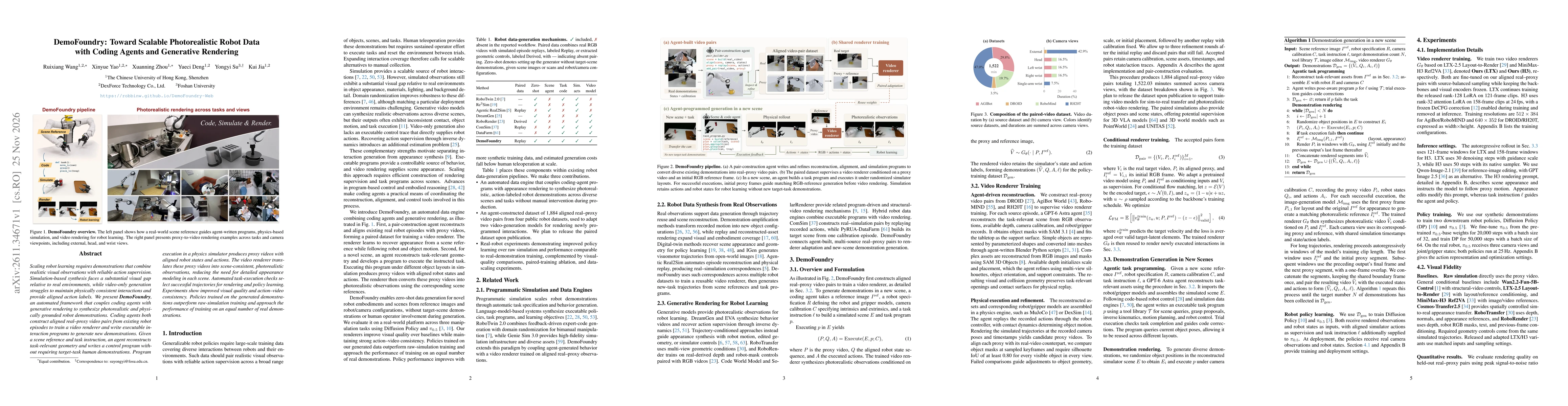
DemoFoundry: Toward Scalable Photorealistic Robot Data with Coding Agents and Generative Rendering
Ruixiang Wang, Xinyue Yao, Xuanning Zhou +3 more · Nov 25, 2026
Scaling robot learning requires demonstrations that combine realistic visual observations with reliable action supervision. Simulation-based synthesis faces a substantial visual gap relative to real environments, while video-only generation struggles to maintain physically consistent interactions and provide aligned action labels. We present DemoFoundry, an automated framework that couples coding agents with generative rendering to synthesize photorealistic and physically grounded robot demonstrations. Coding agents both construct aligned real--proxy video pairs from existing robot episodes to train a video renderer and write executable interaction programs to generate new demonstrations. Given a scene reference and task instruction, an agent reconstructs task-relevant geometry and writes a control program without requiring target-task human demonstrations. Program execution in a physics simulator produces proxy videos with aligned robot states and actions. The video renderer translates these proxy videos into scene-consistent, photorealistic observations, reducing the need for detailed appearance modeling in each scene. Automated task-execution checks select successful trajectories for rendering and policy learning. Experiments show improved visual quality and action--video consistency. Policies trained on the generated demonstrations outperform raw-simulation training and approach the performance of training on an equal number of real demonstrations.
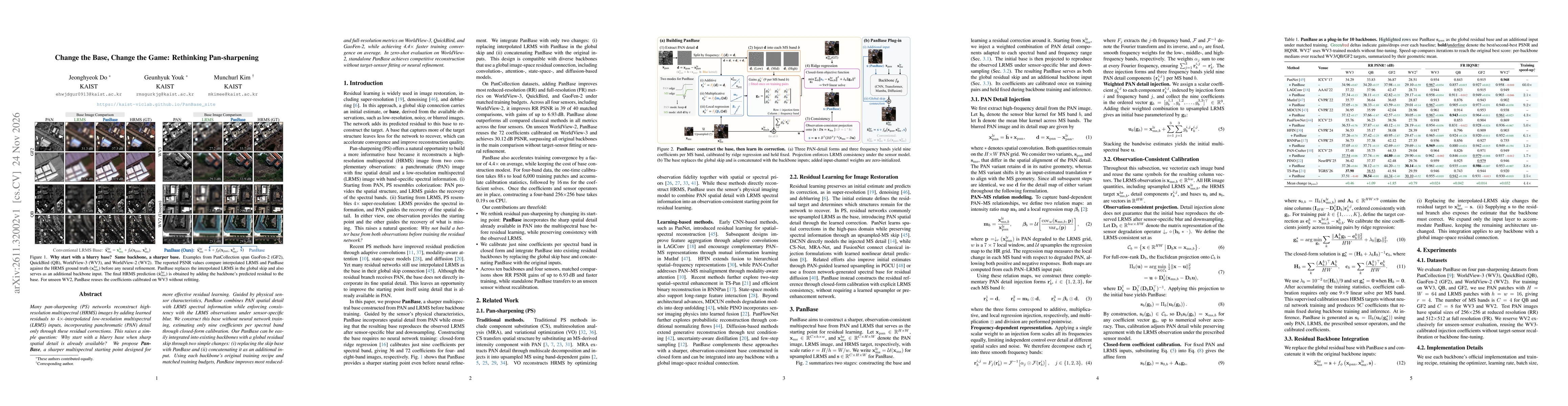
Change the Base, Change the Game: Rethinking Pan-sharpening
Jeonghyeok Do, Geunhyuk Youk, Munchurl Kim · Nov 24, 2026
Many pan-sharpening (PS) networks reconstruct high-resolution multispectral (HRMS) images by adding learned residuals to 4times-interpolated low-resolution multispectral (LRMS) inputs, incorporating panchromatic (PAN) detail only through these residual corrections. This raises a simple question: Why start with a blurry base when sharp spatial detail is already available? We propose PanBase, a sharper multispectral starting point designed for more effective residual learning. Guided by physical sensor characteristics, PanBase combines PAN spatial detail with LRMS spectral information while enforcing consistency with the LRMS observations under sensor-specific blur. We construct this base without neural network training, estimating only nine coefficients per spectral band through closed-form calibration. Our PanBase can be easily integrated into existing backbones with a global residual skip through two simple changes: (i) replacing the skip base with PanBase and (ii) concatenating it as an additional input. Using each backbone's original training recipe and matched training budgets, PanBase improves most reduced- and full-resolution metrics on WorldView-3, QuickBird, and GaoFen-2, while achieving 4.4times faster training convergence on average. In zero-shot evaluation on WorldView-2, standalone PanBase achieves competitive reconstruction without target-sensor fitting or neural refinement.
OmniPersist: Persistent Dynamic World Modeling via Coupled Panoramic Evolution
Zhilu Zhang, Xiaoyu Liu, Wenxi Liu +1 more · Nov 24, 2026
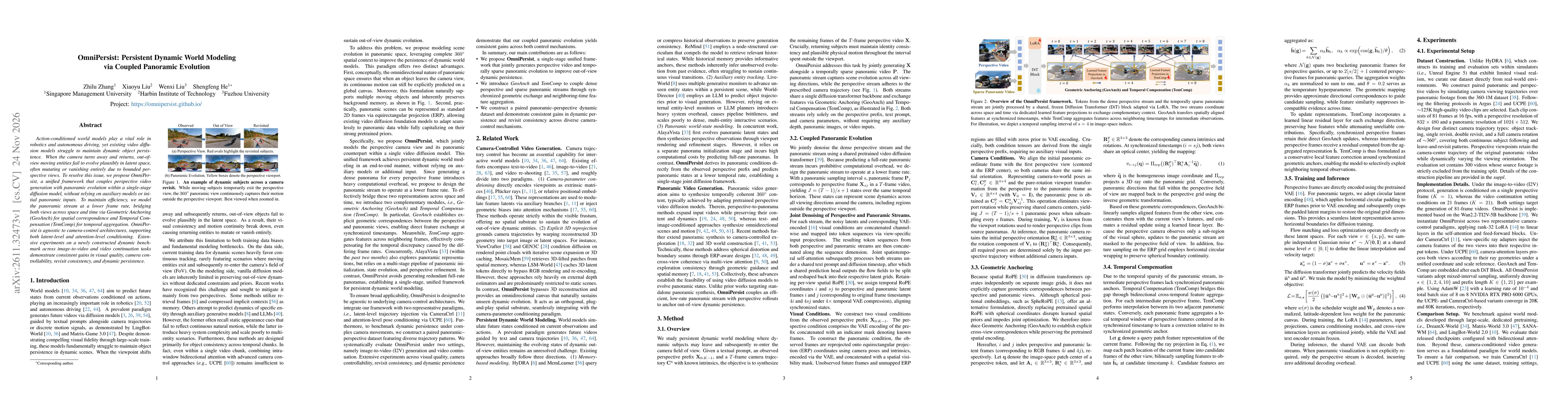
Action-conditioned world models play a vital role in robotics and autonomous driving, yet existing video diffusion models struggle to maintain dynamic object persistence. When the camera turns away and returns, out-of-view moving entities fail to evolve plausibly in latent space, often mutating or vanishing entirely due to bounded perspective views. To resolve this issue, we propose OmniPersist, a unified framework that couples perspective video generation with panoramic evolution within a single-stage diffusion model, without relying on auxiliary models or initial panoramic inputs. To maintain efficiency, we model the panoramic stream at a lower frame rate, bridging both views across space and time via Geometric Anchoring (GeoAnch) for spatial correspondence and Temporal Compensation (TemComp) for temporal aggregation. OmniPersist is agnostic to camera-control architectures, supporting both latent-level and attention-level conditioning. Extensive experiments on a newly constructed dynamic benchmark across image-to-video and video continuation tasks demonstrate consistent gains in visual quality, camera controllability, revisit consistency, and dynamic persistence.
Puzzling-Bench: Evaluating Language Models on 23,777 Human-Written Puzzles with Community-Verified Answers
Abhinav Sharma, Li Li, Chien Van Nguyen +13 more · Nov 25, 2026
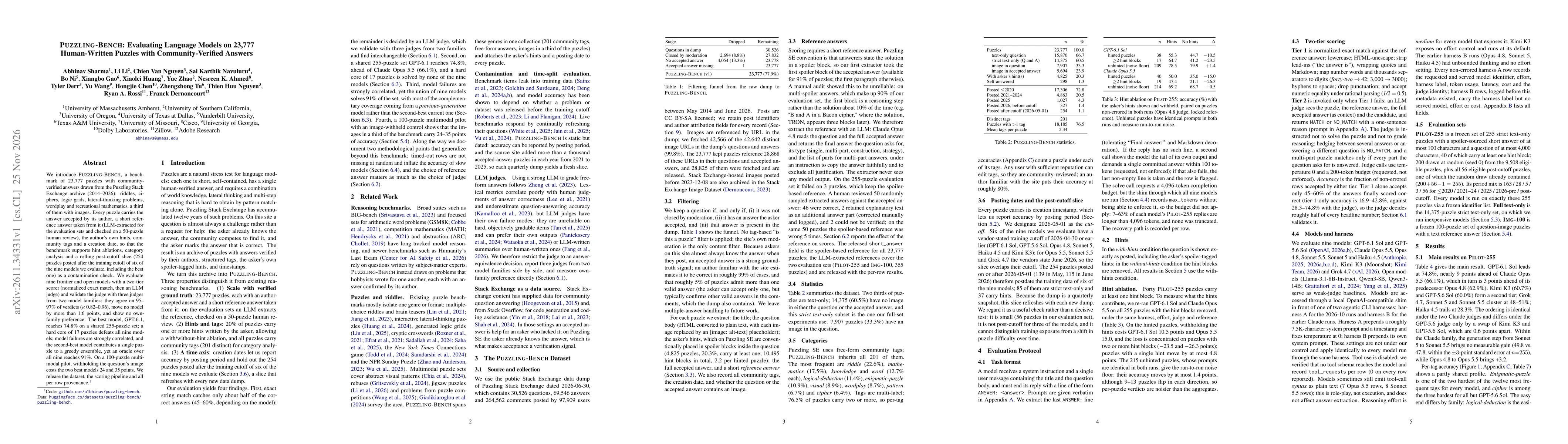
We introduce Puzzling-Bench, a benchmark of 23,777 puzzles with community-verified answers drawn from the Puzzling Stack Exchange archive (2014-2026): riddles, ciphers, logic grids, lateral-thinking problems, wordplay and recreational mathematics, a third of them with images. Every puzzle carries the answer accepted by its author, a short reference answer taken from it (LLM-extracted for the evaluation sets and checked on a 50-puzzle human review), the author's own hints, community tags and a creation date, so that the benchmark supports hint ablations, category analysis and a rolling post-cutoff slice (254 puzzles posted after the training cutoff of six of the nine models we evaluate, including the best one) as a contamination check. We evaluate nine frontier and open models with a two-tier scorer (normalized exact match, then an LLM judge) and validate the judge with three judges from two model families: they agree on 95-97% of verdicts (kappa 0.82-0.96), move no model by more than 1.6 points, and show no own-family preference. The best model, GPT-6.1, reaches 74.8% on a shared 255-puzzle set; a hard core of 17 puzzles defeats all nine models; model failures are strongly correlated, and the second-best model contributes a single puzzle to a greedy ensemble, yet an oracle over all nine reaches 91%. On a 100-puzzle multimodal pilot, withholding the question's image costs the two best models 24 and 35 points. We release the dataset, the scoring pipeline and all per-row provenance.
3D CoCa v3: Contrastive Learners with Scene Graphs for Urban Scene Understanding
Nannan Zhang, Ting Huang, Zeyu Zhang +3 more · Nov 25, 2026
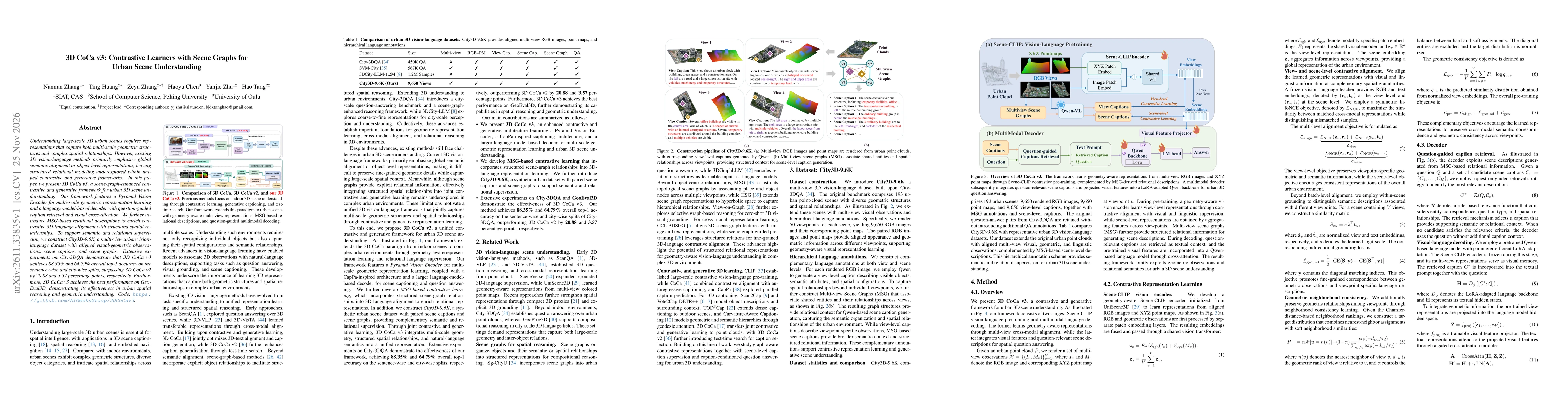
Understanding large-scale 3D urban scenes requires representations that capture both multi-scale geometric structures and complex spatial relationships. However, existing 3D vision-language methods primarily emphasize global semantic alignment or object-level representations, leaving structured relational modeling underexplored within unified contrastive and generative frameworks. In this paper, we present 3D CoCa v3, a scene-graph-enhanced contrastive and generative framework for urban 3D scene understanding. Our framework features a Pyramid Vision Encoder for multi-scale geometric representation learning and a language-model-based decoder with question-guided caption retrieval and visual cross-attention. We further introduce MSG-based relational descriptions to enrich contrastive 3D-language alignment with structured spatial relationships. To support semantic and relational supervision, we construct City3D-9.6K, a multi-view urban vision-language dataset with aligned visual-geometric observations, scene captions, and scene graphs. Extensive experiments on City-3DQA demonstrate that 3D CoCa v3 achieves 88.35% and 64.79% overall top-1 accuracy on the sentence-wise and city-wise splits, surpassing 3D CoCa v2 by 20.88 and 3.57 percentage points, respectively. Furthermore, 3D CoCa v3 achieves the best performance on GeoEval3D, demonstrating its effectiveness in urban spatial reasoning and geometric understanding. Code is available at https://github.com/AIGeeksGroup/3DCoCav3.
CONCOR: Benchmarking Contrastive Decoding for Visual Hallucination Mitigation Beyond Final-Output Performance
Ting Chen, Geng Li, Guohao Chen +1 more · Nov 25, 2026
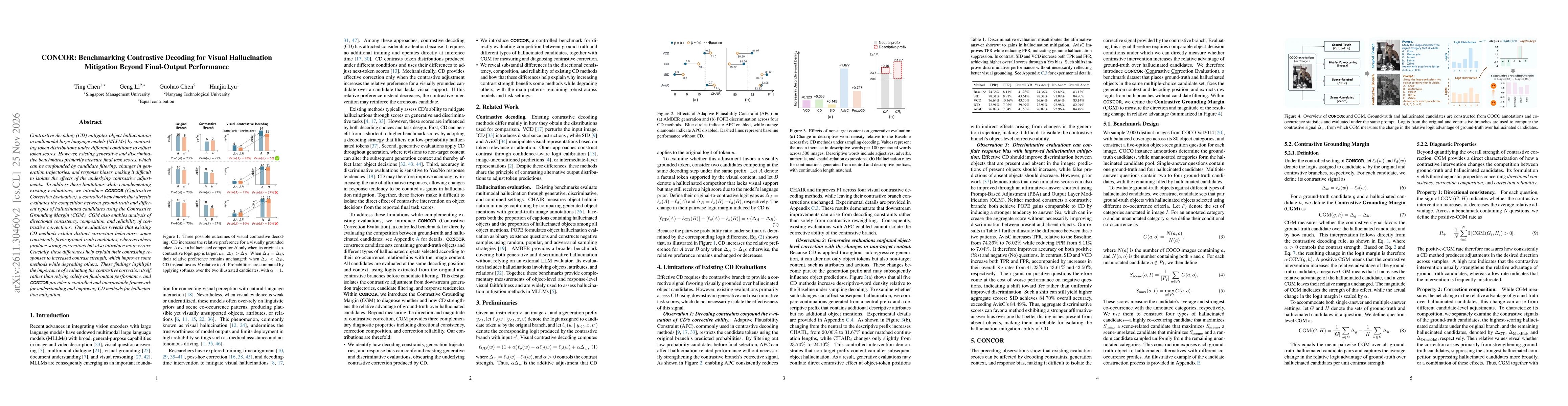
Contrastive decoding (CD) mitigates object hallucination in multimodal large language models (MLLMs) by contrasting token distributions under different conditions to adjust token scores. However, existing generative and discriminative benchmarks primarily measure final task scores, which can be confounded by candidate filtering, changes in generation trajectories, and response biases, making it difficult to isolate the effects of the underlying contrastive adjustments. To address these limitations while complementing existing evaluations, we introduce CONCOR (Contrastive Correction Evaluation), a controlled benchmark that directly evaluates the competition between ground-truth and different types of hallucinated candidates using the Contrastive Grounding Margin (CGM). CGM also enables analysis of directional consistency, composition, and reliability of contrastive corrections. Our evaluation reveals that existing CD methods exhibit distinct correction behaviors: some consistently favor ground-truth candidates, whereas others produce strong corrections but also introduce more errors. Crucially, these differences help explain their contrasting responses to increased contrast strength, which improves some methods while degrading others. These findings highlight the importance of evaluating the contrastive correction itself, rather than relying solely on final-output performance, and CONCOR provides a controlled and interpretable framework for understanding and improving CD methods for hallucination mitigation.
Speak When You See It: Proactive Task Assistants Should Wait for Evidence, Not the Clock
Bohe Chen · Nov 23, 2026
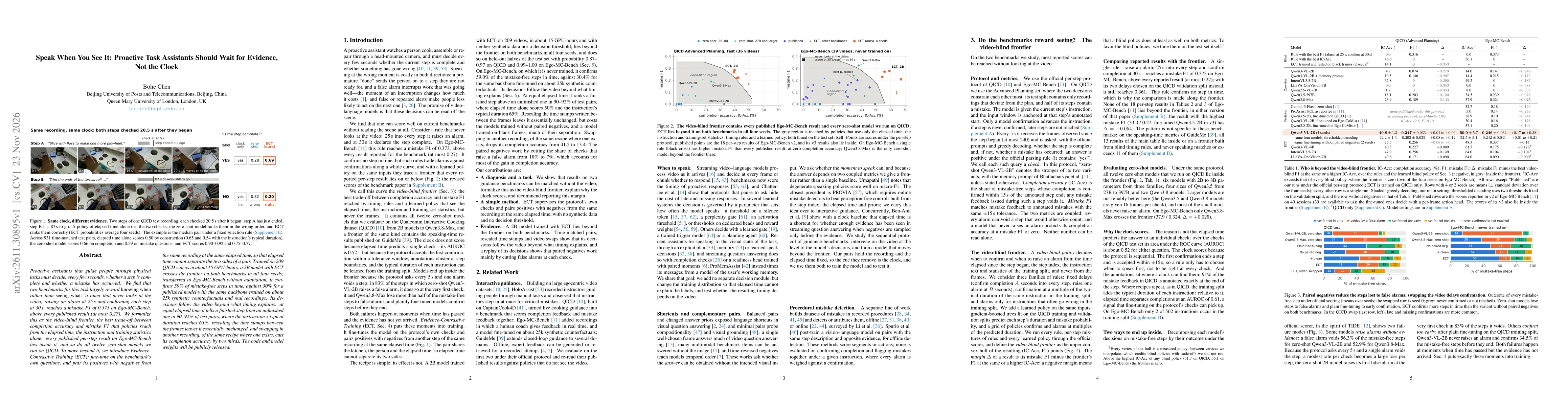
Proactive assistants that guide people through physical tasks must decide, every few seconds, whether a step is complete and whether a mistake has occurred. We find that two benchmarks for this task largely reward knowing when rather than seeing what: a timer that never looks at the video, raising an alarm at 25 s and confirming each step at 30 s, reaches a mistake F1 of 0.373 on Ego-MC-Bench, above every published result (at most 0.27). We formalize this as the video-blind frontier, the best trade-off between completion accuracy and mistake F1 that policies reach from the elapsed time, the instruction and training statistics alone: every published per-step result on Ego-MC-Bench lies inside it, and so do all twelve zero-shot models we run on QICD. To move beyond it, we introduce Evidence-Contrastive Training (ECT): fine-tune on the benchmark's own questions, and pair its positives with negatives from the same recording at the same elapsed time, so that elapsed time cannot separate the two sides of a pair. Trained on 209 QICD videos in about 15 GPU-hours, a 2B model with ECT crosses the frontier on both benchmarks in all four seeds; transferred to Ego-MC-Bench without adaptation, it confirms 59% of mistake-free steps in time, against 30% for a published model with the same backbone trained on about 25k synthetic counterfactuals and real recordings. Its decisions follow the video beyond what timing explains: at equal elapsed time it tells a finished step from an unfinished one in 90-92% of test pairs, where the instruction's typical duration reaches 65%, rescaling the time stamps between the frames leaves it essentially unchanged, and swapping in another recording, of the same recipe where one exists, cuts its completion accuracy by two thirds. The code and model weights will be publicly released.
LiveVAE: Causal Window Attention Makes Efficient Streaming Video VAE
Jiachen An, Sijie Zhao, Le Li +9 more · Nov 25, 2026
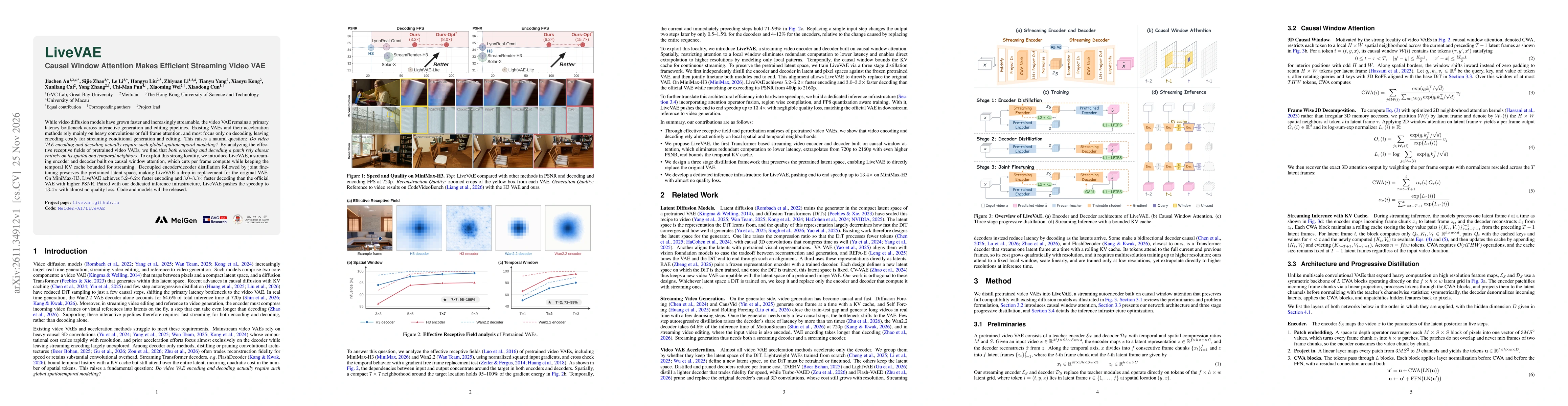
While video diffusion models have grown faster and increasingly streamable, the video VAE remains a primary latency bottleneck across interactive generation and editing pipelines. Existing VAEs and their acceleration methods rely mainly on heavy convolutions or full frame attention, and most focus only on decoding, leaving encoding costly for streaming conditional generation and editing. This raises a natural question: Do video VAE encoding and decoding actually require such global spatiotemporal modeling? By analyzing the effective receptive fields of pretrained video VAEs, we find that both encoding and decoding a patch rely almost entirely on its spatial and temporal neighbors. To exploit this strong locality, we introduce LiveVAE, a streaming encoder and decoder built on causal window attention, which cuts per frame compute while keeping the temporal KV cache bounded for streaming. Decoupled encoder/decoder distillation followed by joint finetuning preserves the pretrained latent space, making LiveVAE a drop-in replacement for the original VAE. On MiniMax-H3, LiveVAE achieves 5.2-6.2x faster encoding and 3.0-3.3x faster decoding than the official VAE with higher PSNR. Paired with our dedicated inference infrastructure, LiveVAE pushes the speedup to 13.4x with almost no quality loss. Code and models will be released.
SIA: Selective Image Analogy
Amirhossein Alimohammadi, Kian Izadpanah, Bardiya Kariminia +2 more · Nov 25, 2026
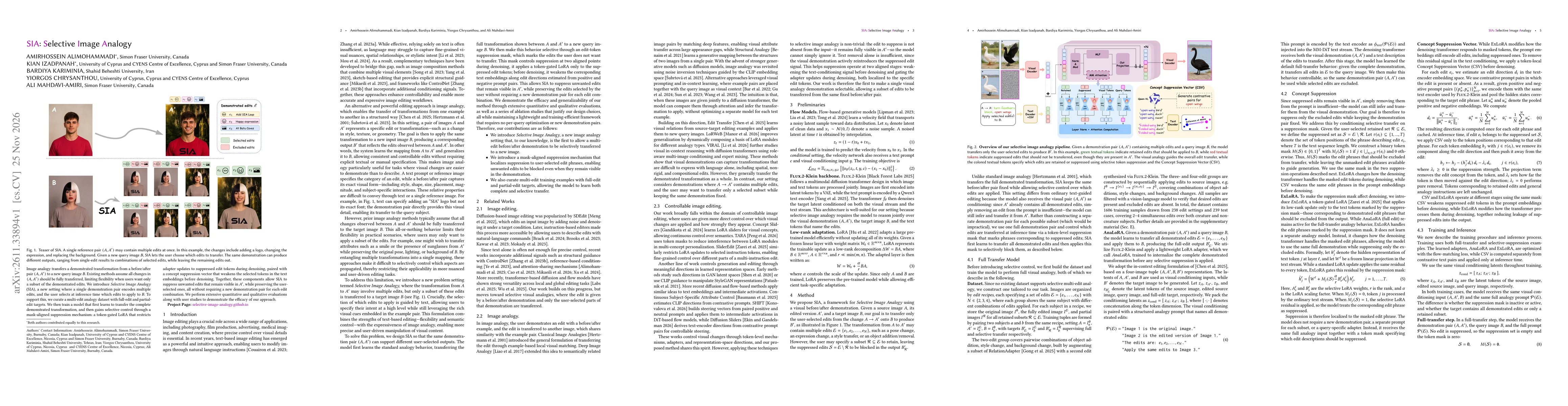
Image analogy transfers a demonstrated transformation from a before/after pair (A, A') to a new query image B. Existing methods assume all changes in (A, A') should be fully transferred, limiting flexibility when users want only a subset of the demonstrated edits. We introduce Selective Image Analogy (SIA), a new setting where a single demonstration pair encodes multiple edits, and the user selects at inference time which edits to apply to B. To support this, we curate a multi-edit analogy dataset with full-edit and partial-edit targets. We then train a model that first learns to transfer the complete demonstrated transformation, and then gains selective control through a mask-aligned suppression mechanism: a token-gated LoRA that restricts adapter updates to suppressed edit tokens during denoising, paired with a concept suppression vector that weakens the selected tokens in the text embeddings before denoising. Together, these components allow SIA to suppress unwanted edits that remain visible in A', while preserving the user-selected ones, all without requiring a new demonstration pair for each edit combination. We perform extensive quantitative and qualitative evaluations along with user studies to demonstrate the efficacy of our approach.
A Mesh for Every Moment
Roy Or-El, Jeong Joon Park, Ira Kemelmacher-Shlizerman · Nov 25, 2026
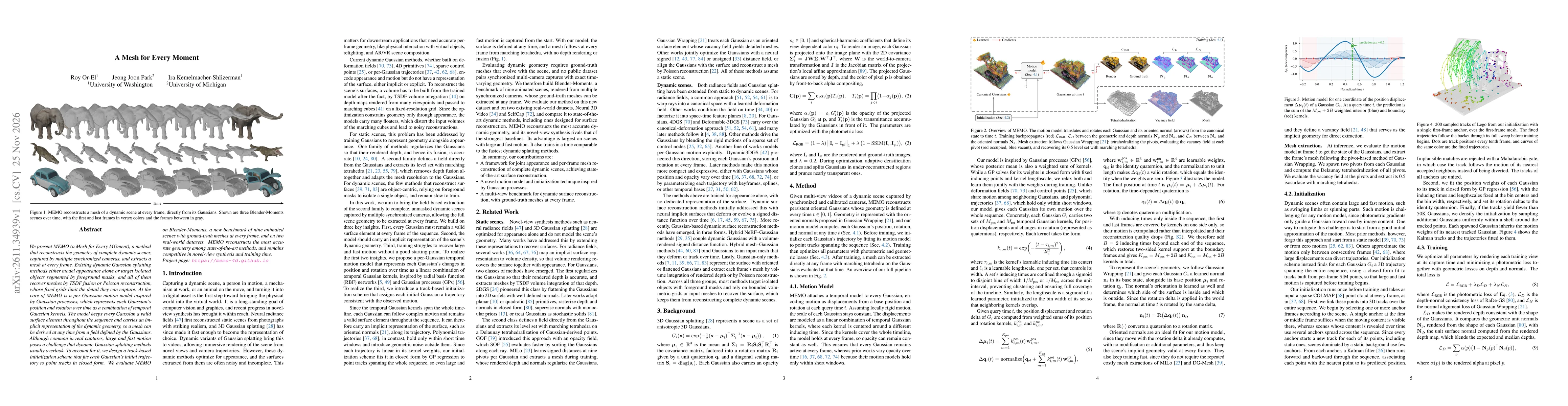
We present MEMO (a Mesh for Every MOment), a method that reconstructs the geometry of complete dynamic scenes, captured by multiple synchronized cameras, and extracts a mesh at every frame. Existing dynamic Gaussian splatting methods either model appearance alone or target isolated objects segmented by foreground masks, and all of them recover meshes by TSDF fusion or Poisson reconstruction, whose fixed grids limit the detail they can capture. At the core of MEMO is a per-Gaussian motion model inspired by Gaussian processes, which represents each Gaussian's position and rotation over time as a combination of temporal Gaussian kernels. The model keeps every Gaussian a valid surface element throughout the sequence and carries an implicit representation of the dynamic geometry, so a mesh can be derived at any time from a field defined by the Gaussians. Although common in real captures, large and fast motion poses a challenge that dynamic Gaussian splatting methods usually overlook. To account for it, we design a track-based initialization scheme that fits each Gaussian's initial trajectory to point tracks in closed form. We evaluate MEMO on Blender-Moments, a new benchmark of nine animated scenes with ground-truth meshes at every frame, and on two real-world datasets. MEMO reconstructs the most accurate geometry among state-of-the-art methods, and remains competitive in novel-view synthesis and training time. Project page: https://memo-4d.github.io
DexEngine: Scaling Human Demonstrations into Physically Executable Whole-Robot Data
Wongyun Yu, Honggeun Kim, Donguk Lee +3 more · Nov 25, 2026
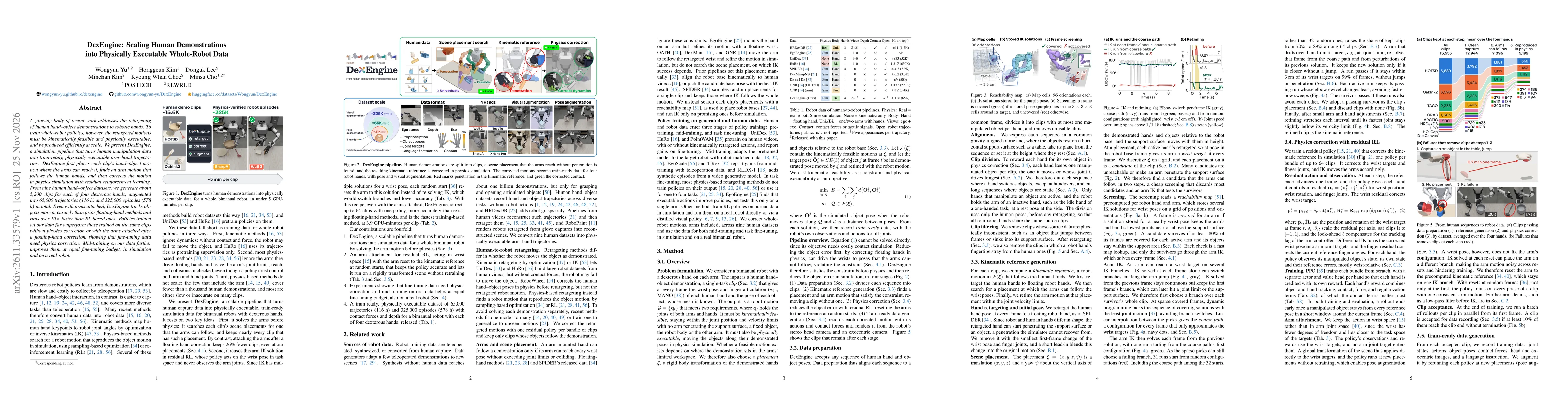
A growing body of recent work addresses the retargeting of human hand-object demonstrations to robotic hands. To train whole-robot policies, however, the retargeted motions must be kinematically feasible and physically executable, and be produced efficiently at scale. We present DexEngine, a simulation pipeline that turns human manipulation data into train-ready, physically executable arm-hand trajectories. DexEngine first places each clip's hand-object motion where the arms can reach it, finds an arm motion that follows the human hands, and then corrects the motion in physics simulation with residual reinforcement learning. From nine human hand-object datasets, we generate about 5,200 clips for each of four dexterous hands, augmented into 65,000 trajectories (116 h) and 325,000 episodes (578 h) in total. Even with arms attached, DexEngine tracks objects more accurately than prior floating-hand methods and runs over 10x faster than RL-based ones. Policies trained on our data far outperform those trained on the same clips without physics correction or with the arms attached after a floating-hand correction, showing that fine-tuning data need physics correction. Mid-training on our data further improves them at equal fine-tuning budget, in simulation and on a real robot.
SOLVE: Sparse, Ordered Keyposes Make LLM Agents Versatile and Efficient Robot Manipulator
Xiang Li, Hongyu Zhou, Ya-Li Li +5 more · Nov 25, 2026
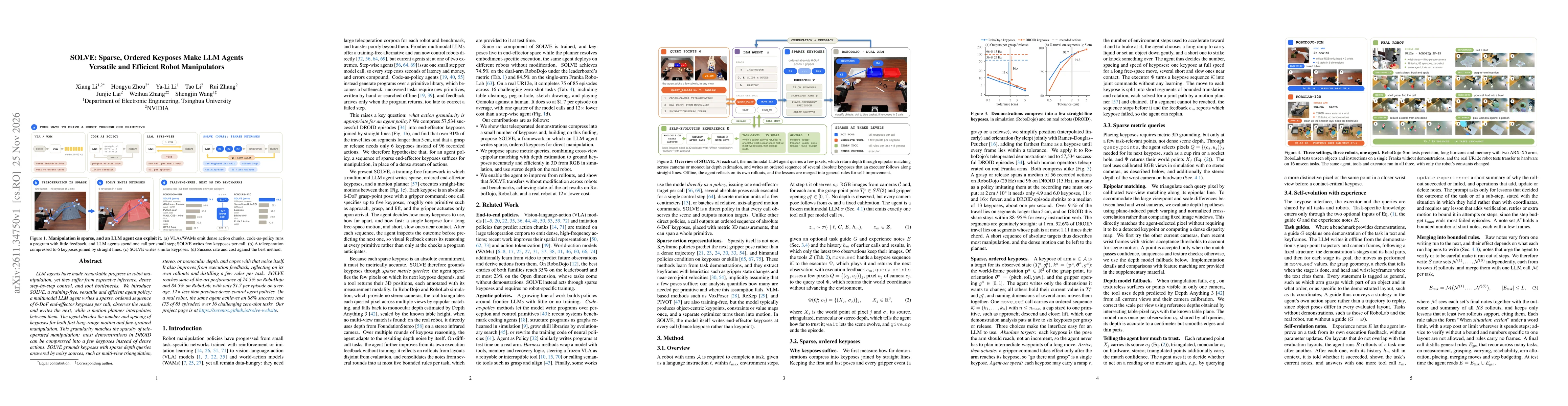
LLM agents have made remarkable progress in robot manipulation, yet they suffer from expensive inference, dense step-by-step control, and tool bottlenecks. We introduce SOLVE, a training-free, versatile and efficient agent policy: a multimodal LLM agent writes a sparse, ordered sequence of 6-DoF end-effector keyposes per call, observes the result, and writes the next, while a motion planner interpolates between them. The agent decides the number and spacing of keyposes for both fast long-range motion and fine-grained manipulation. This granularity matches the sparsity of teleoperated manipulation: most demonstrations in DROID can be compressed into a few keyposes instead of dense actions. SOLVE grounds keyposes with sparse depth queries answered by noisy sources, such as multi-view triangulation, stereo, or monocular depth, and copes with that noise itself. It also improves from execution feedback, reflecting on its own rollouts and distilling a few rules per task. SOLVE reaches state-of-the-art performance of 74.5% on RoboDojo and 84.5% on RoboLab, with only $1.7 per episode on average, 12x less than previous dense-control agent policies. On a real robot, the same agent achieves an 88% success rate (75 of 85 episodes) over 16 challenging zero-shot tasks. Our project page is at https://serenos.github.io/solve-website.
SPARC: Geometry-Guided Attention Pruning for Long-Horizon Camera-Controlled Video Generation
Zesong Yang, Weikai Chen, Liyuan Cui +11 more · Nov 25, 2026
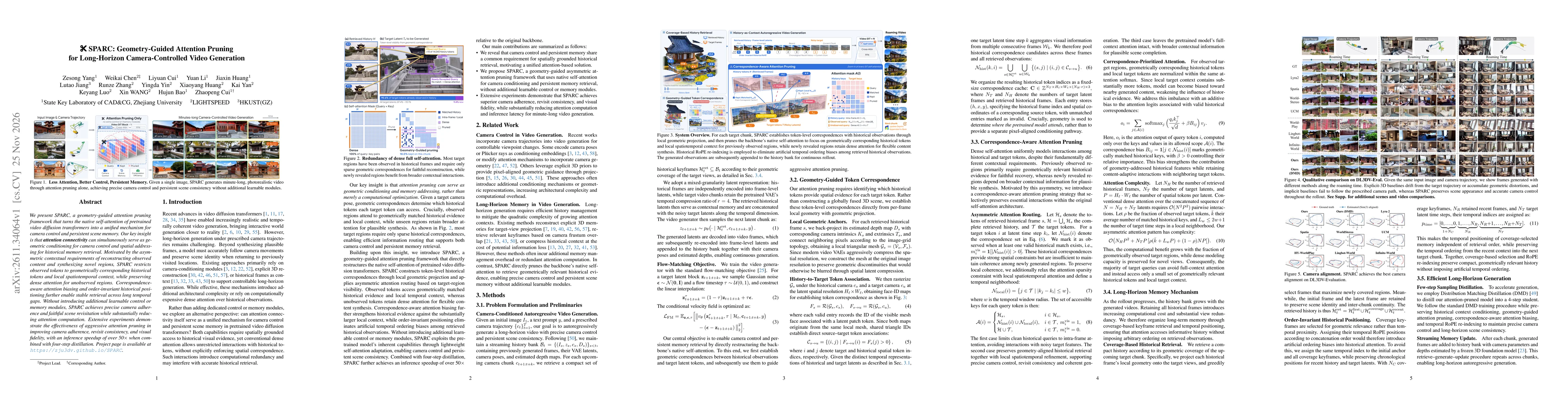
We present SPARC, a geometry-guided attention pruning framework that turns the native self-attention of pretrained video diffusion transformers into a unified mechanism for camera control and persistent scene memory. Our key insight is that attention connectivity can simultaneously serve as geometric conditioning for camera control and spatial addressing for historical memory retrieval. Motivated by the asymmetric contextual requirements of reconstructing observed content and synthesizing novel regions, SPARC restricts observed tokens to geometrically corresponding historical tokens and local spatiotemporal context, while preserving dense attention for unobserved regions. Correspondence-aware attention biasing and order-invariant historical positioning further enable stable retrieval across long temporal gaps. Without introducing additional learnable control or memory modules, SPARC achieves precise camera adherence and faithful scene revisitation while substantially reducing attention computation. Extensive experiments demonstrate the effectiveness of aggressive attention pruning in improving camera adherence, revisit consistency, and visual fidelity, with an inference speedup of over 50x when combined with four-step distillation. Project page is available at https://zju3dv.github.io/SPARC.
Negative-Only Policy Optimization for One-Sided Verifiable Rewards
Jiacheng Xu, Shuo He, Fuxiang Zhang +2 more · Nov 12, 2026
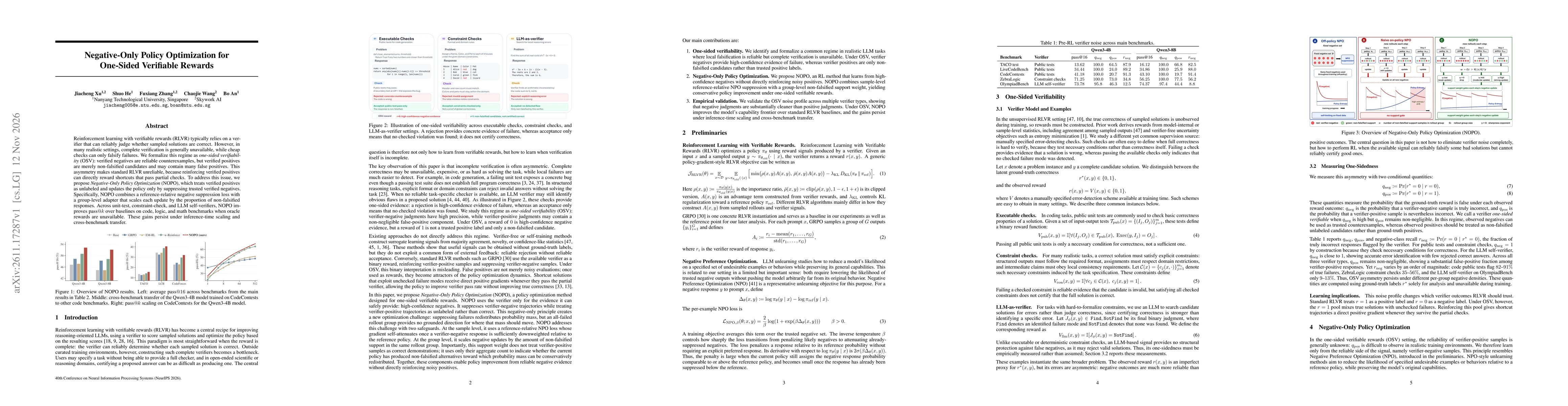
Reinforcement learning with verifiable rewards (RLVR) typically relies on a verifier that can reliably judge whether sampled solutions are correct. However, in many realistic settings, complete verification is generally unavailable, while cheap checks can only falsify failures. We formalize this regime as one-sided verifiability (OSV): verified negatives are reliable counterexamples, but verified positives are merely non-falsified candidates and may contain many false positives. This asymmetry makes standard RLVR unreliable, because reinforcing verified positives can directly reward shortcuts that pass partial checks. To address this issue, we propose Negative-Only Policy Optimization (NOPO), which treats verified positives as unlabeled and updates the policy only by suppressing trusted verified negatives. Specifically, NOPO combines a reference-relative negative suppression loss with a group-level adapter that scales each update by the proportion of non-falsified responses. Across unit-test, constraint-check, and LLM self-verifiers, NOPO improves pass@k over baselines on code, logic, and math benchmarks when oracle rewards are unavailable. These gains persist under inference-time scaling and cross-benchmark transfer.