Trending on arXiv
Today's most upvoted papers on arXiv
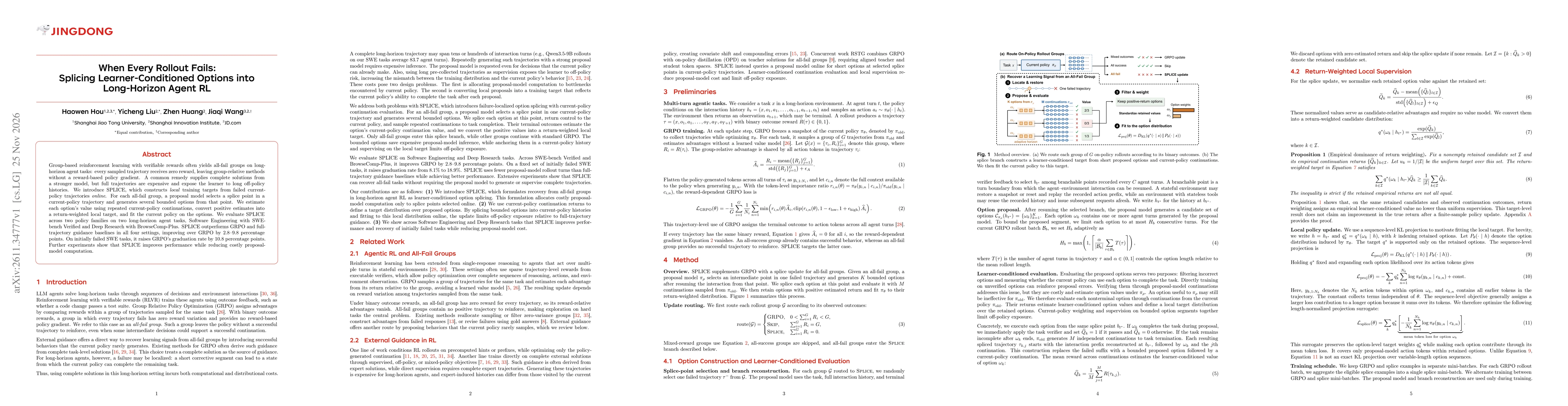
When Every Rollout Fails: Splicing Learner-Conditioned Options into Long-Horizon Agent RL
Haowen Hou, Yicheng Liu, Zhen Huang +1 more · Nov 25, 2026
Group-based reinforcement learning with verifiable rewards often yields all-fail groups on long-horizon agent tasks: every sampled trajectory receives zero reward, leaving group-relative methods without a reward-based policy gradient. A common remedy supplies complete solutions from a stronger model, but full trajectories are expensive and expose the learner to long off-policy histories. We introduce SPLICE, which constructs local training targets from failed current-policy trajectories online. For each all-fail group, a proposal model selects a splice point in a current-policy trajectory and generates several bounded options from that point. We estimate each option's value using repeated current-policy continuations, convert positive estimates into a return-weighted local target, and fit the current policy on the options. We evaluate SPLICE across two policy families on two long-horizon agent tasks, Software Engineering with SWE-bench Verified and Deep Research with BrowseComp-Plus. SPLICE outperforms GRPO and full-trajectory guidance baselines in all four settings, improving over GRPO by 2.8--9.8 percentage points. On initially failed SWE tasks, it raises GRPO's graduation rate by 10.8 percentage points. Further experiments show that SPLICE improves performance while reducing costly proposal-model computation.
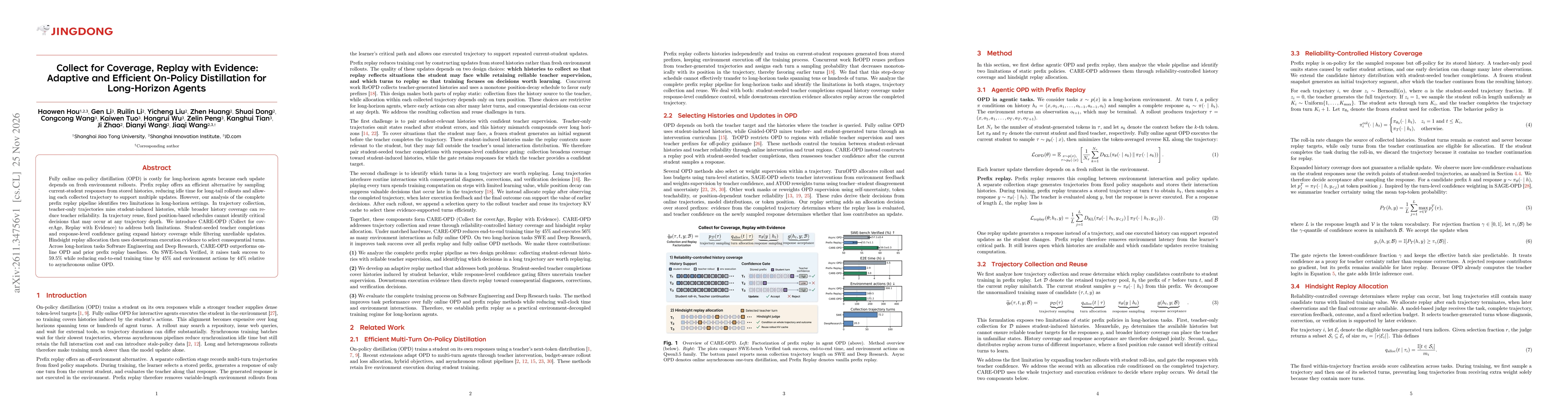
Collect for Coverage, Replay with Evidence: Adaptive and Efficient On-Policy Distillation for Long-Horizon Agents
Haowen Hou, Gen Li, Ruilin Li +11 more · Nov 25, 2026
Fully online on-policy distillation (OPD) is costly for long-horizon agents because each update depends on fresh environment rollouts. Prefix replay offers an efficient alternative by sampling current-student responses from stored histories, reducing idle time for long-tail rollouts and allowing each collected trajectory to support multiple updates. However, our analysis of the complete prefix replay pipeline identifies two limitations in long-horizon settings. In trajectory collection, teacher-only trajectories miss student-induced histories, while broader history coverage can reduce teacher reliability. In trajectory reuse, fixed position-based schedules cannot identify critical decisions that may occur at any trajectory depth. We introduce CARE-OPD (Collect for coverAge, Replay with Evidence) to address both limitations. Student-seeded teacher completions and response-level confidence gating expand history coverage while filtering unreliable updates. Hindsight replay allocation then uses downstream execution evidence to select consequential turns. Across long-horizon tasks Software Engineering and Deep Research, CARE-OPD outperforms online OPD and prior prefix replay baselines. On SWE-bench Verified, it raises task success to 59.5% while reducing end-to-end training time by 45% and environment actions by 44% relative to asynchronous online OPD.