Trending on arXiv
Today's most upvoted papers on arXiv
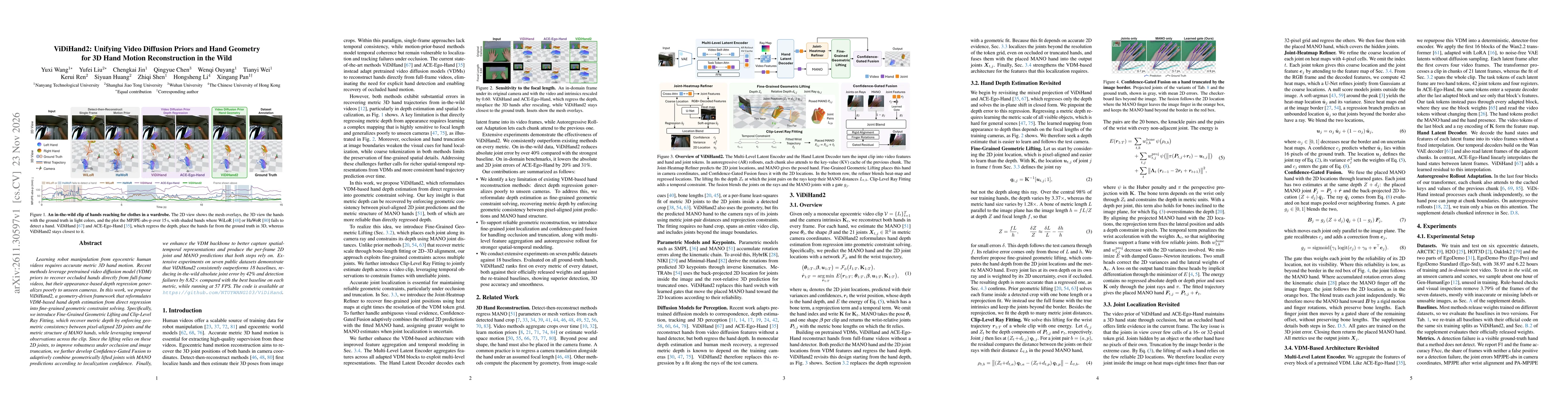
ViDiHand2: Unifying Video Diffusion Priors and Hand Geometry for 3D Hand Motion Reconstruction in the Wild
Yuxi Wang, Yufei Liu, Chengkai Jin +8 more · Nov 23, 2026
Learning robot manipulation from egocentric human videos requires accurate metric 3D hand motion. Recent methods leverage pretrained video diffusion model (VDM) priors to recover occluded hands directly from full-frame videos, but their appearance-based depth regression generalizes poorly to unseen cameras. In this work, we propose ViDiHand2, a geometry-driven framework that reformulates VDM-based hand depth estimation from direct regression into fine-grained geometric constraint solving. Specifically, we introduce Fine-Grained Geometric Lifting and Clip-Level Ray Fitting, which recover metric depth by enforcing geometric consistency between pixel-aligned 2D joints and the metric structure of MANO hands, while leveraging temporal observations across the clip. Since the lifting relies on these 2D joints, to improve robustness under occlusion and image truncation, we further develop Confidence-Gated Fusion to adaptively combine geometrically lifted joints with MANO predictions according to localization confidence. Finally, we enhance the VDM backbone to better capture spatial-temporal representations and produce the per-frame 2D joint and MANO predictions that both steps rely on. Extensive experiments on seven public datasets demonstrate that ViDiHand2 consistently outperforms 18 baselines, reducing in-the-wild absolute joint error by 42% and detection failures by 8.82x compared with the best baseline on each metric, while running at 57 FPS. The code is available at https://github.com/NTUYWANG103/ViDiHand.
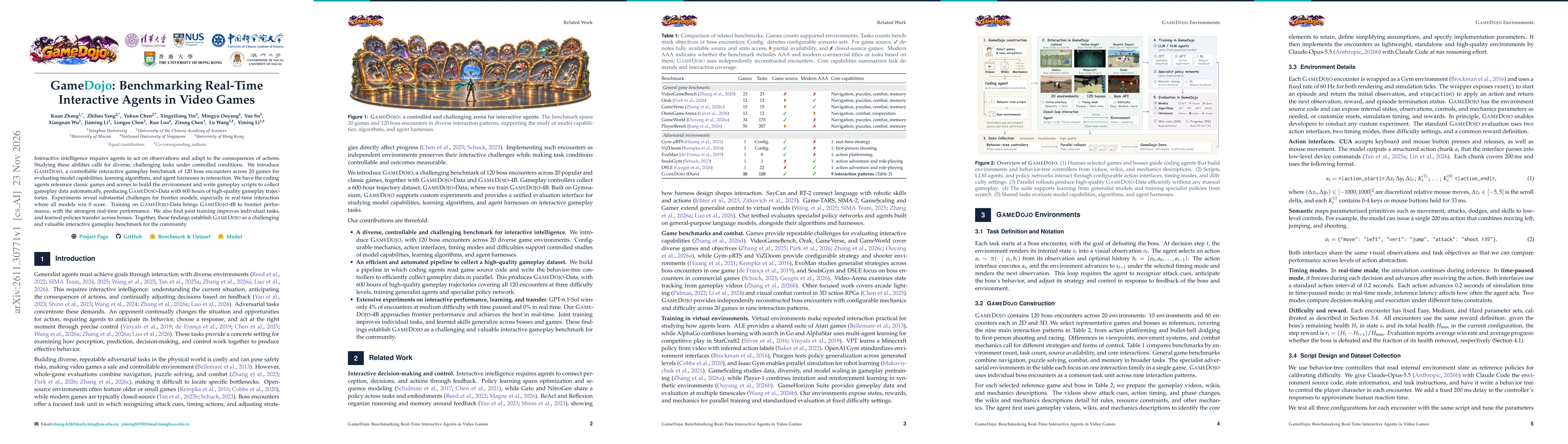
GameDojo: Benchmarking Real-Time Interactive Agents in Video Games
Kuan Zhang, Zhihao Yang, Yukun Chen +10 more · Nov 23, 2026
Interactive intelligence requires agents to act on observations and adapt to the consequences of actions. Studying these abilities calls for diverse, challenging tasks under controlled conditions. We introduce GameDojo, a controllable interactive gameplay benchmark of 120 boss encounters across 20 games for evaluating model capabilities, learning algorithms, and agent harnesses. Coding agents reconstruct the environments and write gameplay scripts, producing GameDojo-Data with 600 hours of gameplay trajectories. Experiments reveal substantial challenges for frontier models, especially in real-time interaction. Training on GameDojo-Data brings GameDojo-4B to frontier performance, with the strongest real-time performance. We also find joint training improves individual tasks, and learned policies transfer across bosses. Together, these findings establish GameDojo as a challenging and valuable interactive gameplay benchmark for the community. Our project page is at https://gamedojo-benchmark.github.io/ , and our code is at https://github.com/THUSI-Lab/GameDojo .
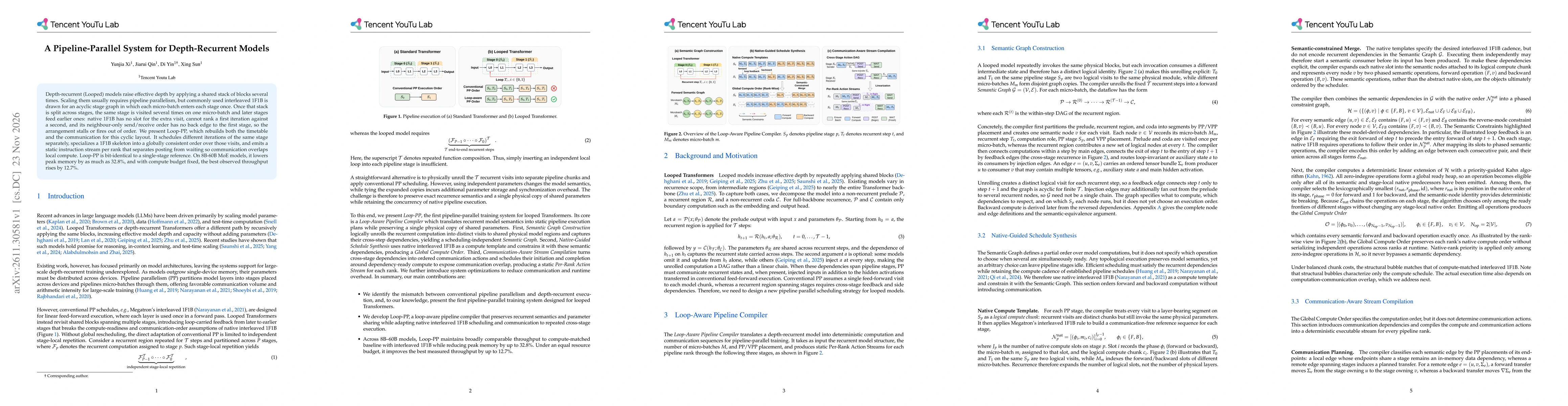
A Pipeline-Parallel System for Depth-Recurrent Models
Yunjia Xi, Jiarui Qin, Di Yin +1 more · Nov 23, 2026
Depth-recurrent (Looped) models raise effective depth by applying a shared stack of blocks several times. Scaling them usually requires pipeline parallelism, but commonly used interleaved 1F1B is drawn for an acyclic stage graph in which each micro-batch enters each stage once. Once that stack is split across stages, the same stage is visited several times on one micro-batch and later stages feed earlier ones: native 1F1B has no slot for the extra visit, cannot rank a first iteration against a second, and its neighbour-only send/receive order has no back edge to the first stage, so the arrangement stalls or fires out of order. We present Loop-PP, which rebuilds both the timetable and the communication for this cyclic layout. It schedules different iterations of the same stage separately, specializes a 1F1B skeleton into a globally consistent order over those visits, and emits a static instruction stream per rank that separates posting from waiting so communication overlaps local compute. Loop-PP is bit-identical to a single-stage reference. On 8B-60B MoE models, it lowers peak memory by as much as 32.8\%, and with compute budget fixed, the best observed throughput rises by 12.7\%.
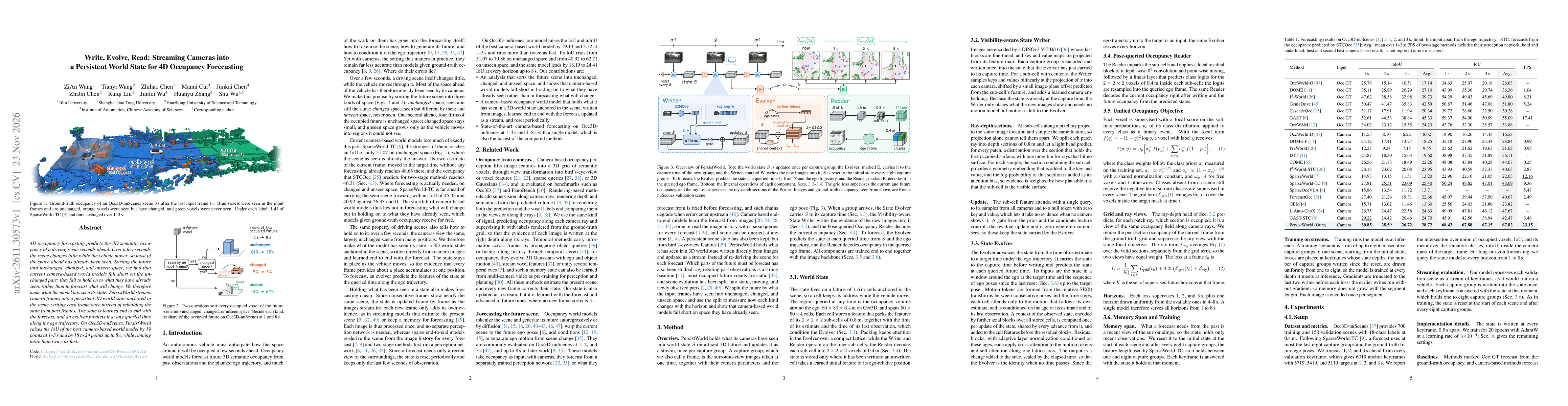
Write, Evolve, Read: Streaming Cameras into a Persistent World State for 4D Occupancy Forecasting
ZiAn Wang, Tianyi Wang, Zhihao Chen +7 more · Nov 23, 2026
4D occupancy forecasting predicts the 3D semantic occupancy of a driving scene seconds ahead. Over a few seconds, the scene changes little while the vehicle moves, so most of the space ahead has already been seen. Sorting the future into unchanged, changed, and unseen space, we find that current camera-based world models fall short on the unchanged part: they fail to hold on to what they have already seen, rather than to forecast what will change. We therefore make what the model has seen its state. PersistWorld streams camera frames into a persistent 3D world state anchored in the scene, writing each frame once instead of rebuilding the state from past frames. The state is learned end to end with the forecast, and an evolver predicts it at any queried time along the ego trajectory. On Occ3D-nuScenes, PersistWorld raises the IoU of the best camera-based world model by 19 points at 1-3 s and by 18 to 24 points up to 8 s, while running more than twice as fast. Code and models: https://github.com/wangzian828/PersistWorld. Project page: https://wangzian828.github.io/PersistWorld
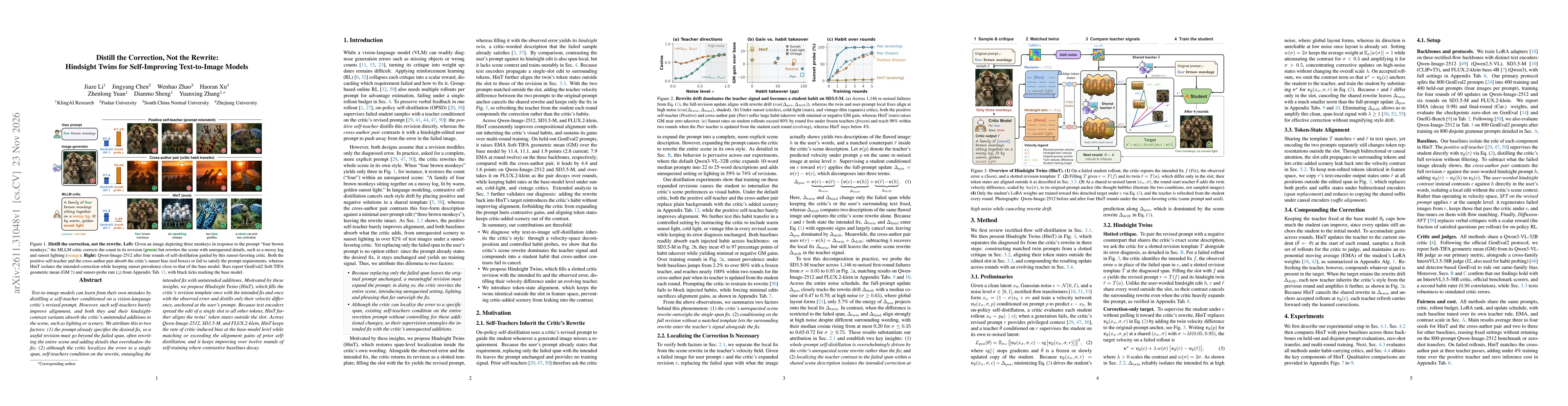
Distill the Correction, Not the Rewrite: Hindsight Twins for Self-Improving Text-to-Image Models
Jiaze Li, Jingyang Chen, Wenhao Zhao +4 more · Nov 23, 2026
Text-to-image models can learn from their own mistakes by distilling a self-teacher conditioned on a vision-language critic's revised prompt. However, such self-teachers barely improve alignment, and both they and their hindsight-contrast variants absorb the critic's unintended additions to the scene, such as lighting or scenery. We attribute this to two factors: (1) the prompt already specifies the desired fix, so a useful revision must go beyond the failed span, often rewriting the entire scene and adding details that overshadow the fix; (2) although the critic localizes the error to a single span, self-teachers condition on the rewrite, entangling the intended fix with unintended additions. Motivated by these insights, we propose Hindsight Twins (HinT), which fills the critic's revision template once with the intended fix and once with the observed error and distills only their velocity difference, anchored at the user's prompt. Because text encoders spread the edit of a single slot to all other tokens, HinT further aligns the twins' token states outside the slot. Across Qwen-Image-2512, SD3.5-M, and FLUX.2-klein, HinT keeps the rate of critic-induced bias at the base-model level while matching or exceeding the alignment gains of prior self-distillation, and it keeps improving over twelve rounds of self-training where contrastive baselines decay.
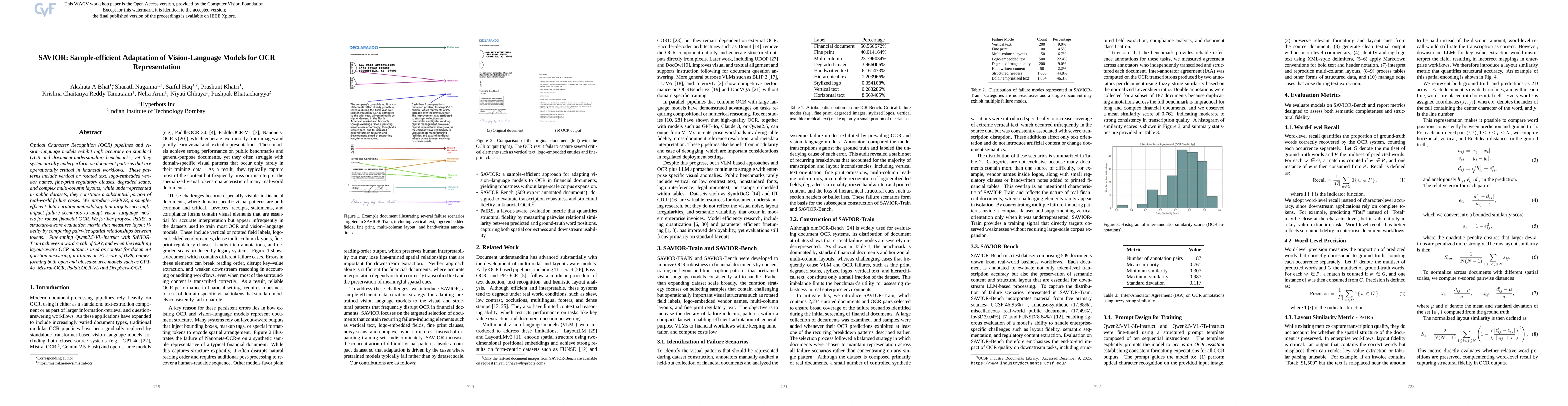
SAVIOR: Sample-efficient Adaptation of Vision-Language Models for OCR Representation
Akshata A Bhat, Sharath Naganna, Saiful Haq +5 more · Nov 20, 2026
Optical Character Recognition (OCR) pipelines and vision-language models exhibit high accuracy on standard OCR and document-understanding benchmarks, yet they systematically underperform on document patterns that are operationally critical in financial workflows. These patterns include vertical or rotated text, logo-embedded vendor names, fine-print regulatory clauses, degraded scans, and complex multi-column layouts. While underrepresented in public datasets, they constitute a substantial portion of real-world failure cases. We introduce SAVIOR, a sample-efficient data curation methodology that targets such high-impact failure scenarios to adapt vision-language models for robust financial OCR. We further propose PaIRS, a structure-aware evaluation metric that measures layout fidelity by comparing pairwise spatial relationships between tokens. Fine-tuning Qwen2.5-VL-Instruct with SAVIOR-Train achieves a word recall of 0.93. When the resulting layout-aware OCR output is used as context for document question answering, it attains an F1 score of 0.89, outperforming both open- and closed-source models such as GPT-4o, Mistral-OCR, PaddleOCR-VL, and DeepSeek-OCR.
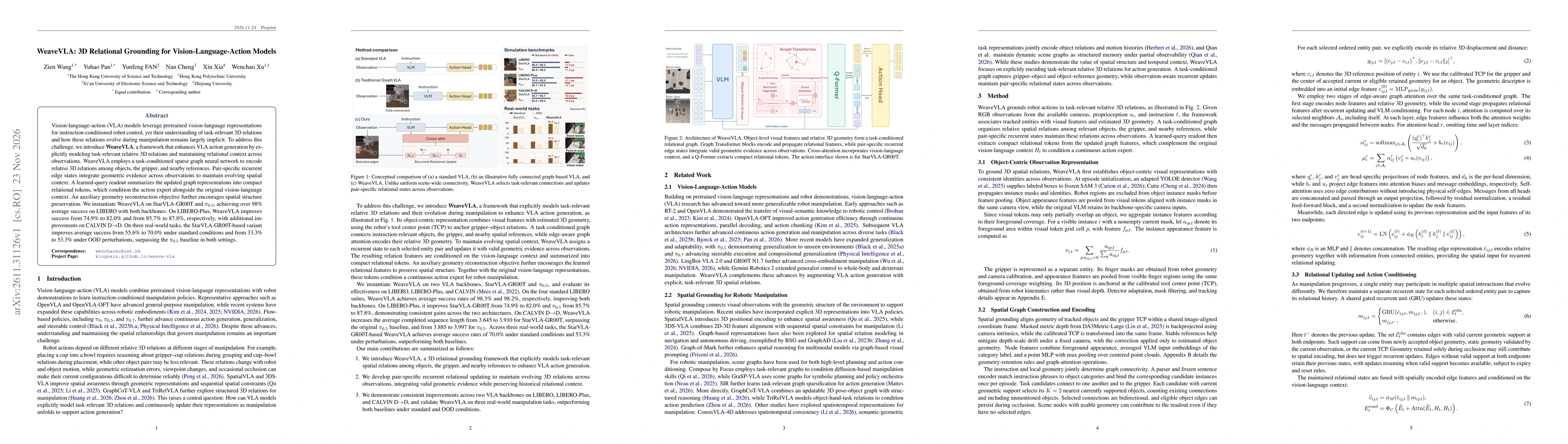
WeaveVLA: 3D Relational Grounding for Vision-Language-Action Models
Zien Wang, Yuhao Pan, Yunfeng Fan +3 more · Nov 23, 2026
Vision-language-action (VLA) models leverage pretrained vision-language representations for instruction-conditioned robot control, yet their understanding of task-relevant 3D relations and how these relations evolve during manipulation remains largely implicit. To address this challenge, we introduce WeaveVLA, a framework that enhances VLA action generation by explicitly modeling task-relevant relative 3D relations and maintaining relational context across observations. WeaveVLA employs a task-conditioned sparse graph neural network to encode relative 3D relations among objects, the gripper, and nearby references. Pair-specific recurrent edge states integrate geometric evidence across observations to maintain evolving spatial context. A learned-query readout summarizes the updated graph representations into compact relational tokens, which condition the action expert alongside the original vision-language context. An auxiliary geometry reconstruction objective further encourages spatial structure preservation. We instantiate WeaveVLA on StarVLA-GR00T and π_{0.5}, achieving over 98\% average success on LIBERO with both backbones. On LIBERO-Plus, WeaveVLA improves success from 74.9\% to 82.0\% and from 85.7\% to 87.8\%, respectively, with additional improvements on CALVIN DrightarrowD. On three real-world tasks, the StarVLA-GR00T-based variant improves average success from 55.6\% to 70.0\% under standard conditions and from 33.3\% to 53.3\% under OOD perturbations, surpassing the π_{0.5} baseline in both settings.
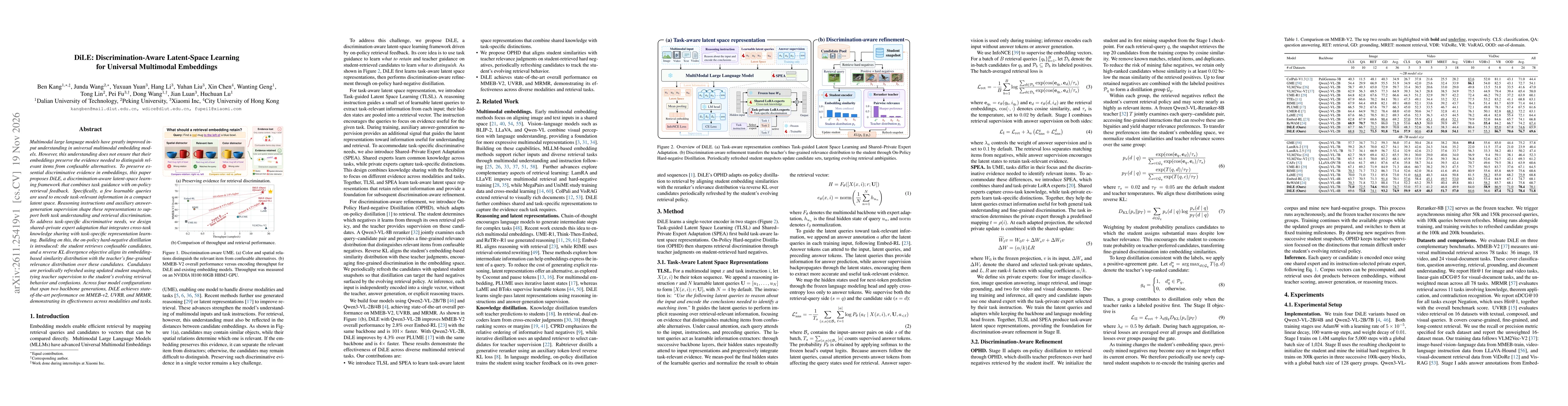
DiLE: Discrimination-Aware Latent-Space Learning for Universal Multimodal Embeddings
Ben Kang, Junda Wang, Yuxuan Yuan +9 more · Nov 19, 2026
Multimodal large language models have greatly improved input understanding in universal multimodal embedding models. However, this understanding does not ensure that their embeddings preserve the evidence needed to distinguish relevant items from confusable alternatives. To preserve essential discriminative evidence in embeddings, this paper proposes DiLE, a discrimination-aware latent-space learning framework that combines task guidance with on-policy retrieval feedback. Specifically, a few learnable queries are used to encode task-relevant information in a compact latent space. Reasoning instructions and auxiliary answer-generation supervision shape these representations to support both task understanding and retrieval discrimination. To address task-specific discriminative needs, we design shared-private expert adaptation that integrates cross-task knowledge sharing with task-specific representation learning. Building on this, the on-policy hard-negative distillation is introduced: the student retrieves confusable candidates, and a reverse KL divergence objective aligns its embedding-based similarity distribution with the teacher's fine-grained relevance distribution over these candidates. Candidates are periodically refreshed using updated student snapshots, tying teacher supervision to the student's evolving retrieval behavior and confusions. Across four model configurations that span two backbone generations, DiLE achieves state-of-the-art performance on MMEB-v2, UVRB, and MRMR, demonstrating its effectiveness across modalities and tasks.
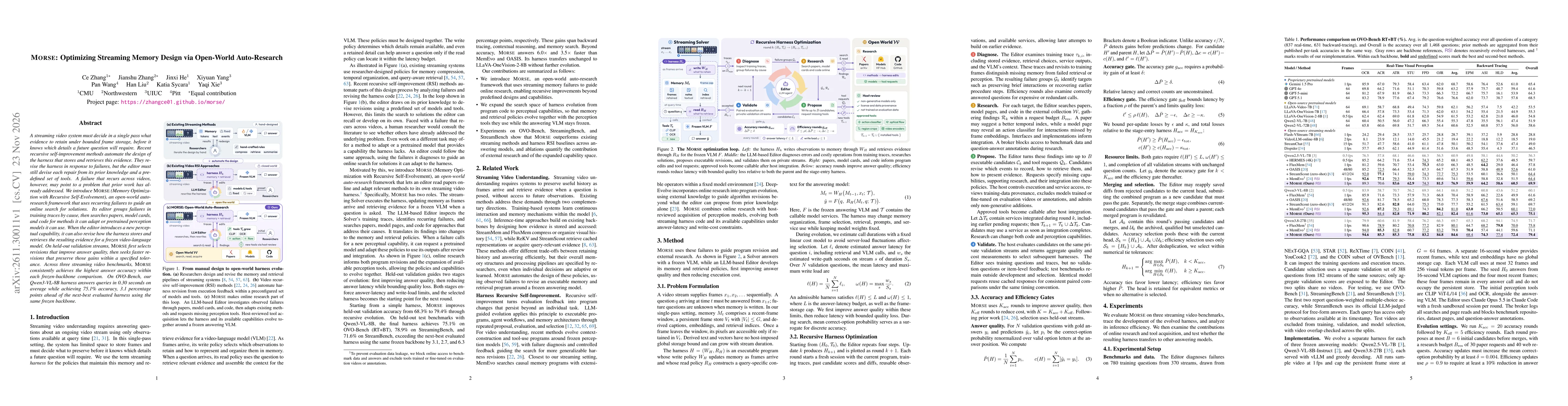
MORSE: Optimizing Streaming Memory Design via Open-World Auto-Research
Ce Zhang, Jianshu Zhang, Jinxi He +5 more · Nov 23, 2026
A streaming video system must decide in a single pass what evidence to retain under bounded frame storage, before it knows which details a future question will require. Recent recursive self-improvement methods automate the design of the harness that stores and retrieves this evidence. They revise the harness in response to failures, but the editor must still devise each repair from its prior knowledge and a predefined set of tools. A failure that recurs across videos, however, may point to a problem that prior work has already addressed. We introduce MORSE (Memory Optimization with Recursive Self-Evolvement), an open-world auto-research framework that uses recurring failures to guide an online search for solutions. Its editor groups failures in training traces by cause, then searches papers, model cards, and code for methods it can adapt or pretrained perception models it can use. When the editor introduces a new perceptual capability, it can also revise how the harness stores and retrieves the resulting evidence for a frozen video-language model. On held-out validation streams, MORSE first selects revisions that improve answer quality, then seeks faster revisions that preserve those gains within a specified tolerance. Across three streaming video benchmarks, MORSE consistently achieves the highest answer accuracy within each frozen-backbone comparison. On OVO-Bench, our Qwen3-VL-8B harness answers queries in 0.30 seconds on average while achieving 75.1% accuracy, 3.1 percentage points ahead of the next-best evaluated harness using the same frozen backbone.
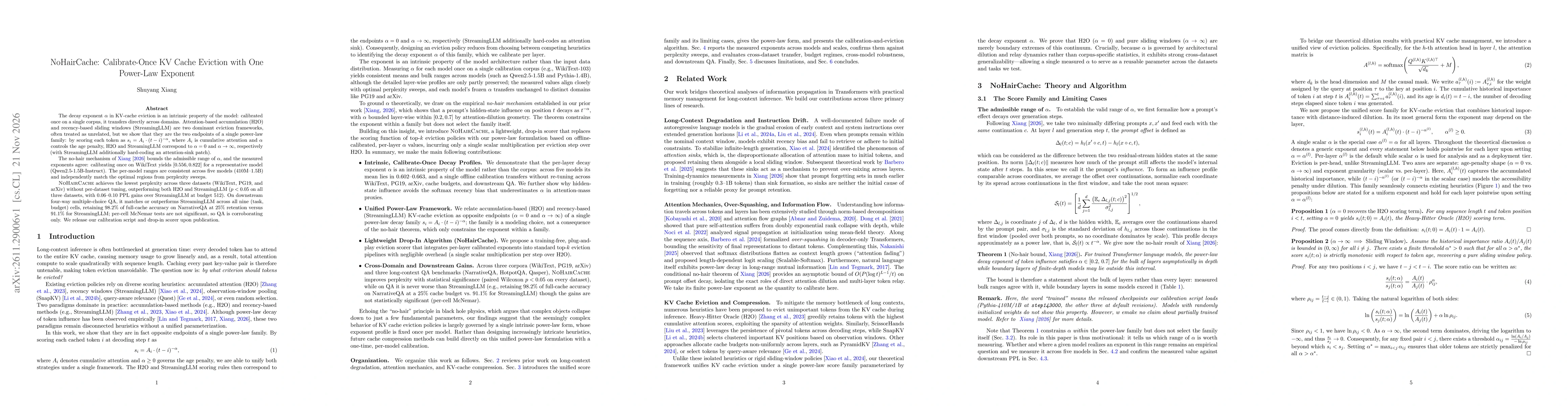
NoHairCache: Calibrate-Once KV Cache Eviction with One Power-Law Exponent
Shuyang Xiang · Nov 21, 2026
The decay exponent α in KV-cache eviction is an intrinsic property of the model: calibrated once on a single corpus, it transfers directly across domains. Attention-based accumulation (H2O) and recency-based sliding windows (StreamingLLM) are two dominant eviction frameworks, often treated as unrelated, but we show that they are the two endpoints of a single power-law family: by scoring each token as s_i = A_i cdot (t-i)^{-α}, where A_i is cumulative attention and α controls the age penalty, H2O and StreamingLLM correspond to α=0 and αtoinfty, respectively (with StreamingLLM additionally hard-coding an attention-sink patch). The no-hair mechanism of xiang2026nohair bounds the admissible range of α, and the measured exponents agree: calibrating once on WikiText yields [0.556, 0.822] for a representative model (Qwen2.5-1.5B-Instruct). The per-model ranges are consistent across five models (410M--1.5B) and independently match the optimal regions from perplexity sweeps. NoHairCache achieves the lowest perplexity across three datasets (WikiText, PG19, and arXiv) without per-dataset tuning, outperforming both H2O and StreamingLLM (p < 0.05 on all three datasets, with 0.06--0.10 PPL gains over StreamingLLM at budget 512). On downstream four-way multiple-choice QA, it matches or outperforms StreamingLLM across all nine (task, budget) cells, retaining 98.2% of full-cache accuracy on NarrativeQA at 25% retention versus 91.1% for StreamingLLM; per-cell McNemar tests are not significant, so QA is corroborating only. We release our calibration script and drop-in scorer upon publication.
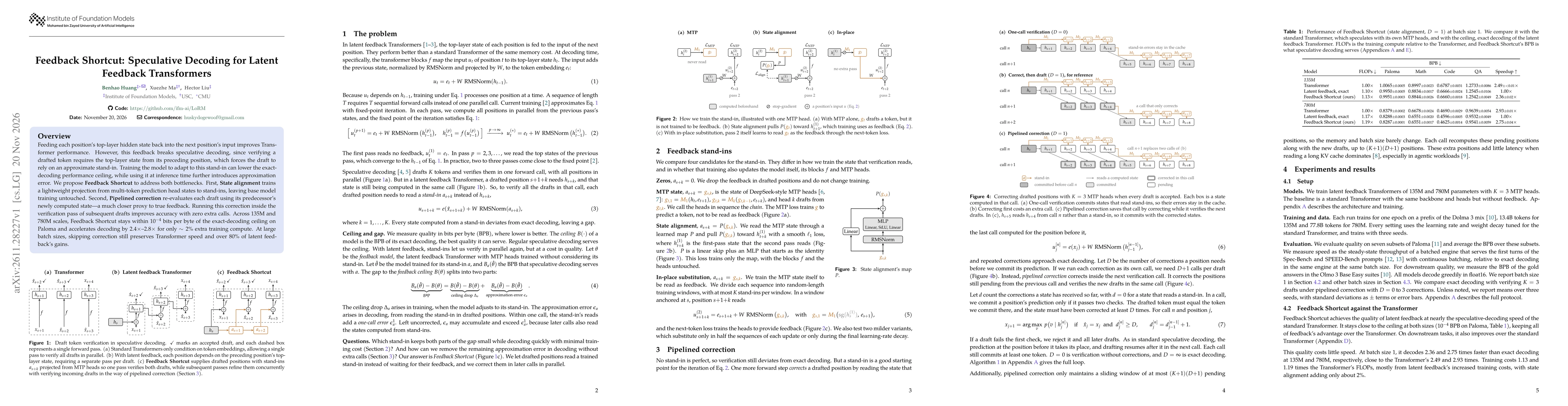
Feedback Shortcut: Speculative Decoding for Latent Feedback Transformers
Benhao Huang, Xuezhe Ma, Hector Liu · Nov 20, 2026
Feeding each position's top-layer hidden state back into the next position's input improves Transformer performance. However, this feedback breaks speculative decoding, since verifying a drafted token requires the top-layer state from its preceding position, which forces the draft to rely on an approximate stand-in. Training the model to adapt to this stand-in can lower the exact-decoding performance ceiling, while using it at inference time further introduces approximation error. We propose Feedback Shortcut to address both bottlenecks. First, state alignment trains a lightweight projection from multi-token prediction head states to stand-ins, leaving base model training untouched. Second, pipelined correction re-evaluates each draft using its predecessor's newly computed state, a much closer proxy to true feedback. Running this correction inside the verification pass of subsequent drafts improves accuracy with zero extra calls. Across 135M and 780M scales, Feedback Shortcut stays within 10^{-4} bits per byte of the exact-decoding ceiling on Paloma and accelerates decoding by 2.4-2.8x with about 2% more training compute than the latent feedback Transformer. At large batch sizes, skipping correction still preserves Transformer speed and over 80% of latent feedback's gains.
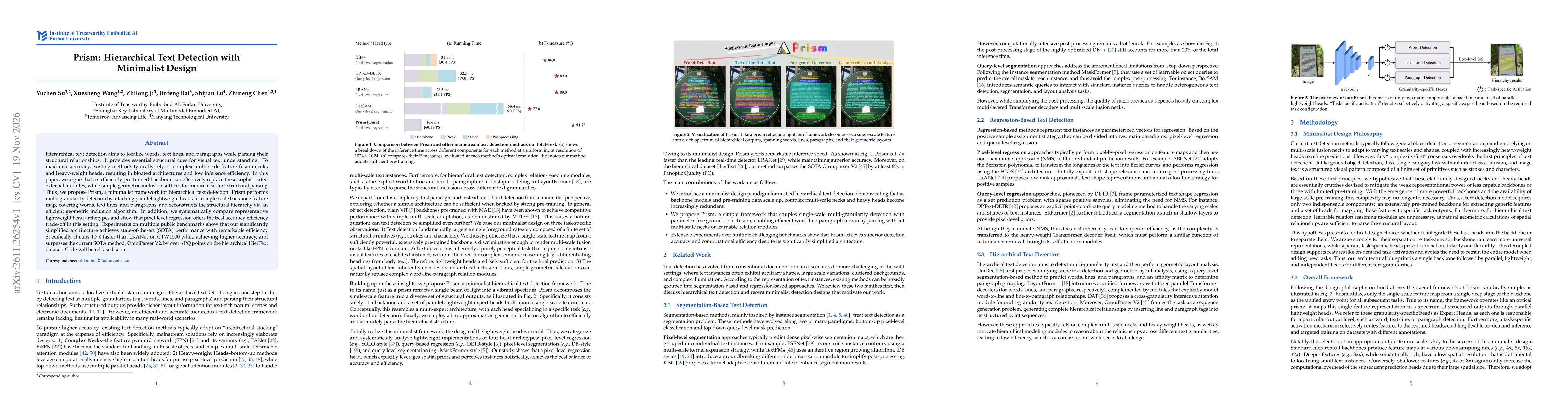
Prism: Hierarchical Text Detection with Minimalist Design
Yuchen Su, Xuesheng Wang, Zhilong Ji +3 more · Nov 19, 2026
Hierarchical text detection aims to localize words, text lines, and paragraphs while parsing their structural relationships. It provides essential structural cues for visual text understanding. To maximize accuracy, existing methods typically rely on complex multi-scale feature fusion necks and heavy-weight heads, resulting in bloated architectures and low inference efficiency. In this paper, we argue that a sufficiently pre-trained backbone can effectively replace these sophisticated external modules, while simple geometric inclusion suffices for hierarchical text structural parsing. Thus, we propose Prism, a minimalist framework for hierarchical text detection. Prism performs multi-granularity detection by attaching parallel lightweight heads to a single-scale backbone feature map, covering words, text lines, and paragraphs, and reconstructs the structural hierarchy via an efficient geometric inclusion algorithm. In addition, we systematically compare representative lightweight head archetypes and show that pixel-level regression offers the best accuracy-efficiency trade-off in this setting. Experiments on multiple public benchmarks show that our significantly simplified architecture achieves state-of-the-art (SOTA) performance with remarkable efficiency. Specifically, it runs 1.7times faster than LRANet on CTW1500 while achieving higher accuracy, and surpasses the current SOTA method, OmniParser V2, by over 6 PQ points on the hierarchical HierText dataset. Code will be released soon.
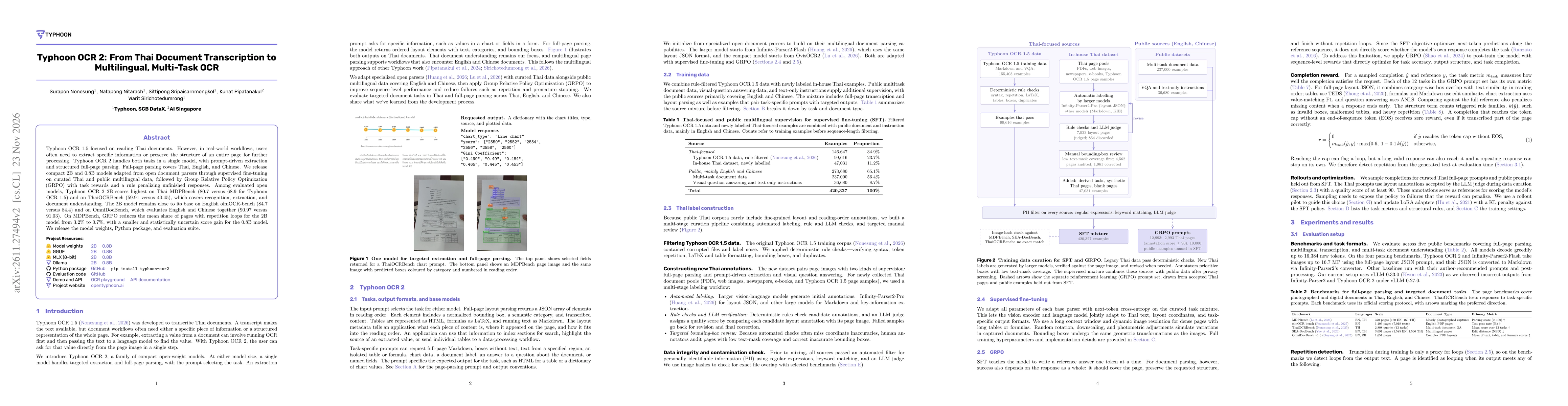
Typhoon OCR 2: From Thai Document Transcription to Multilingual, Multi-Task OCR
Surapon Nonesung, Natapong Nitarach, Sittipong Sripaisarnmongkol +2 more · Nov 23, 2026
Typhoon OCR 1.5 focused on reading Thai documents. However, in real-world workflows, users often need to extract specific information or preserve the structure of an entire page for further processing. Typhoon OCR 2 handles both tasks in a single model, with prompt-driven extraction and structured full-page parsing. Full-page parsing covers Thai, English, and Chinese. We release compact 2B and 0.8B models adapted from open document parsers through supervised fine-tuning on curated Thai and public multilingual data, followed by Group Relative Policy Optimization (GRPO) with task rewards and a rule penalizing unfinished responses. Among evaluated open models, Typhoon OCR 2 2B scores highest on Thai MDPBench (80.7 versus 68.9 for Typhoon OCR 1.5) and on ThaiOCRBench (59.91 versus 40.45), which covers recognition, extraction, and document understanding. The 2B model remains close to its base on English olmOCR-bench (84.7 versus 84.4) and on OmniDocBench, which evaluates English and Chinese together (90.97 versus 91.03). On MDPBench, GRPO reduces the mean share of pages with repetition loops for the 2B model from 3.2% to 0.7%, with a smaller and statistically uncertain score gain for the 0.8B model. We release the model weights, Python package, and evaluation suite.
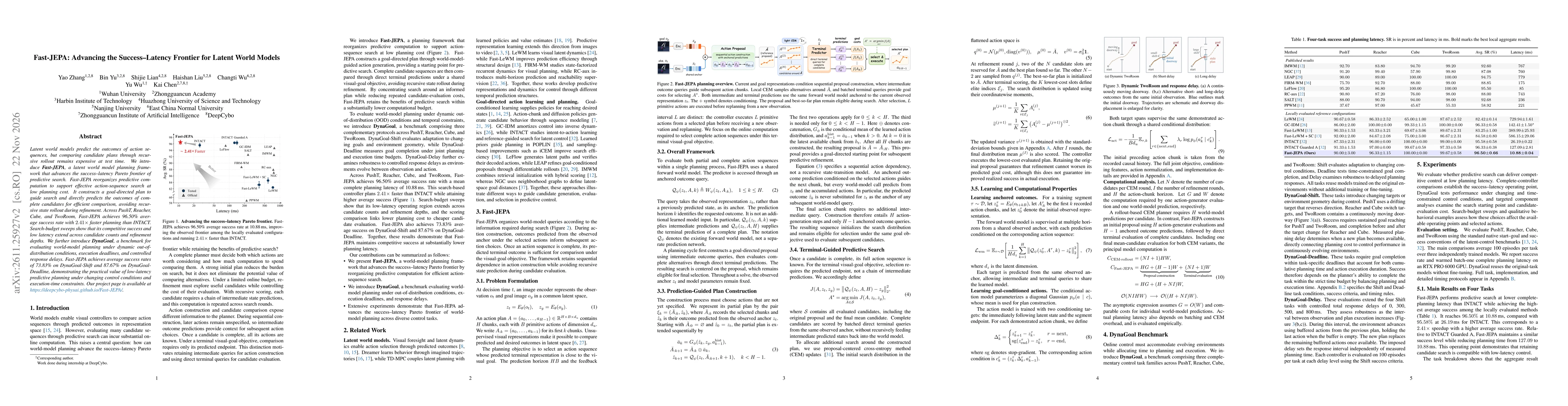
Fast-JEPA: Advancing the Success-Latency Frontier for Latent World Models
Yao Zhang, Bin Yu, Shijie Lian +4 more · Nov 19, 2026
Latent world models predict the outcomes of action sequences, but comparing candidate plans through recursive rollout remains expensive at test time. We introduce Fast-JEPA, a latent world model planning framework that advances the success-latency Pareto frontier of predictive search. Fast-JEPA reorganizes predictive computation to support effective action-sequence search at low planning cost. It constructs a goal-directed plan to guide search and directly predicts the outcomes of complete candidates for efficient comparison, avoiding recursive state rollout during refinement. Across PushT, Reacher, Cube, and TwoRoom, Fast-JEPA achieves 96.50% average success rate with 2.41x faster planning than INTACT. Search-budget sweeps show that its competitive success and low latency extend across candidate counts and refinement depths. We further introduce DynaGoal, a benchmark for evaluating world-model planning under dynamic out-of-distribution conditions, execution deadlines, and controlled response delays. Fast-JEPA achieves average success rates of 73.83% on DynaGoal-Shift and 87.67% on DynaGoal-Deadline, demonstrating the practical value of low-latency predictive planning under changing control conditions and execution-time constraints. Our code is available at https://github.com/Sofilyzia/Fast-JEPA.
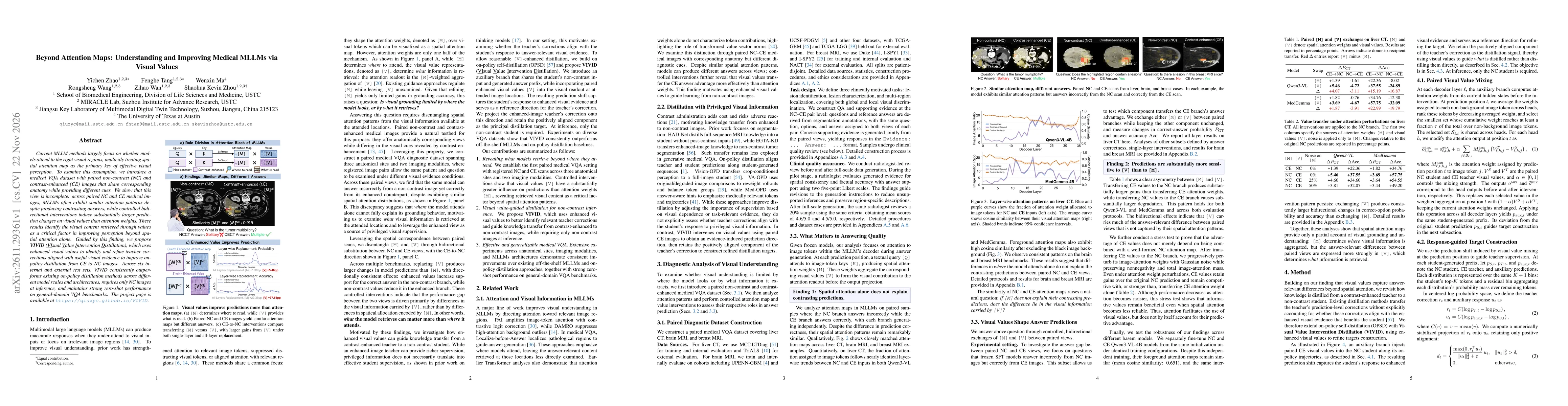
Beyond Attention Maps: Understanding and Improving Medical MLLMs via Visual Values
Yichen Zhao, Fenghe Tang, Wenxin Ma +3 more · Nov 22, 2026
Current MLLM methods largely focus on whether models attend to the right visual regions, implicitly treating spatial attention map as the primary key of effective visual perception. To examine this assumption, we introduce a medical VQA dataset with paired non-contrast (NC) and contrast-enhanced (CE) images that share corresponding anatomy while providing different cues. We show that this view is incomplete: across paired NC and CE medical images, MLLMs often exhibit similar attention patterns despite producing contrasting answers, while controlled bidirectional interventions induce substantially larger prediction changes on visual values than attention weights. These results identify the visual content retrieved through values as a critical factor in improving perception beyond spatial attention alone. Guided by this finding, we propose VIVID (VIsual Value Intervention Distillation), which uses enhanced visual values to identify and refine teacher corrections aligned with useful visual evidence to improve on-policy distillation from CE to NC images. Across six internal and external test sets, VIVID consistently outperforms existing on-policy distillation methods across different model scales and architectures, requires only NC images at inference, and maintains strong zero-shot performance on general-domain VQA benchmarks. The project page is available at https://qiuzyc.github.io/VIVID.
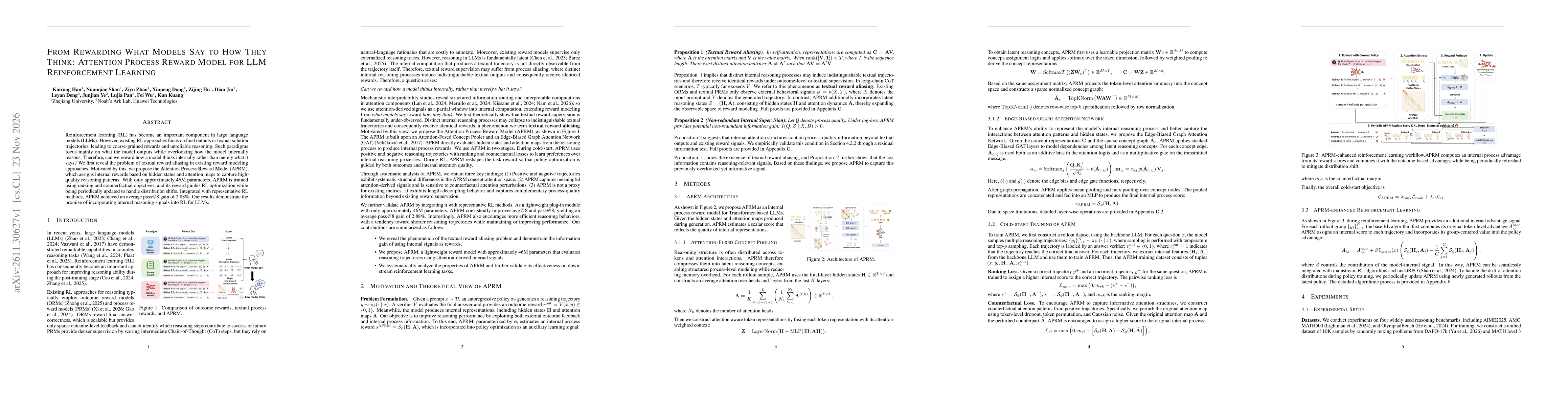
From Rewarding What Models Say to How They Think: Attention Process Reward Model for LLM Reinforcement Learning
Kairong Han, Nuanqiao Shan, Ziyu Zhao +8 more · Nov 23, 2026
Reinforcement learning (RL) has become an important component in large language models (LLMs). However, existing RL approaches focus on final outputs or textual solution trajectories, leading to coarse-grained rewards and unreliable reasoning. Such paradigms focus mainly on what the model outputs while overlooking how the model internally reasons. Therefore, can we reward how a model thinks internally rather than merely what it says? We first reveal the problem of textual reward aliasing in existing reward modeling approaches. Motivated by this, we propose the Attention Process Reward Model (APRM), which assigns internal rewards based on hidden states and attention maps to capture high-quality reasoning patterns. With only approximately 46M parameters, APRM is trained using ranking and counterfactual objectives, and its reward guides RL optimization while being periodically updated to handle distribution shifts. Integrated with representative RL methods, APRM achieved an average pass@8 gain of 2.88\%. Our results demonstrate the promise of incorporating internal reasoning signals into RL for LLMs.
MMMem: Self-Improving Agents with Task-Aware Multimodal Experience Consolidation
Yuxuan Chen, Changwei Lv, Yunfei Li +9 more · Nov 23, 2026
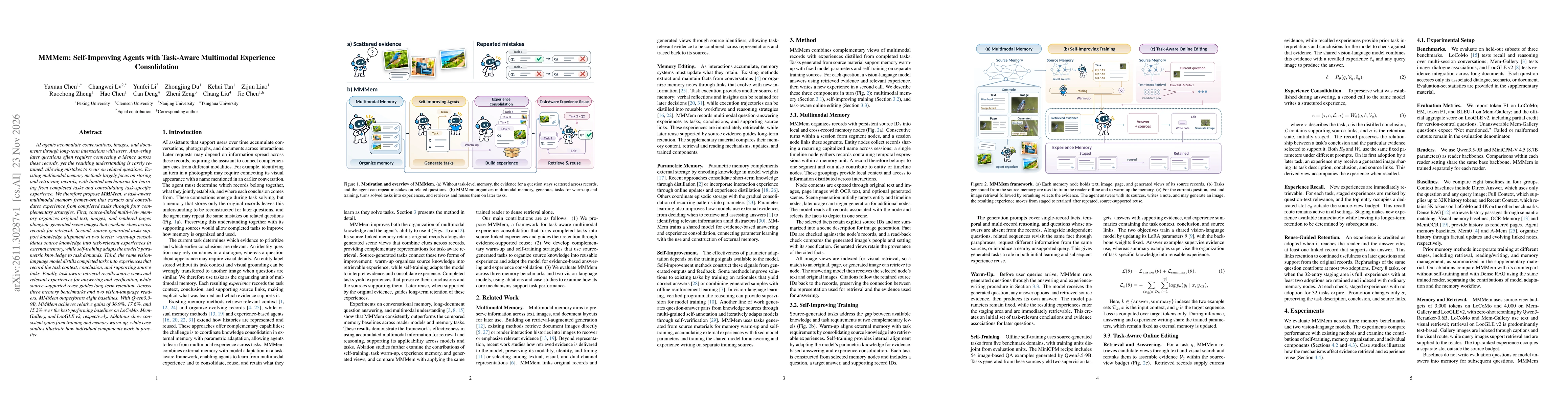
AI agents accumulate conversations, images, and documents through long-term interactions with users. Answering later questions often requires connecting evidence across these records, yet the resulting understanding is rarely retained, allowing mistakes to recur on related questions. Existing multimodal memory methods largely focus on storing and retrieving records, with limited mechanisms for learning from completed tasks and consolidating task-specific experience. We therefore propose MMMem, a task-aware multimodal memory framework that extracts and consolidates experience from completed tasks through four complementary strategies. First, source-linked multi-view memory organizes original text, images, and rendered pages alongside generated scene images that combine clues across records for retrieval. Second, source-generated tasks support knowledge alignment at two levels: warm-up consolidates source knowledge into task-relevant experiences in external memory, while self-training adapts the model's parametric knowledge to task demands. Third, the same vision-language model distills completed tasks into experiences that record the task context, conclusion, and support links. Finally, task-aware retrieval recalls source views and relevant experiences for answering and verification, while source-supported reuse guides long-term retention. Across three memory benchmarks and two vision-language readers, MMMem outperforms eight baselines. With Qwen3.5-9B, MMMem achieves relative gains of 36.9%, 17.6%, and 15.2% over the best-performing baselines on LoCoMo, Mem-Gallery, and LooGLE v2, respectively. Ablations show consistent gains from training and memory warm-up, while case studies illustrate how individual components work in practice.
The norm axiom and factor hyperfields
Alessandro Linzi · Nov 22, 2026
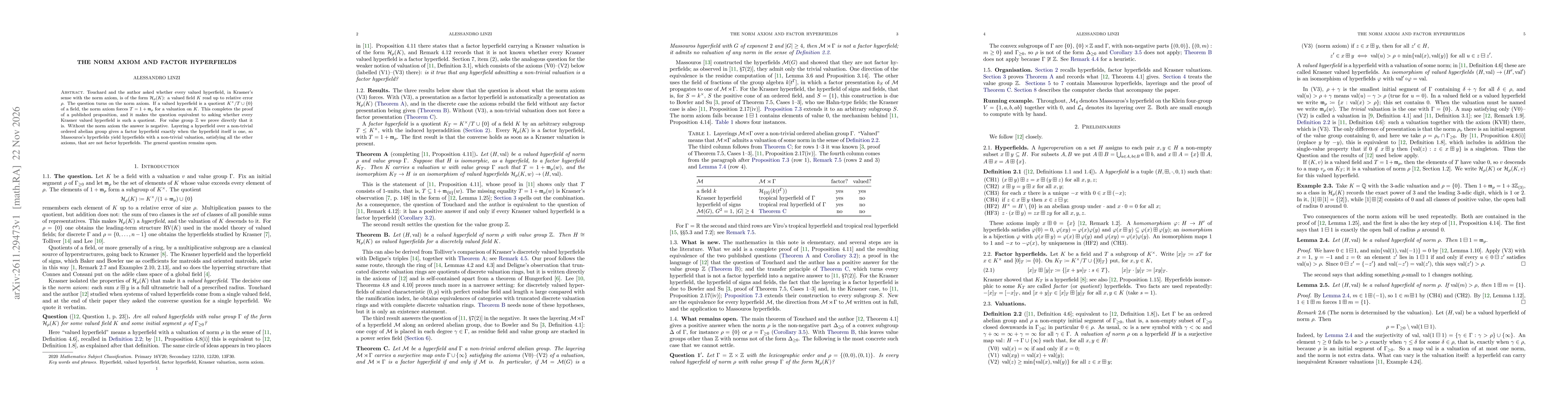
Touchard and the author asked whether every valued hyperfield, in Krasner's sense with the norm axiom, is of the form H_ρ(K): a valued field K read up to relative error ρ. The question turns on the norm axiom. If a valued hyperfield is a quotient K^times/Tcup{0} of a field, the norm axiom forces T=1+m_ρ for a valuation on K. This completes the proof of a published proposition, and it makes the question equivalent to asking whether every Krasner valued hyperfield is such a quotient. For value group Z we prove directly that it is. Without the norm axiom the answer is negative. Layering a hyperfield over a non-trivial ordered abelian group gives a factor hyperfield exactly when the hyperfield itself is one, so Massouros's hyperfields yield hyperfields with a non-trivial valuation, satisfying all the other axioms, that are not factor hyperfields. The general question remains open.
Deterministic, Reproducible Inference in Exact Integer Arithmetic, and Verifiable Distributed Inference as Its Consequence
Sayed Amir Karim · Nov 10, 2026
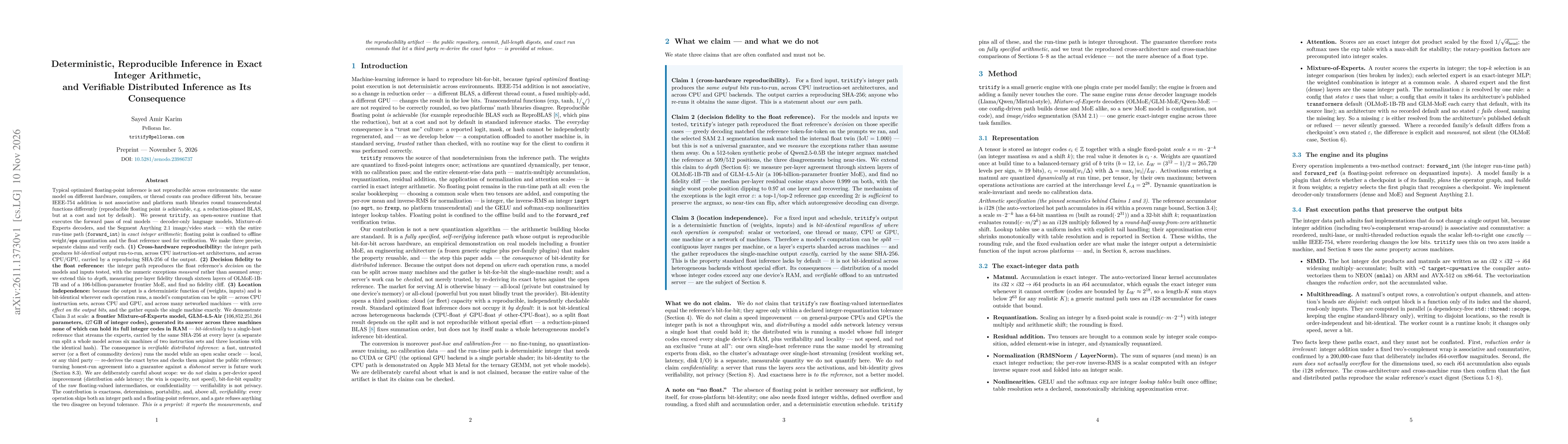
Optimized floating-point inference is not reproducible across environments: the same model on different hardware, compilers or thread counts can produce different bits. We present tritify, an open-source runtime that executes the forward pass of real models -- decoder-only language models, Mixture-of-Experts decoders, and the Segment Anything 2.1 image/video stack -- with the entire run-time path in exact integer arithmetic; floating point is confined to offline quantization and the float reference used for verification. We make three separate claims and verify each. (1) Cross-hardware reproducibility: the integer path produces bit-identical output run to run, across CPU instruction-set architectures, and across CPU/GPU, carried by a reproducing SHA-256 of the output. (2) Decision fidelity: the integer path reproduces the float reference's decision on the models and inputs tested, with the numeric exceptions measured; per-layer fidelity through sixteen layers of OLMoE-1B-7B and of a 106-billion-parameter MoE shows no fidelity cliff. (3) Location independence: a model's computation can be split across instruction sets, CPU and GPU, and networked machines with zero effect on the output bits. GLM-4.5-Air (106,852,251,264 parameters, 427 GB of integer codes) generated its answer across three machines, none of which can hold its integer codes in RAM, bit-identically to a single-host reference. The consequence is verifiable distributed inference: an untrusted server or a fleet of devices runs the model while an open scalar oracle re-derives the exact bytes; a guarantee against a dishonest server is future work. We do not claim a per-device speed-up, bit-equality of floating-valued intermediates, or confidentiality. Code: https://github.com/pelloran-inc/tritify
UniVEP: Unifying Velocity and Endpoint Prediction for Robot Manipulation
Zhengtu Liang, Qiwei Liang, Tao Lin +8 more · Nov 19, 2026
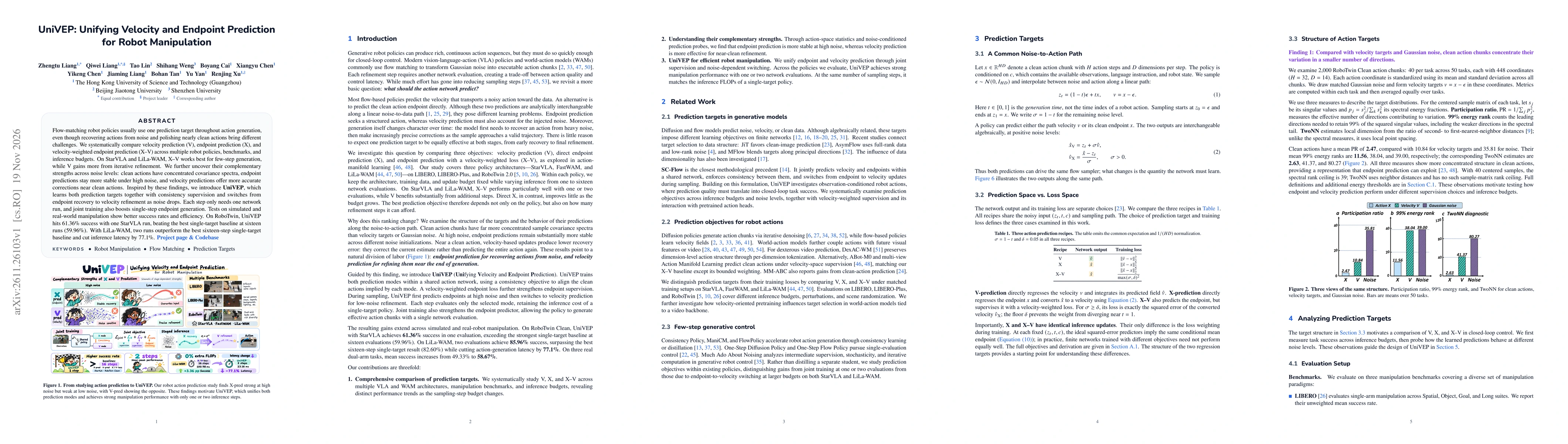
Flow-matching robot policies usually use one prediction target throughout action generation, even though recovering actions from noise and polishing nearly clean actions bring different challenges. We systematically compare velocity prediction (V), endpoint prediction (X), and velocity-weighted endpoint prediction (X--V) across multiple robot policies, benchmarks, and inference budgets. On StarVLA and LiLa-WAM, X--V works best for few-step generation, while V gains more from iterative refinement. We further uncover their complementary strengths across noise levels: clean actions have concentrated covariance spectra, endpoint predictions stay more stable under high noise, and velocity predictions offer more accurate corrections near clean actions. Inspired by these findings, we introduce UniVEP, which learns both prediction targets together with consistency supervision and switches from endpoint recovery to velocity refinement as noise drops. Each step only needs one network run, and joint training also boosts single-step endpoint generation. Tests on simulated and real-world manipulation show better success rates and efficiency. On RoboTwin, UniVEP hits 61.36% success with one StarVLA run, beating the best single-target baseline at sixteen runs (59.96%). With LiLa-WAM, two runs outperform the best sixteen-step single-target baseline and cut inference latency by 77.1%.