Trending on arXiv
Today's most upvoted papers on arXiv
Seeing Right, Writing Wrong: Where Short Chain-of-Thought Breaks Spatial VQA
Chenhao Zhang · Nov 21, 2026
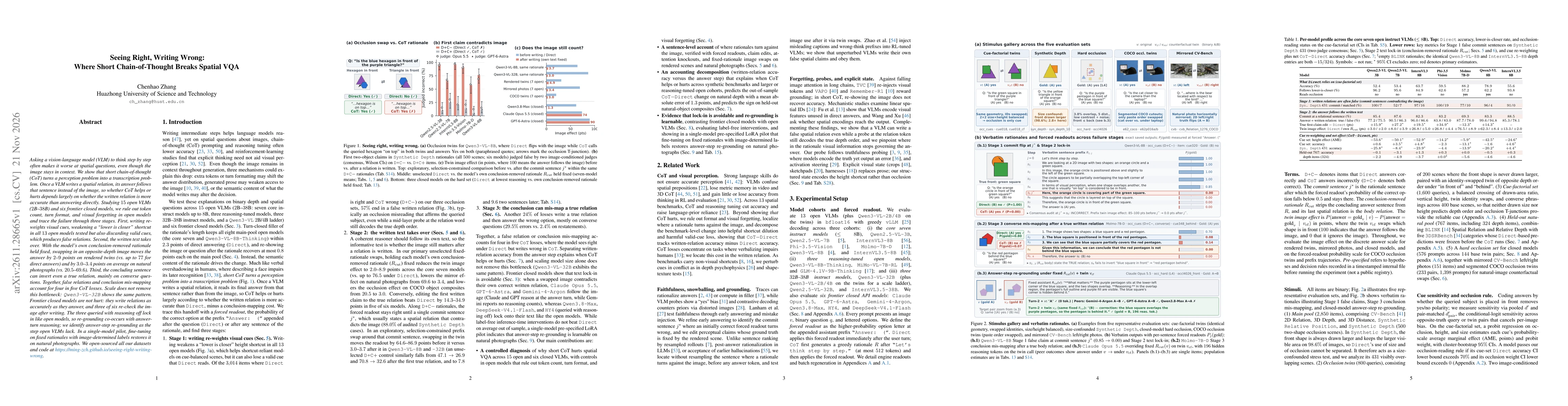
Asking a vision-language model (VLM) to think step by step often makes it worse at spatial questions, even though the image stays in context. We show that short chain-of-thought (CoT) turns a perception problem into a transcription problem. Once a VLM writes a spatial relation, its answer follows that sentence instead of the image, so whether CoT helps or hurts depends largely on whether the written relation is more accurate than answering directly. Studying 15 open VLMs (2B-38B) and six frontier closed models, we rule out token count, turn format, and visual forgetting in open models and trace the failure through three stages. First, writing re-weights visual cues, weakening a "lower is closer" shortcut in all 13 open models tested but also discarding valid cues, which produces false relations. Second, the written text takes over. With the model's own conclusion-removed rationale held fixed, swapping in an opposite-depth image moves the answer by 2-9 points on rendered twins (vs. up to 77 for direct answers) and by 3.0-3.4 points on average on natural photographs (vs. 20.5-69.6). Third, the concluding sentence can invert even a true relation, mainly on converse questions. Together, false relations and conclusion mis-mapping account for four in five CoT losses. Scale does not remove this bottleneck: Qwen3-VL-32B shows the same pattern. Frontier closed models are not hurt: they write relations as accurately as they answer, and three of six re-check the image after writing. The three queried with reasoning off lock in like open models, so re-grounding co-occurs with answer-turn reasoning; we identify answer-step re-grounding as the step open VLMs lack. In a single-model pilot, fine-tuning on fixed rationales with image-determined labels restores it on natural photographs. We open-sourced all our datasets and code at https://ming-zch.github.io/seeing-right-writing-wrong.
How Complete Must an Environment Be to Train a Capable GUI Agent?
Jingxing Wang, Teng Wang, Xingyu Lou +5 more · Nov 18, 2026
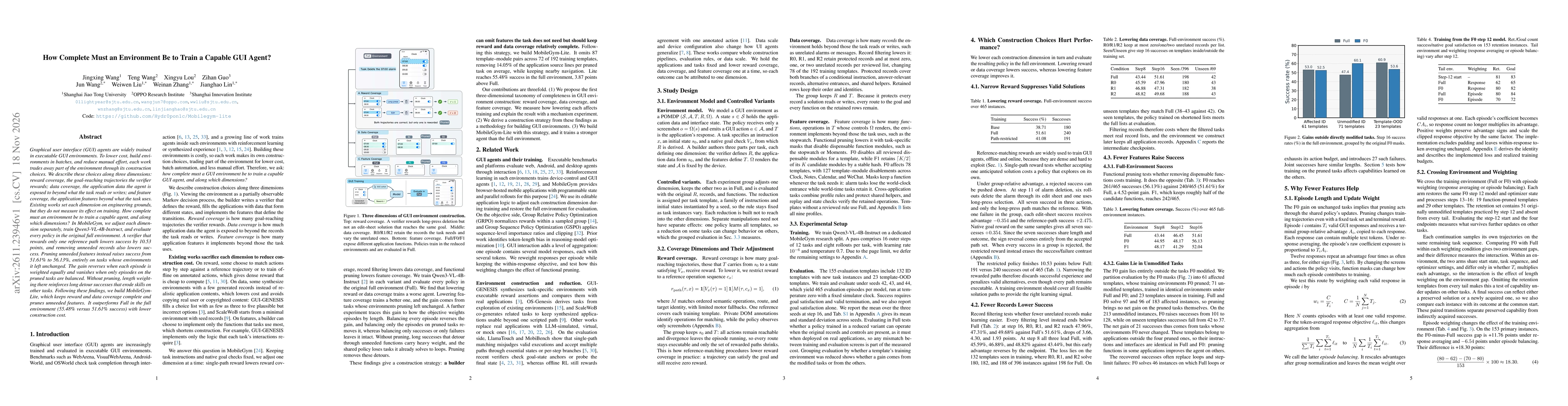
Graphical user interface (GUI) agents are widely trained in executable GUI environments. To lower cost, build environments in batches, and reduce manual effort, each work trades away part of the environment through its construction choices. We describe these choices along three dimensions: reward coverage, the goal-reaching trajectories the verifier rewards; data coverage, the application data the agent is exposed to beyond what the task reads or writes; and feature coverage, the application features beyond what the task uses. Existing works set each dimension on engineering grounds, but they do not measure its effect on training. How complete must an environment be to train a capable agent, and along which dimensions? In MobileGym, we adjust each dimension separately, train Qwen3-VL-4B-Instruct, and evaluate every policy in the original full environment. A verifier that rewards only one reference path lowers success by 10.53 points, and removing unneeded records also lowers success. Pruning unneeded features instead raises success from 51.61% to 56.13%, entirely on tasks whose environments it left unchanged. The gain reverses when each episode is weighted equally and vanishes when only episodes on the pruned tasks are balanced. Without pruning, length weighting there reinforces long detour successes that erode skills on other tasks. Following these findings, we build MobileGym-Lite, which keeps reward and data coverage complete and prunes unneeded features. It outperforms Full in the full environment (55.48% versus 51.61% success) with lower construction cost.
SWEEP-Bench: Do Embodied Policies Act on the Speed They See?
Hiroaki Honda, Koya Sakamoto, Shu Morikuni +2 more · Nov 23, 2026
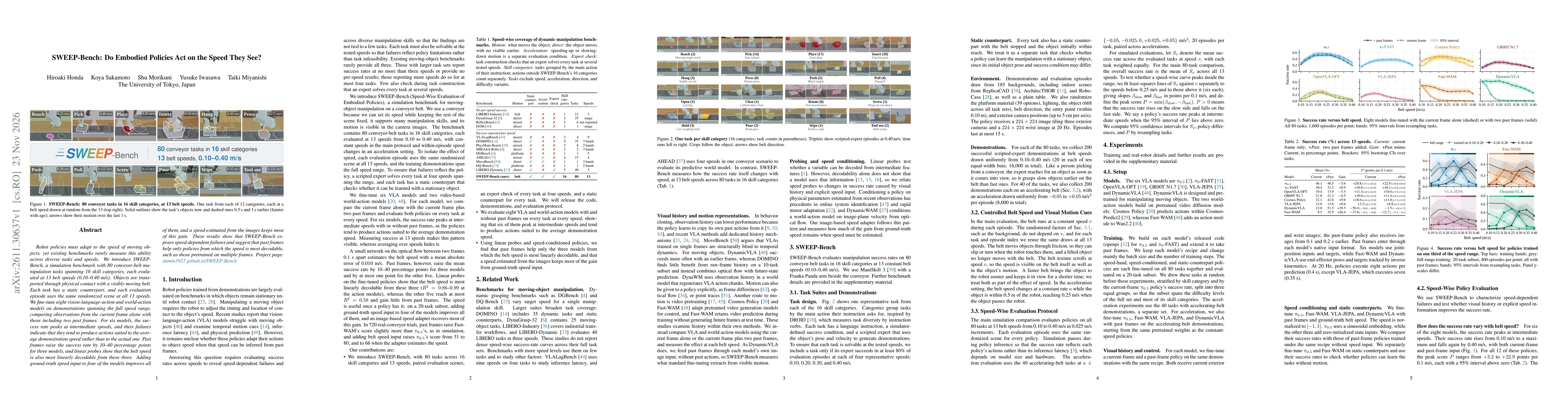
Robot policies must adapt to the speed of moving objects, yet existing benchmarks rarely measure this ability across diverse tasks and speeds. We introduce SWEEP-Bench, a simulation benchmark with 80 conveyor-belt manipulation tasks spanning 16 skill categories, each evaluated at 13 belt speeds (0.10-0.40 m/s). Objects are transported through physical contact with a visibly moving belt. Each task has a static counterpart, and each evaluation episode uses the same randomized scene at all 13 speeds. We fine-tune eight vision-language-action and world-action models on demonstrations spanning the full speed range, comparing observations from the current frame alone with those including two past frames. For six models, the success rate peaks at intermediate speeds, and their failures indicate that they tend to produce actions suited to the average demonstration speed rather than to the actual one. Past frames raise the success rate by 10-40 percentage points for three models, and linear probes show that the belt speed is also most linearly decodable from these three. Adding ground-truth speed input to four of the models improves all of them, and a speed estimated from the images keeps most of this gain. These results show that SWEEP-Bench exposes speed-dependent failures and suggest that past frames help only policies from which the speed is most decodable, such as those pretrained on multiple frames. Project page: https://damin3927.github.io/SWEEP-Bench