Mechanistic Interpretability Needs Philosophy
Abstract
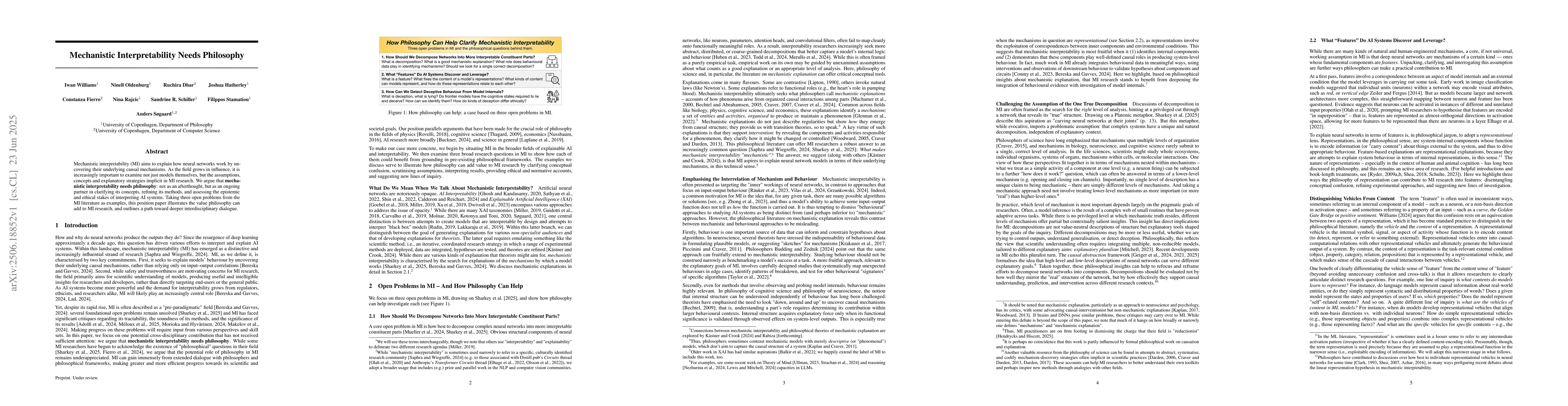
Mechanistic interpretability (MI) aims to explain how neural networks work by uncovering their underlying causal mechanisms. As the field grows in influence, it is increasingly important to examine not just models themselves, but the assumptions, concepts and explanatory strategies implicit in MI research. We argue that mechanistic interpretability needs philosophy: not as an afterthought, but as an ongoing partner in clarifying its concepts, refining its methods, and assessing the epistemic and ethical stakes of interpreting AI systems. Taking three open problems from the MI literature as examples, this position paper illustrates the value philosophy can add to MI research, and outlines a path toward deeper interdisciplinary dialogue.
Analysis
AI-generated · verify against the original paper
Generated Jan 1, 0001LimitationsWhere the findings need caution
- The paper relies on theoretical argumentation without empirical validation of the proposed philosophical interventions.
- The discussion is limited to three example problems and may not generalize to all challenges in mechanistic interpretability.
MethodologyHow the work was done
The paper conducts a conceptual analysis of three open problems in mechanistic interpretability, illustrating how philosophical frameworks and concepts can address each problem through interdisciplinary dialogue.
SignificanceWhy the work matters
The work highlights that integrating philosophy can clarify concepts, refine methods, and navigate epistemic and ethical complexities in mechanistic interpretability, thereby unlocking unrealized progress in the field.
Technical contributionsWhat the work introduces
It proposes a structured interdisciplinary framework that maps philosophical concepts to specific mechanistic interpretability challenges, offering practical recommendations for collaboration.
NoveltyHow it differs from prior work
The paper uniquely positions philosophy as an essential, ongoing partner for mechanistic interpretability, a perspective not previously emphasized in the AI interpretability literature.
Future workQuestions that remain
- Develop concrete collaborative research projects between philosophers and mechanistic interpretability researchers.
- Empirically test philosophical frameworks on a broader set of interpretability tasks.
Discussion 0