Reliability-Role Collaborative Learning for Semi-Supervised Cardiac Image Segmentation
Abstract
Semi-supervised cardiac image segmentation aims to exploit abundant unlabeled images together with limited annotations, but the reliability of pseudo-label supervision is highly uneven across spatial regions. In a dual-network setting, interior regions are usually more stable, whereas boundary regions, low-confidence areas, and disagreements between networks can introduce noisy supervision. However, existing methods typically impose uniform supervision on all unlabeled pixels, overlooking reliability differences and limiting discriminative learning in challenging areas. To address this issue, we propose R2CL (Reliability-Role Collaborative Learning), a framework for semi-supervised cardiac image segmentation. R2CL models confidence relationships between two networks to assign roles to unlabeled regions: mutually uncertain regions are used for entropy regularization, confidence-discrepant regions for directional knowledge transfer, and mutually confident regions as reliable supervision anchors. Reliability-Role Mixed Cross Learning (RR-MCL) implements these roles through region-mixed training, directional cross-network supervision, and entropy regularization over mutually uncertain regions. Reliability-Transition Prototype Contrastive Learning (RT-PCL) constructs query features from foreground-adjacent reliability-transition regions and learns network-specific class prototypes from mutually confident regions, improving feature discrimination around ambiguous boundaries. High-confidence Context Refinement (HCR) exploits reliable interior pixels and trusted dense blocks within mutually confident regions to complement stable contextual supervision. R2CL achieves stable improvements in region-overlap and boundary-related metrics across multiple datasets, with more evident advantages on the foreground-sparse MVAA-CT dataset.
Analysis
AI-generated · verify against the original paper
Generated Jan 1, 0001ResultsWhat the authors found
- On the ACDC dataset, R2CL improves DSC from 86.54% (baseline) to 89.93% and reduces 95HD from 5.96 mm to 1.43 mm.
- On the MVAA‑CT dataset, R2CL raises DSC from 71.93% to 78.10% and lowers 95HD from 4.98 mm to 1.71 mm, showing larger gains on the foreground‑sparse task.
- Ablation studies demonstrate that RR‑MCL alone contributes most of the DSC gain, while RT‑PCL further reduces boundary error and HCR enhances region‑overlap metrics.
MethodologyHow the work was done
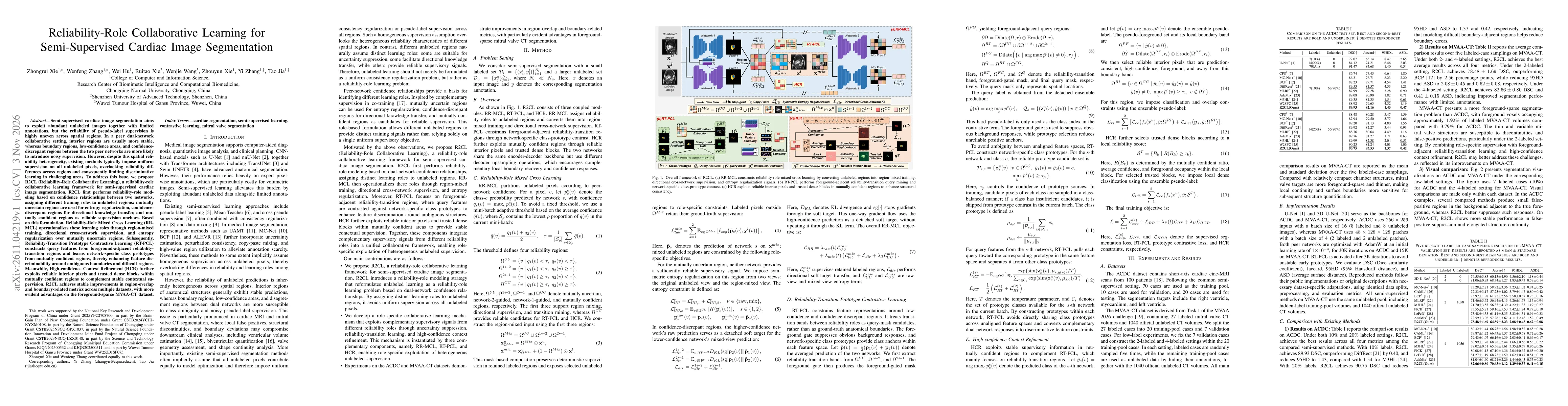
R2CL (Reliability-Role Collaborative Learning) uses a dual‑network framework to model confidence relationships and assign unlabeled regions to three roles: mutually uncertain regions for entropy regularization, confidence‑discrepant regions for directional cross‑network supervision, and mutually confident regions as reliable anchors. These roles are operationalized by Reliability‑Role Mixed Cross Learning (RR‑MCL) with region‑mixed training, Reliability‑Transition Prototype Contrastive Learning (RT‑PCL) that builds class prototypes from confident regions and queries from reliability‑transition regions, and High‑confidence Context Refinement (HCR) that exploits interior pixels and trusted dense blocks for contextual supervision.
SignificanceWhy the work matters
The proposed reliability‑role modeling enables semi‑supervised cardiac segmentation to exploit heterogeneous unlabeled supervision, leading to consistent improvements in both overlap and boundary accuracy across multiple imaging modalities, especially in challenging sparse‑foreground scenarios.
Technical contributionsWhat the work introduces
Introduction of a reliability‑role modeling strategy that partitions unlabeled pixels into role‑specific groups and integrates three complementary learning modules (RR‑MCL, RT‑PCL, HCR) within a unified semi‑supervised training pipeline.
NoveltyHow it differs from prior work
First work to explicitly model and leverage spatial reliability differences via dual‑network confidence relationships, assigning distinct learning roles to unlabeled regions for semi‑supervised cardiac image segmentation.
Future workQuestions that remain
- Explore adaptive reliability estimation techniques.
- Extend the reliability‑role framework to broader medical segmentation scenarios.
Discussion 0