AskQE: Question Answering as Automatic Evaluation for Machine Translation
AskQE detects machine translation errors with a question-answering framework that provides actionable feedback for monolingual English speakers, outperforming other quality estimation metrics on real-world datasets.
Abstract
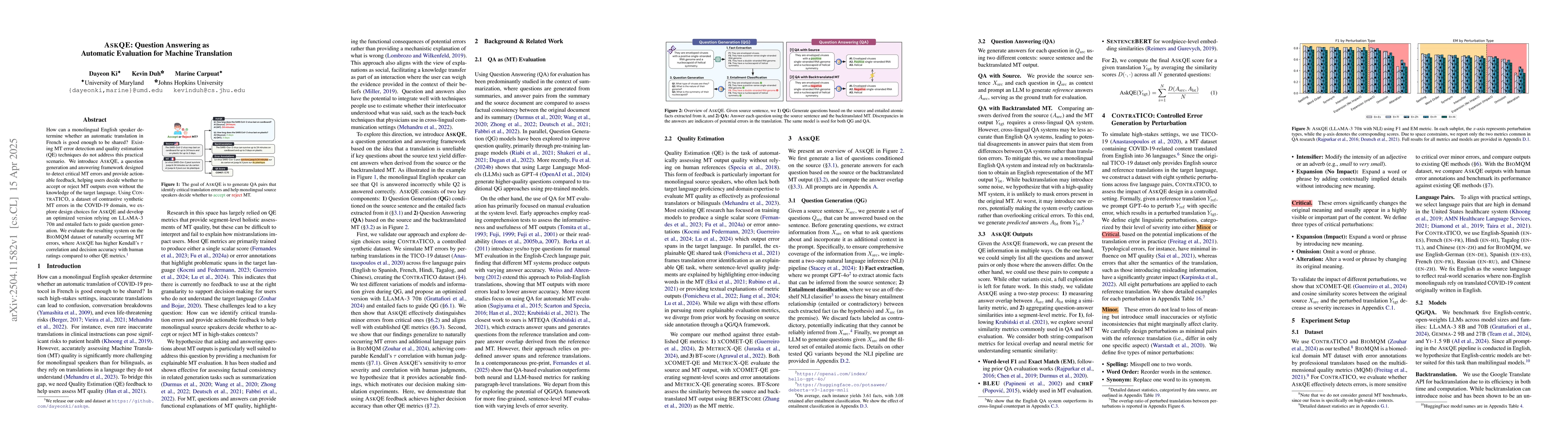
How can a monolingual English speaker determine whether an automatic translation in French is good enough to be shared? Existing MT error detection and quality estimation (QE) techniques do not address this practical scenario. We introduce AskQE, a question generation and answering framework designed to detect critical MT errors and provide actionable feedback, helping users decide whether to accept or reject MT outputs even without the knowledge of the target language. Using ContraTICO, a dataset of contrastive synthetic MT errors in the COVID-19 domain, we explore design choices for AskQE and develop an optimized version relying on LLaMA-3 70B and entailed facts to guide question generation. We evaluate the resulting system on the BioMQM dataset of naturally occurring MT errors, where AskQE has higher Kendall's Tau correlation and decision accuracy with human ratings compared to other QE metrics.
Analysis
AI-generated · verify against the original paper
Generated Jun 9, 2025ResultsWhat the authors found
- AskQE outperforms other QE metrics on the BioMQM dataset in terms of Kendall's Tau correlation and decision accuracy with human ratings.
- An optimized version of AskQE, using LLaMA-3 70B and entailed facts, was developed for question generation.
- AskQE is effective for various language pairs including EN-ES, EN-FR, EN-HI, EN-TL, and EN-ZH.
LimitationsWhere the findings need caution
- The study was limited to English as the source language and focused on five target languages.
- Performance on lower-resource languages (EN-HI and EN-TL) was lower compared to higher-resource languages.
MethodologyHow the work was done
The research introduces AskQE, a framework for question generation and answering to evaluate machine translation quality, focusing on detecting critical errors without requiring knowledge of the target language.
SignificanceWhy the work matters
This work is significant as it addresses the practical need for monolingual English speakers to evaluate machine translations in their native language, providing actionable feedback for acceptance or rejection of MT outputs.
Technical contributionsWhat the work introduces
The paper presents a novel approach to MT evaluation using question answering, leveraging large language models and entailed facts for robust question generation.
NoveltyHow it differs from prior work
Unlike existing QE methods that require target language knowledge, AskQE offers a monolingual solution for evaluating MT quality, focusing on detecting critical errors through question answering.
Future workQuestions that remain
- Further research could explore the applicability of AskQE to other language pairs and domains.
- Investigating the integration of AskQE with real-time MT systems for immediate user feedback.
Discussion 0